
Amazon's $8 Billion Nvidia Chip Sale-Leaseback Turns GPUs Into an Asset Class
Amazon is exploring an $8 billion Nvidia chip sale-leaseback, moving Grace Blackwell GPUs into an investor-funded vehicle to cut AI capital intensity.
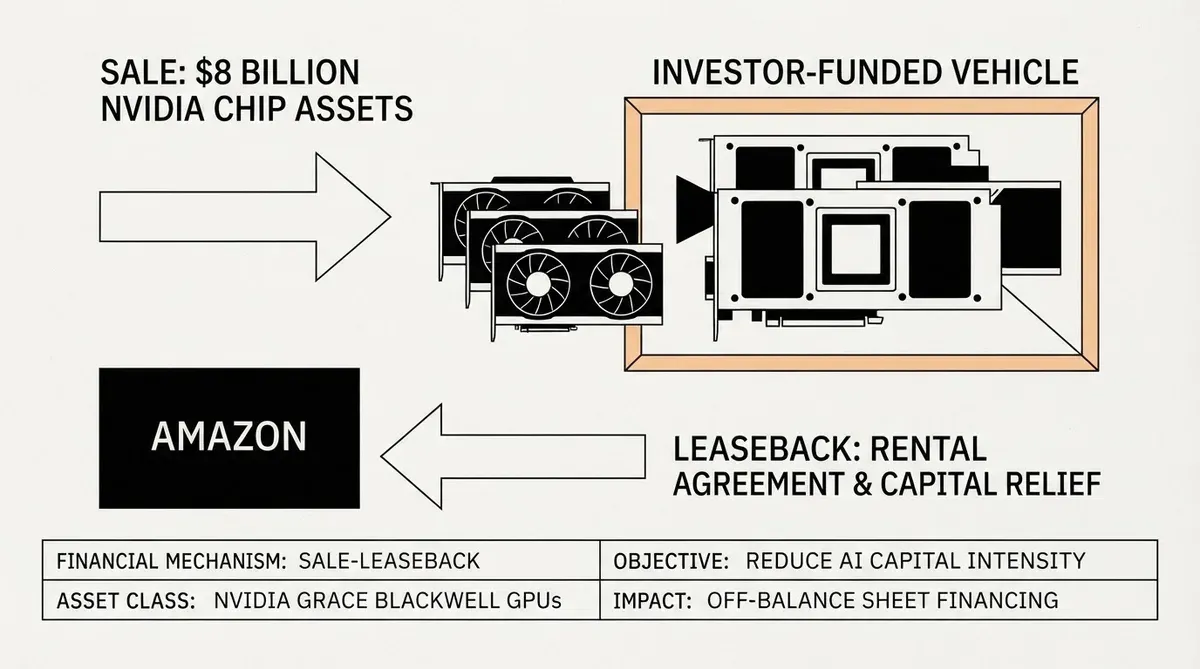
Amazon is negotiating with outside investors to shift roughly $8 billion of Nvidia Grace Blackwell processors into a special-purpose vehicle and lease the hardware back for its cloud network. The proposed Nvidia chip sale-leaseback would cover thousands of accelerators spread across more than a dozen U.S. data centers. Amazon would retain operational control of the machines while ownership, and the debt attached to them, sits with the new entity rather than on Amazon's own books. Talks between Amazon and potential investors surfaced in early October 2026.
The structure runs in two layers. Investors would take equity of up to about 10%, with debt covering the remainder, and the vehicle would use the proceeds to buy the chips before renting them to Amazon. Amazon has been testing investor appetite for the vehicle, which indicates the discussions have moved past an internal concept into the stage where pricing terms get measured against real capital.
How the Nvidia Chip Sale-Leaseback Would Work
Special-purpose vehicles are standard practice in aircraft, shipping and power generation finance, where a dedicated entity buys a long-lived asset and rents it back to the operator. Applying that template to one specific generation of AI accelerators at this scale is new. The fleet in question is not generic compute. It is Grace Blackwell, Nvidia's current flagship platform for training and inference, which carries a premium price per unit and a short expected competitive life.
| Element | Detail |
|---|---|
| Asset | Nvidia Grace Blackwell accelerators |
| Transaction size | About $8 billion |
| Chip count | Thousands of units |
| Footprint | More than a dozen U.S. data centers |
| Investor equity | Up to roughly 10% |
| Debt | Remainder, raised by the vehicle |
| Amazon's role | Lessee, retains operational control |
The footprint shapes how a lender would secure the Nvidia chip sale-leaseback. Because the chips sit across more than a dozen sites, no single power interruption or facility failure strands the whole fleet, and the lease can be written around aggregate capacity rather than one location. A financier ends up with a diversified set of installations and a single tenant whose cloud business carries an investment-grade profile.
The economics turn on who absorbs depreciation. Accelerators shed value faster than buildings or power contracts because each new generation resets the performance-per-dollar benchmark that buyers use to judge them. In a leaseback, that decline lands on the vehicle and its investors rather than on Amazon's income statement as depreciation of owned assets. Amazon's quarterly results then show a lease expense instead of a large capital outlay followed by years of write-downs.
The Balance Sheet Arithmetic
Amazon's long-term debt has climbed to $119 billion, and the company is funding one of the largest capital programs in corporate history across data centers, power procurement and custom silicon. Shifting $8 billion of hardware off the balance sheet lowers reported capital intensity and keeps leverage ratios away from the thresholds that feed into credit ratings and borrowing costs. Lease accounting rules still require a lessee to recognise most long-term obligations, so the benefit depends on how the transaction is classified rather than on the label attached to it.
Credit ratings are the practical constraint. A sale-leaseback that removes assets and the matching debt from the balance sheet can improve the ratios rating agencies watch, even when the operational obligation is unchanged. For a company carrying $119 billion in long-term debt while committing tens of billions more to AI capacity, protecting those ratios lowers the cost of every subsequent borrowing.
Eight billion dollars is a modest slice of Amazon's total AI commitment. The template matters more than the sum. If the structure prices well, it can be repeated across successive chip generations and other hardware classes, turning a lumpy capital expense into a recurring lease payment that is easier to forecast and easier to fund. That repeatability is the part rivals would study.
Chip Rental Prices Are Moving the Other Way
Amazon has also been raising the rates it charges for AI chip capacity, a sign that demand for accelerators still outruns supply. Higher rental rates improve the returns on owning compute, which makes the decision to sell and lease back look less like a retreat from ownership than an arbitrage. Amazon keeps the usage, collects the rental spread, and hands residual value risk to a third party. The company captures the operating economics of the hardware without carrying the asset.
What Amazon Gives Up
Ownership of the accelerators carries options that a lease does not. A buyer can redeploy hardware between regions, sell it into a secondary market, or keep using it past its accounting life at near-zero marginal cost. A lessee gives up most of that flexibility, and the lease payments continue whether or not the capacity is fully utilised. Amazon's bet is that the flexibility is worth less than the capital it frees up.
The trade-off is sharpest at the end of the term. If the chips are still productive, the vehicle's investors capture the upside. If they are obsolete, Amazon has already paid for their use and walks away. That asymmetry is what makes the structure attractive to the lessee and demanding for the equity holder.
What Investors and Competitors Should Watch
For investors, the appeal is contracted cash flow from a creditworthy tenant plus equity upside if the chips hold value longer than the lease assumes. The exposure is residual value. If Blackwell-class hardware is displaced faster than the lease term anticipates, the vehicle holds assets worth less than the debt secured against them, and the equity tranche absorbs the loss first. The 10% equity slice is where the real risk sits.
The closest comparison is aircraft leasing, which survived repeated downturns because planes have service lives measured in decades and a deep secondary market for used units. Accelerators have neither. Their resale market is thin, and their useful life is set against a product roadmap that Nvidia refreshes roughly once a year. A leaseback works best on assets that outlive the debt; this one rests on assets that may not.
The transaction also puts a price on Nvidia hardware from a buyer other than the hyperscalers themselves. If investors will fund Grace Blackwell chips through a leased structure, they are effectively setting a residual value for the platform, which gives every large buyer a new reference point in negotiations over future generations.
Funding cost is the second variable. The structure works only if the yield demanded by debt and equity investors stays below the return Amazon earns on the compute. With 10-year Treasury yields near multi-decade highs, the risk-free alternative is expensive, and the spread investors demand above it eats into the margin Amazon can keep. Each 100 basis points added to the vehicle's funding cost raises the lease payment Amazon has to cover, and the chips keep depreciating while that payment runs.
Other hyperscalers face the same arithmetic. Data center spending has outgrown the cash flow the largest cloud businesses generate, which pushes operators toward structures that split ownership from use. If Amazon completes the transaction on attractive terms, it hands every competitor a template for keeping capacity while moving the capital cost elsewhere. If pricing comes in wide, it tells the market that investors are not yet ready to underwrite chip residual values at scale.
Why this matters
Amazon's move signals that the largest buyers of AI hardware are starting to treat compute as a financeable asset rather than a purchase, shifting part of the buildout's risk from hyperscaler balance sheets to capital markets. If the model prices successfully, expect similar vehicles for rival chip generations and competing clouds, since every operator faces the same depreciation curve. If it does not, the constraint on AI capacity growth may turn out to be the cost of capital rather than the supply of chips.
AI-generated image.
Related Articles
- Nvidia Pitches AI Compute as an Investable Asset Class
- How Anthropic's $35B Lambda Deal Turns Nvidia Into AI's Landlord
- Google's $150B Anthropic Chip Financing Machine Beats Nvidia on Borrowing Costs
✔Human Verified
Researched and cross-referenced against primary sources by the Bytevyte editorial team. This article was generated with the assistance of artificial intelligence and reviewed by the Bytevyte editorial team.