
Anthropic Long-Term Benefit Trust Adds Ben Bernanke
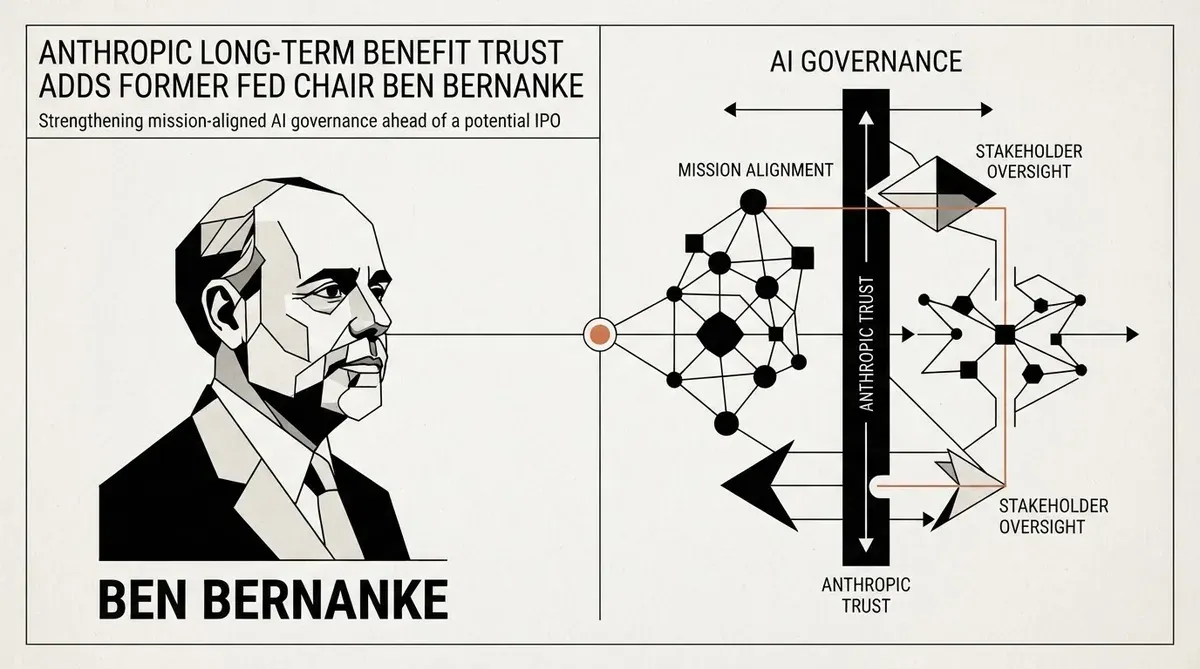
Anthropic has appointed Ben Bernanke, the former Federal Reserve chair and Nobel Prize-winning economist, to the Anthropic Long-Term Benefit Trust, placing a world-recognized figure in monetary policy at the heart of a governance structure designed to keep the AI company aligned with its public mission. The company confirmed the move this week, adding Bernanke to the independent body that holds special Class T shares with the authority to eventually elect a majority of Anthropic's board of directors.
The trust's existence stems from Anthropic's legal status as a Public Benefit Corporation, a structure that requires directors to balance shareholder value against a stated public mission. But the Anthropic Long-Term Benefit Trust goes further than typical benefit corporation frameworks. Its Class T shares give it control over board composition, creating an oversight layer that the company describes as a safeguard against mission drift as it scales. Most PBCs do not embed this kind of mechanism in their charter.
Bernanke led the Federal Reserve from 2006 through 2014, steering U.S. monetary policy during the worst financial crisis since the Great Depression. He received the Nobel Prize in Economic Sciences in 2022 for his work on bank runs and the role of financial intermediaries during economic panics. His academic and policymaking record aligns directly with the trust's mandate, which includes evaluating how artificial intelligence is changing the economy, according to Anthropic's description of the role. Bernanke is currently a Distinguished Fellow at the Brookings Institution.
The former Fed chair joins three existing trustees: Neil Buddy Shah, Richard Fontaine, and Mariano-Florentino Cuellar. Each brings a distinct background. Shah has experience in global development and public health. Fontaine focuses on national security and foreign policy. Cuellar, a former California Supreme Court justice and Homeland Security official, contributes legal and regulatory expertise. Bernanke adds macroeconomic analysis and crisis management to this mix. Trust members receive no equity stake in Anthropic and are compensated solely for their service, a design choice that prevents financial conflicts from undermining the body's independence.
Anthropic Long-Term Benefit Trust and IPO Preparation
Bernanke's appointment arrives as Anthropic intensifies preparations for an initial public offering that could begin as early as the second half of 2026. The company has engaged Wilson Sonsini Goodrich & Rosati, a law firm with deep technology IPO expertise, to lead the legal groundwork. Wilson Sonsini has handled IPOs for some of the most prominent technology companies over the past two decades. The IPO process requires companies to disclose governance structures in detail, and Anthropic's trust-based model will face scrutiny from underwriters and institutional investors. For a company heading to public markets, a governance structure that includes a Nobel-winning former regulator signals that the board has meaningful independent oversight. That factor can directly affect valuation and investor confidence.
Public Benefit Corporations face additional scrutiny when they list because their fiduciary duties are split between profit and purpose. An IPO prospectus must explain how the board handles that duality. The Anthropic Long-Term Benefit Trust provides a ready-made answer: an independent body with concrete authority to protect the mission, separate from the day-to-day pressures of quarterly earnings. That architecture is rare among AI companies and may become a template for others considering a similar path to public markets.
The Anthropic Long-Term Benefit Trust's ability to appoint board members means it can influence major strategic decisions and act as a check on choices that prioritize short-term revenue over the company's stated safety and alignment goals. Bernanke's presence gives that check a credible public face that investors and regulators alike are likely to recognize.
Political Engagement and Regulatory Strategy
Anthropic has also moved into direct political engagement around AI regulation. The company donated $20 million to political groups that support AI regulation, a sign that its governance strategy extends beyond internal structures into the policy environment. That donation, combined with the Bernanke appointment and the IPO preparations, shows a company working on multiple fronts to shape the conditions under which it will operate as a public entity.
Dario Amodei, Anthropic's CEO, and other employees have also contributed millions of dollars to pro-regulation efforts, according to reports. The alignment between the company's internal governance and its external political activity is notable. The same mission that the Anthropic Long-Term Benefit Trust is designed to protect is one that the company is trying to embed in law and regulation through political spending and advocacy.
Bernanke's role on the trust includes advising on the economic consequences of AI, which overlaps directly with the regulatory conversation. As policymakers debate how to manage AI-driven labor displacement, financial system risks, and macroeconomic shifts, having a former Fed chair inside the governance structure gives Anthropic a direct channel between its internal mission and the broader economic debate. His perspective on systemic risk, honed during the 2008 crisis, carries weight in discussions about how AI might introduce new forms of financial instability.
A Template for Mission-Aligned AI Governance
The Anthropic Long-Term Benefit Trust is central to the company's unusual governance model. Most frontier AI labs are structured as traditional for-profit corporations, either privately held or organized with capped-profit subsidiaries under a nonprofit parent. Companies like OpenAI and Inflection AI have adopted variations of that capped-profit model. Anthropic's approach, with its Public Benefit Corporation status and the trust mechanism, is closer to a stakeholder governance model than what the rest of the industry uses.
The Bernanke appointment tests whether that model scales. If Anthropic successfully goes public with the trust intact and the structure performs as designed, it could become a reference architecture for other AI companies facing the same tension between growth and mission. If the structure proves unwieldy or gets weakened during the IPO process, the experiment may serve as a cautionary case for the industry. Either path will inform how future AI companies design their own governance frameworks.
The design of the Class T shares is central to this experiment. These shares are held exclusively by the trust and do not carry economic value in the traditional sense. Their power lies entirely in board appointment authority, which means the trust's influence is structural rather than financial. This separation of control from economic interest is a deliberate feature intended to ensure that the trust's decisions are not influenced by the financial incentives that drive ordinary shareholders. It creates a governance dynamic more similar to a foundation than a typical corporate board.
Bernanke's own experience with institutional decision-making under extreme uncertainty is directly relevant. During the 2008 financial crisis, the Fed under his leadership deployed tools that had no modern precedent, including large-scale asset purchases and emergency lending facilities. The ability to make high-stakes decisions with incomplete information transfers naturally to the domain of AI governance, where the trajectory of the technology and its societal effects remain deeply uncertain. The same analytical rigor that informed trillion-dollar policy decisions will now apply to questions about AI safety, deployment boundaries, and economic disruption.
Either outcome of the Anthropic experiment carries implications for how the broader technology sector thinks about corporate purpose. The debate over stakeholder versus shareholder capitalism has been largely theoretical for most tech companies, which operate under standard corporate law. Anthropic has built a concrete institutional answer to that debate, and Bernanke is now one of its key custodians.
Why this matters
For an AI industry racing toward public markets, the Bernanke appointment offers a proof point that mission-aligned governance can attract figures of the highest institutional credibility. If investors accept the trust structure as a strength rather than a constraint, other AI companies may adopt similar models, reshaping how the sector balances profit and purpose at scale. The stakes extend beyond Anthropic: the experiment could influence how a generation of technology companies incorporate public benefit into their corporate DNA.
AI-generated image.
Related Articles
- OpenAI and Anthropic IPOs: AI Leaders File Confidentially for Public Listings
- AI Implementation Services, Not Models, Will Capture the Trillion-Dollar Prize, Blackstone and Anthropic Bet
- Washington's Frontier AI Regulation Plan Borrows from FINRA
✔Human Verified
Researched and cross-referenced against primary sources by the Bytevyte editorial team.