
Apple Mercenary Spyware Alerts Now Reach iPhone Lock Screens in 110 Countries
Apple mercenary spyware alerts now land directly on iPhone Lock Screens and in Settings after a wave hit users in 110 countries. Here's what to do.
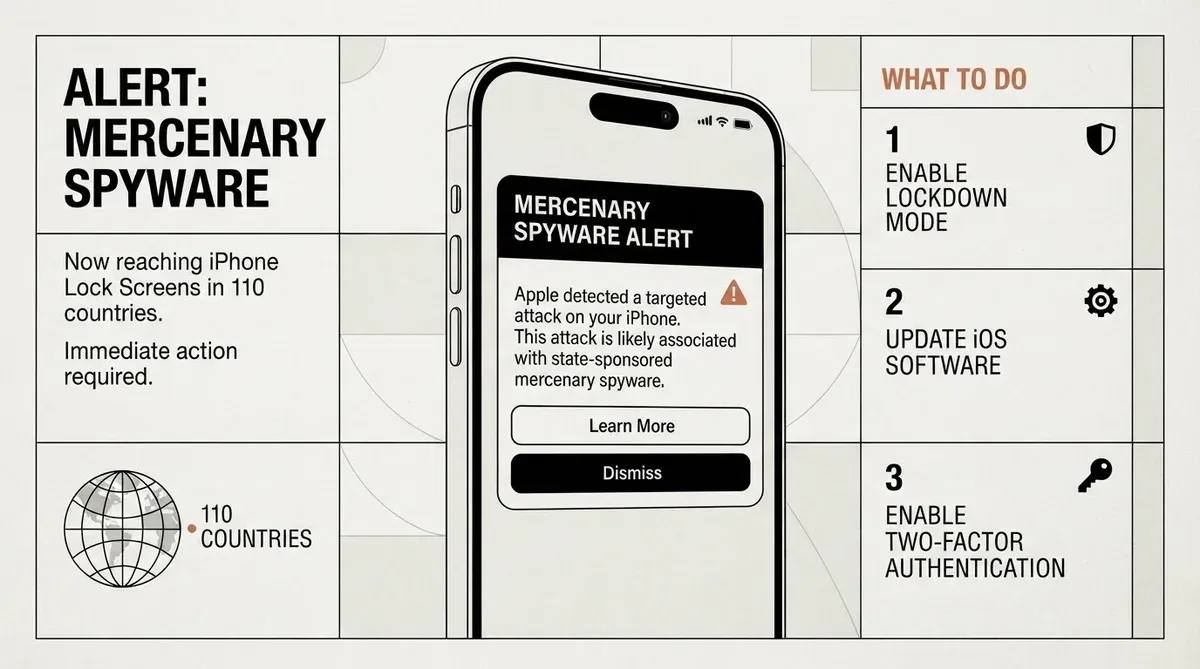
Apple mercenary spyware alerts now arrive directly on the iPhone Lock Screen and inside the Settings app, a delivery change that makes a high-risk warning far harder to overlook. Apple sent the latest round of threat notifications on Thursday, August 13 to an unspecified number of users across 110 countries, and the company has now alerted customers in more than 150 countries since the program began in 2021.
Apple describes the warnings as high-confidence alerts that a specific user has been individually targeted by mercenary spyware, likely because of who they are or what they do. The people in that category are typically journalists, activists, politicians, and diplomats, and the tools involved are surveillance systems sold by private contractors such as NSO Group, maker of Pegasus. The alerts cover iPhones, iPads, and Macs.
Most iPhone owners will never see one of these notifications. Apple sends them only when it has high confidence that a particular person was targeted, which keeps the list narrow even as the geographic reach grows. That focus is why a single wave touching 110 countries stands out: it reflects how many individuals worldwide are considered at risk, not a mass warning to every user.
The push alert tells the recipient that Apple detected a mercenary spyware attack targeted at their iPhone and urges them to take action, linking to a screen with support contacts and instructions. This is the first time in the program's five-year history that the warning has landed directly on the device rather than arriving by email alone.
An updated support document published the same day lists four channels for a threat notification: a push alert on the Lock Screen, a dedicated Apple Threat Notification row near the top of Settings with a red badge, a banner in the Apple Account settings, and an email from threat-notifications@email.apple.com. Apple notes that the exact combination can vary by device model and software version.
Why the Lock Screen matters
For the five years the warning program has run, alerts reached users mostly by email, a channel that can sit unnoticed for a week or more. A push notification forces a decision in the moment: open the guidance and secure the device, or dismiss the warning deliberately. The trade-off cuts both ways. On-device alerts are harder to ignore, but the Lock Screen message is visible to anyone holding the phone, an open question for users who may be under physical surveillance.
The scale of this round of Apple mercenary spyware alerts is itself information. Reaching users in 110 countries in a single wave, on top of more than 150 countries since 2021, shows how widely government-grade surveillance tools are deployed against individuals. Apple has not named the threat actor behind this wave or listed the countries involved, and it did not clarify specifics about the threat itself.
How to respond to Apple mercenary spyware alerts
Anyone who receives a notification should treat it as genuine and act on it; Apple has confirmed the latest warnings are real. The recommended first step is updating the device to the latest software, followed by enabling Lockdown Mode, a setting that limits certain iPhone features to make a remote compromise harder to pull off. Apple recommends Lockdown Mode for people who believe they may be personally targeted, and the alert itself links to a screen with support contacts and instructions.
Lockdown Mode is the strongest option in the guidance, and the cost is concrete: a device with fewer conveniences until the threat is addressed. For someone who has just learned they were a target, that trade is usually easy to accept.
The guidance also covers the follow-on risk. Attackers frequently use the warning itself as a hook for phishing, so recipients should avoid clicking links in unsolicited messages and review the Apple Account page for signs of unauthorized activity. The practical checklist for a recipient is short: update the operating system, restrict the device with Lockdown Mode, and verify anything that claims to be related to the alert.
Why this matters
The move to the Lock Screen changes what Apple mercenary spyware alerts mean in practice: the people most at risk, from journalists to diplomats, now receive a warning they cannot easily miss, and the response no longer depends on checking a rarely read inbox. For everyone else, the wave is a reminder that commercial surveillance tools remain an active threat to consumer devices, and that the defense still comes down to updates, restrictions, and caution before clicking.
Sources
Apple now uses iPhone alerts for targets of mercenary spyware
AI-generated image.
Related Articles
- Apple's iOS 26.5.2 Security Update Patches 29 Vulnerabilities as AI Threats Accelerate
- LightSpy Spyware Goes Commercial, Infects Routers and Wipes Devices Across 13 Countries
- Apple ships emergency patch for macOS Screen Sharing flaw exploited to install Monero miners
✔Human Verified
Researched and cross-referenced against primary sources by the Bytevyte editorial team. This article was generated with the assistance of artificial intelligence and reviewed by the Bytevyte editorial team.