
ASUS Googlebook Lapis preview: Panther Lake silicon and Google's upmarket gamble
The ASUS Googlebook Lapis (CX9406) leaks with Panther Lake chips, up to 64GB RAM and a sub-1kg chassis. Inside Google's three-tier premium laptop plan.
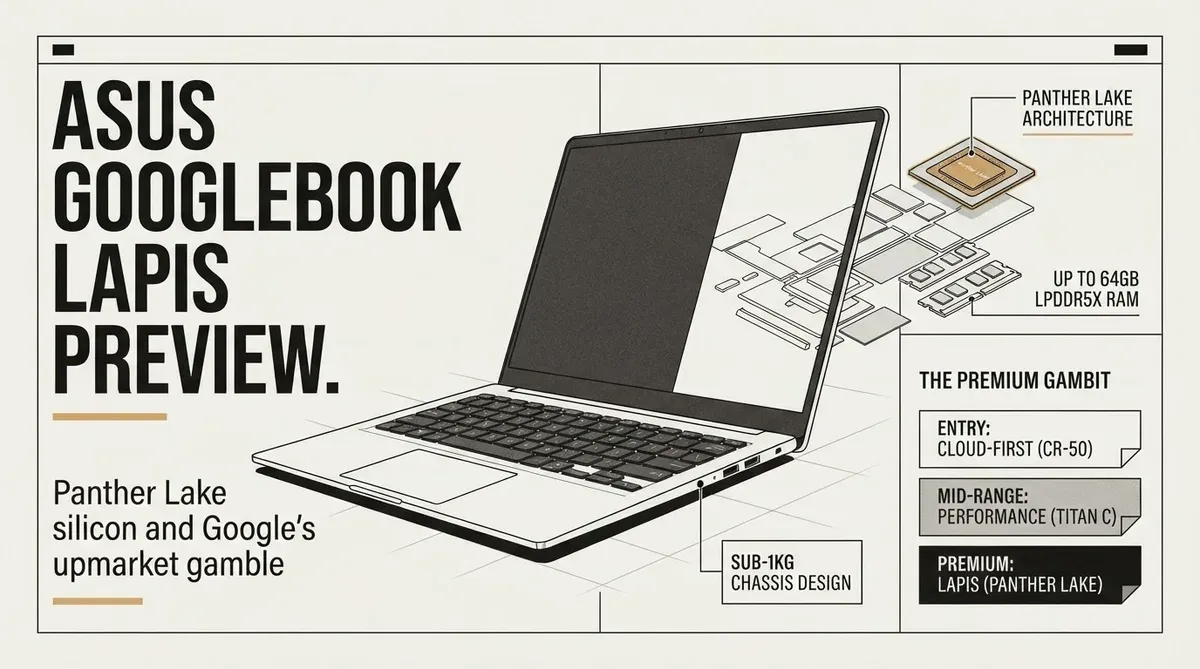
The ASUS Googlebook Lapis is shaping up as the model that defines Google's premium-first push into laptops. The bet is that a ChromeOS successor can sell at flagship prices before cheaper hardware arrives. Leaked specifications describe a 14-inch touchscreen notebook, developed under the codename Lapis and expected to launch as the CX9406, with Intel Panther Lake processors, up to 64GB of LPDDR5X RAM and a chassis that weighs under a kilogram. It is slated to arrive in the first Googlebook wave this fall, alongside a wider lineup that Google has split into three price tiers.
Two processors appear in development: the eight-core Core Ultra 5 325 at up to 4.5 GHz and the eight-core Core Ultra 7 355 at up to 4.7 GHz, both from Intel's Panther Lake Core Ultra Series 3 family. Configurations surfaced so far pair the Ultra 5 with 32GB of memory and the Ultra 7 with 64GB. Graphics come from Intel Xe3 with four Xe cores and a 47 TOPS NPU, and the spec sheet includes Wi-Fi 7, a fingerprint reader and a backlit keyboard.
Leaked renders and listings describe a chassis made from an 'ultra-ceramic' alloy that ASUS claims is 34% lighter and 13% stronger than conventional materials, with a Glowbar light strip on the lid. Energy Star records list the notebook running Aluminium OS, the merged Android-ChromeOS platform Google has been steering toward this year. None of this is confirmed by ASUS or Google, and the 64GB figure may describe a prototype rather than a retail ceiling.
ASUS Googlebook Lapis: what the leaks show
The Lapis sits at the top of a three-tier lineup that Google has defined internally as AL Premium, AL Mass Premium and AL Entry. AL Premium ships first this fall. It pairs OLED screens and premium materials with the fastest chips in the lineup: Intel's Panther Lake Core Ultra 7, Qualcomm's Snapdragon X Elite or X2, and MediaTek's Dimensity CX. The mass-premium tier drops to the eight-core Snapdragon X Plus or a Core Ultra 5, with a 45 TOPS NPU floor. The entry tier, where Chromebooks historically won their buyers, has not surfaced in detail.
| Tier | Silicon | NPU floor | Expected price |
|---|---|---|---|
| AL Premium | Panther Lake Core Ultra 7, Snapdragon X Elite/X2, Dimensity CX | 47 TOPS on the Lapis (Intel Xe3) | $1,600 and up (X Elite) |
| AL Mass Premium | Snapdragon X Plus (8-core), Core Ultra 5 | 45 TOPS minimum | $700 to $1,100 |
| AL Entry | Not detailed | Not detailed | Not detailed |
Price estimates from the leaked hardware run $700 to $1,100 for Snapdragon X Plus machines and $1,600 and up for X Elite configurations. The ASUS Googlebook Lapis, with a Panther Lake Ultra 7 and up to 64GB of memory, would land in the higher bracket, putting the first flagship Googlebook in direct contact with premium Windows ultrabooks and MacBook Air territory.
Google's three-tier plan
The lower tiers appear to lean on Qualcomm silicon that is already shipping elsewhere. Qualcomm's Snapdragon X Plus X1P-42-100 appears twice in the lower tier: two designs named Annite and Pic share a board platform called Mica. The code references include fingerprint readers in both and no USB-A port in either. A separate Acer Googlebook has shown up in leaks with up to 32GB of RAM and a 2.8K OLED display. Google VP John Maletis confirmed in May that Intel, Qualcomm and MediaTek are the three silicon partners behind the platform.
The same pattern holds at the high end. Intel's Fatcat reference board was shared across partners and yielded retail models from Lenovo (Ruby) and Acer (Moonstone). Qualcomm's Calypso reference design, built around the Mensa blueprint for Snapdragon X2 Elite, appears headed to multiple manufacturers as well. That points to several Snapdragon X2 Elite Googlebook variants in development rather than a single flagship.
Aluminium OS is the other half of the story. Merging Android apps with the ChromeOS desktop shell changes what these laptops can run, which is part of why Google feels confident pushing higher-priced hardware: a $1,600 Googlebook only makes sense if it runs the apps people actually use, beyond a browser. The OS shift also explains the strict hardware requirements in the premium tier, since Google is optimizing for a unified platform instead of a web-only one.
Why premium-first is a gamble
Leading with flagships reverses the playbook that made ChromeOS a success. Google is now betting that consumers will pay four figures for a Chromebook successor with premium materials and top-tier silicon, before the cheaper ARM tiers arrive. The real test is the fall price tags: if the mass-premium band holds around $700 to $1,100, the platform can grow without abandoning its price-sensitive base. If premium pricing overshoots, the entry tier that eventually ships will carry the burden of winning back budget buyers.
The spec floor is itself a signal. A 45 TOPS NPU minimum for mass-premium models and a 47 TOPS NPU on the Lapis mean Google treats on-device AI as a baseline requirement, not an option. Even if retail units trim the memory ceiling, engineering a ChromeOS successor around 32GB to 64GB of RAM rather than the 8GB to 16GB of typical Chromebooks shows how far the platform has moved from its budget roots.
Strict hardware requirements for the premium tier also change the game for manufacturers. Partners such as ASUS, Lenovo and Acer now compete on chassis design and silicon selection instead of on shaving cost to hit a $299 Chromebook price point, which is why the first wave includes a sub-1kg ceramic build, OLED panels and fingerprint readers. The platform's reputation now rides on how well those partners execute instead of on how low Google can push the price.
Watch the mass-premium band first, not the flagship. The $700 to $1,100 bracket is where Chromebook owners actually sit, and it is where the Snapdragon X Plus machines such as Annite and Pic will land. If those models keep the 45 TOPS AI floor and ship close to the low end of that range, Google gets its upmarket story without losing its existing customer base. If they drift toward $1,100, the platform risks pricing out the buyers who made ChromeOS relevant.
The trade-off for buyers is timing. Early adopters get the best hardware first, but they pay flagship prices for a platform whose ecosystem is still settling. The alternative is waiting for the ARM models, which trade some performance for lower cost and, in the case of the X1P-42-100-based designs, fewer ports. For most consumers, the ASUS Googlebook Lapis shows where Google wants to go, and the mass-premium tier will show whether it can actually get there.
Why this matters
For consumers, the Googlebook era means ChromeOS hardware that no longer competes on price alone, matching Windows ultrabooks on materials, silicon and AI capability. The fall launch answers the central question: whether Google's upmarket bet holds at retail, and whether the ASUS Googlebook Lapis becomes the model that finally shakes off the budget Chromebook reputation.
AI-generated image.
Related Articles
- Asus and Lenovo Googlebook laptops surface in leaked renders ahead of IFA 2026
- Asus Googlebook Appears Ahead of Fall 2026 Launch
- Microsoft Surface Laptop 8 Leaks with Next-Gen Intel Panther Lake Chip
✔Human Verified
Researched and cross-referenced against primary sources by the Bytevyte editorial team. This article was generated with the assistance of artificial intelligence and reviewed by the Bytevyte editorial team.