
Blacksmith's $550M Valuation Puts AI-Driven Software Testing in the Spotlight
Blacksmith raised $45M at a $550M valuation, signaling the rise of AI-driven software testing as autonomous validation agents become a core part of the development stack.
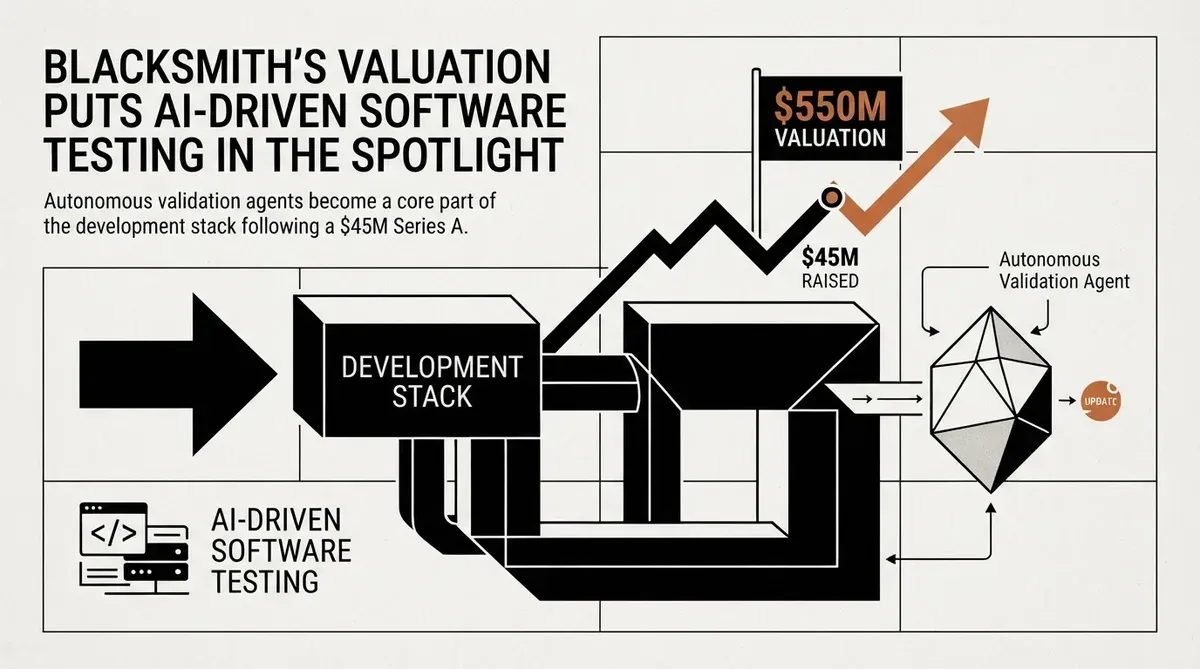
Blacksmith has raised $45 million in a Series B round that values the AI testing startup at $550 million, a tenfold jump from its previous valuation. The round, led by Peak XV, arrives as AI-driven software testing becomes the market's new focus: coding assistants generate code faster than engineering teams can verify it.
Blacksmith's platform runs autonomous validation agents that ingest a codebase, understand its business logic, and generate test suites covering regressions, edge cases, and unusual input patterns. The system slots into existing CI/CD pipelines for pre-merge feedback and automatically updates tests as code evolves, reducing the maintenance burden that typically drags on QA teams.
The Rise of AI-Driven Software Testing
Tools like GitHub Copilot and Cursor accelerated code generation, but human engineers cannot keep pace with the volume of large language model output, and traditional testing frameworks require manual upkeep that scales poorly. Investors have responded by backing AI-driven software testing platforms, and Blacksmith's tenfold valuation jump reflects the broader shift from generative AI to evaluative AI.
The economics reinforce the move. As code generation gets cheaper, the value migrates to proving that code works, and most vendors, Blacksmith included, are adopting consumption-based pricing or enterprise subscriptions to cover GPU costs. Early adopters of these platforms report faster detection of critical bugs and higher code coverage without added developer effort, though passing tests can still miss the real logic paths.
Trade-offs and Competition
Blacksmith's closed-source approach brings vendor lock-in and data-sovereignty concerns, and the compute overhead of deep-learning agents can be prohibitive for smaller teams. The validator itself can also hallucinate, producing tests that pass without matching real system behavior. Rivals split the market differently: Qodo (formerly CodiumAI) works inside the IDE, Diffblue focuses on Java unit tests, and Snyk concentrates on vulnerabilities rather than functional logic.
Regulatory pressure strengthens the case for automated validation. Under the EU AI Act, software in critical infrastructure must meet strict documentation and accuracy standards, and logs from platforms like Blacksmith may become part of compliance evidence.
Why This Matters
The practical consequence for engineering teams is that verification, not generation, is becoming the scarce skill in software delivery. Blacksmith's $550 million valuation signals that AI-driven software testing is moving into the core development stack, and the real test is whether it prevents production failures, not whether coverage numbers look good.
Sources
AI-generated image.
Related Articles
- Cloudsmith Secures $72 Million to Protect Software Supply Chains from AI-Generated Risks
- Cognition AI Hits $26 Billion Valuation to Scale Software Automation Platform
- Agentic AI Funding Surges as Viktor and Primer Raise $175M for Autonomous Agents
✔Human Verified
Researched and cross-referenced against primary sources by the Bytevyte editorial team. This article was generated with the assistance of artificial intelligence and reviewed by the Bytevyte editorial team.