
Cloudflare and Upwork Cut Staff to Accelerate Pivot Toward Agentic AI Models
Cloudflare and Upwork slash workforces to pivot toward agentic AI models, signaling a shift to autonomous efficiency in the tech sector.
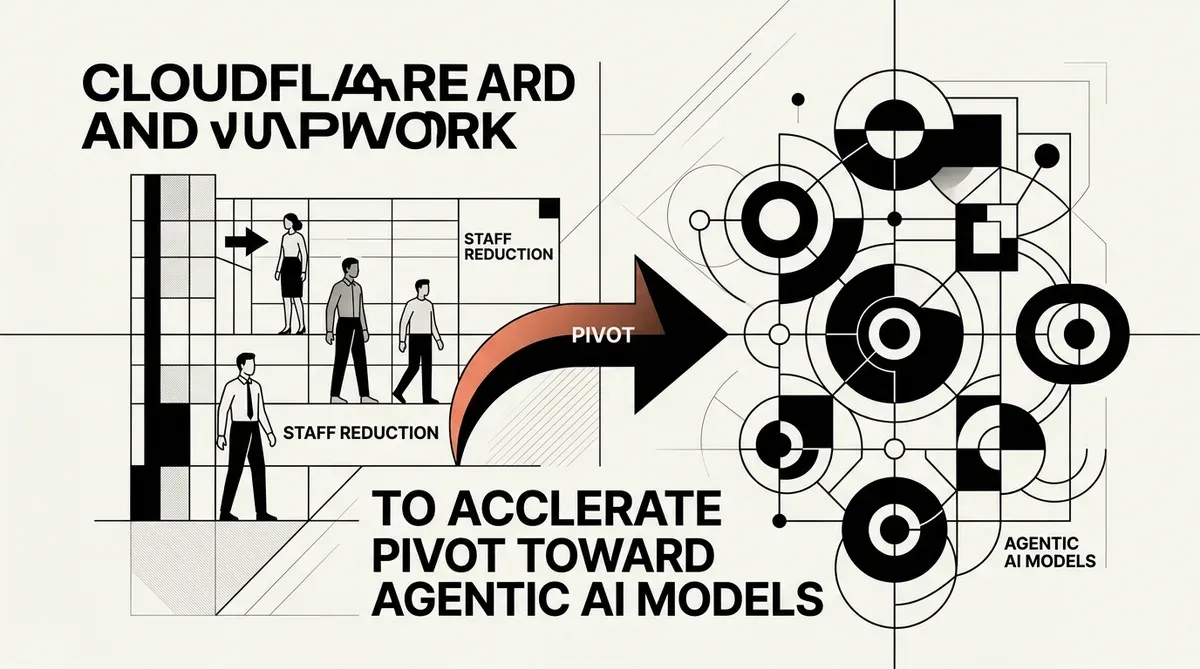
Cloudflare and Upwork have initiated significant workforce reductions as part of a strategic shift toward agentic AI models, signaling a new phase of corporate restructuring driven by autonomous technology. Cloudflare announced a 20% staff cut this week, affecting approximately 1,100 employees, while Upwork reduced its headcount by 24%, or roughly 500 to 600 roles. Both companies cited the increasing efficiency of artificial intelligence as the primary driver for these organizational changes.
The move by Cloudflare follows a massive 600% surge in internal AI usage over the last three months. CEO Matthew Prince has clarified that the layoffs are not a traditional cost-cutting measure but a fundamental pivot to an agentic AI-first model. To support departing staff, the company is providing an industry-leading severance package that includes full pay through the end of 2026. Despite beating first-quarter revenue estimates with $639.8 million, Cloudflare shares dropped 14% following conservative guidance for the upcoming quarter.
Strategic Shift Toward Agentic AI
At Upwork, the restructuring reflects a belief that AI productivity gains allow for smaller, differently resourced teams. CEO Hayden Brown has stated that the era of the two-pizza team is over, suggesting that autonomous agents can now handle tasks that previously required larger human groups. Upwork is integrating its Uma AI work agent to streamline operations, even as the company lowered its 2026 revenue outlook to between $760 million and $790 million. Gross services volume from AI-related work on the platform grew 40% year-over-year in the first quarter.
This trend extends beyond these two firms, as the broader technology sector increasingly adopts AI efficiency as a standard board-level mandate. Coinbase and Meta recently executed staff reductions of 14% and 10% respectively, citing similar shifts toward automated workflows. Industry analysts suggest that 2026 is the year when companies move from experimenting with generative tools to fully integrating autonomous agents into their core business structures.
The financial markets have reacted with a mix of caution and skepticism to these announcements. While the long-term promise of agentic AI suggests higher margins and leaner operations, the immediate impact on revenue guidance has caused significant volatility. Investors are currently weighing the potential for future growth against the short-term costs of large-scale restructuring and the risks associated with such a rapid technological transition.
As of May 8, 2026, the focus for tech leadership has moved toward identifying which internal functions can be fully managed by autonomous systems. The next milestone for these companies will be demonstrating that smaller workforces can maintain or exceed previous output levels through the successful deployment of agentic frameworks. Further updates on the performance of these AI-first models are expected during the next round of quarterly earnings reports.
While we strive for accuracy, bytevyte can make mistakes. Users are advised to verify all information independently. We accept no liability for errors or omissions.
AI-generated image.
Related Articles
- Cloudflare and OpenAI Launch Cloudflare Agent Cloud
- Freshworks AI-led Strategic Realignment Triggers 11% Workforce Reduction
- Meta Realigns Workforce with $135 Billion AI Infrastructure Push
✔Human Verified