
Cognition $40B valuation in sight as coding-agent market re-rates
Cognition $40B valuation talks signal a re-rating of the AI coding-agent market. We break down the multiple, the risks and what to watch.
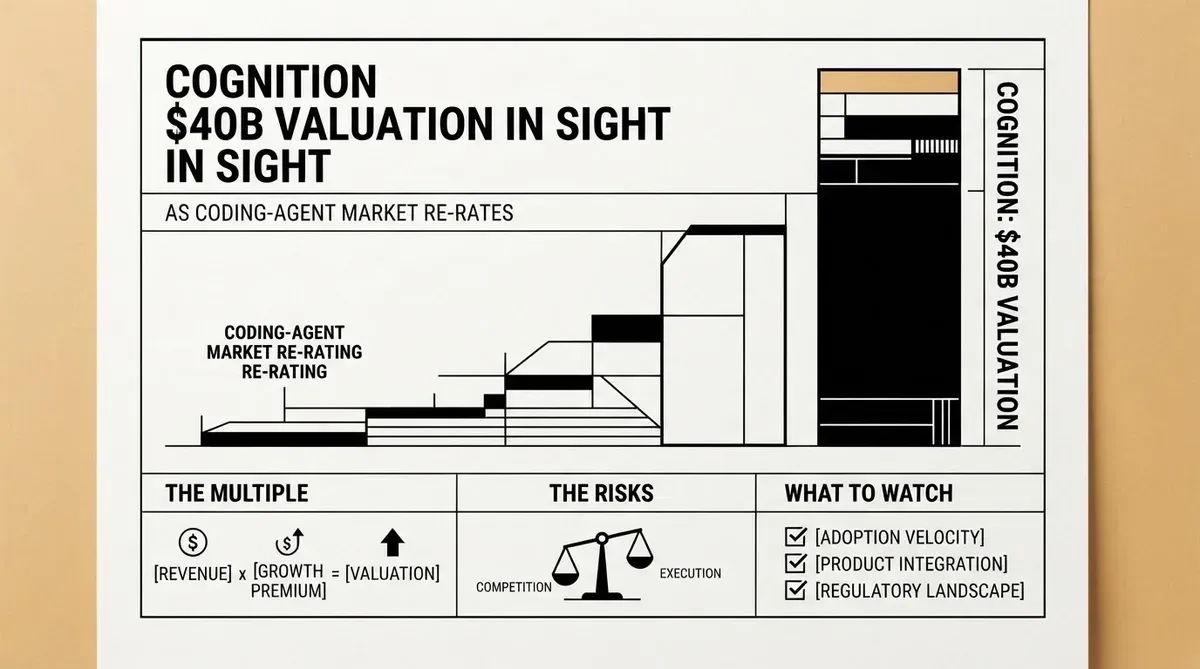
Cognition is in early talks with investors about a new funding round at a valuation of at least $40 billion, a figure more than 50% above the $26 billion post-money mark set when it closed a $1 billion round in May 2026. The Cognition $40B valuation under discussion surfaced this week, less than three months after that financing, and the round could raise more than $1 billion in fresh capital. Cognition's annualized revenue run rate is approaching $1 billion, roughly double its level at the last funding event, with growth driven by enterprise adoption of its Devin coding agent.
The step from $26 billion to $40 billion in under a quarter, taken against a run rate of about $1 billion, is the clearest signal yet that investors are pricing autonomous coding agents as the next major enterprise software category. The price move is the market's way of saying coding agents may be approaching a product category with real platform power, and the test is whether the business can grow into the number. Whether the mark holds will be decided by retention, margins and customer concentration, not by the headline figure alone.
Devin operates as an autonomous AI software engineer that reads codebases, drafts plans, writes code, runs tests and corrects its own output. Cognition says Devin has shipped 89% of its own production code. The pitch to enterprise buyers is that the agent carries a task through the full software delivery cycle instead of suggesting lines at the keyboard, and the company points to that autonomy as the driver of revenue that has roughly doubled since the last round. Goldman Sachs, Mercedes-Benz and several U.S. government agencies are named enterprise clients, and Founders Fund, led by Peter Thiel, remains a prominent backer. Government contracts bring a different kind of stickiness: procurement cycles and security reviews make switching slow, which supports near-term retention. Total funding stands at about $2.1 billion across six rounds.
The AI coding-agent market is repricing in months, not years
Cognition's own trajectory captures the speed of the repricing. The company moved from a $350 million valuation in early 2024 to $2 billion, then $4 billion, before a $400 million round led by Founders Fund in September 2025 set it at $10.2 billion, with Lux Capital, 8VC, Elad Gil, Definition Capital and Bain Capital Ventures participating. That round was framed around surging demand for coding agents as enterprises moved beyond copilots. The $1 billion round in May 2026 took the company to $26 billion post-money. Talks that surfaced in April pointed to $25 billion, and new discussions now cite at least $40 billion, a jump of more than 50% in under a quarter.
| Stage | Timing | Valuation |
|---|---|---|
| Early stage | Early 2024 | $350 million |
| Growth rounds | Through 2025 | $2 billion, then $4 billion |
| $400 million round led by Founders Fund | September 2025 | $10.2 billion |
| $1 billion round | May 2026 | $26 billion post-money |
| New round, in talks | August 2026 | At least $40 billion |
The re-rating extends beyond Cognition. Rival Cursor was valued at $29.3 billion ahead of a reported acquisition by SpaceX, and Cognition absorbed Windsurf's assets after Google hired that startup's cofounders. Cognition's fundraising began before the Cursor deal became public, but investor interest rose afterward, a sign that capital is rotating more aggressively into companies building AI tools for developers. When Cognition negotiated at $25 billion earlier this year, the implied test was lifting ARR from just over $100 million to between $500 million and $1 billion within 12 to 18 months; a run rate now approaching $1 billion suggests that bar has been cleared, and the $40 billion mark prices the next leg of growth.
What the Cognition $40B valuation assumes
Against a run rate near $1 billion, the Cognition $40B valuation implies a revenue multiple in the region of 40x. Enterprise software has carried premium multiples before, but 40x is rich even by that standard, and it assumes growth keeps compounding at the recent pace. The concrete risks sit on three fronts: renewal rates, because enterprise agent contracts must prove their value after the pilot phase; margins, because autonomy shifts the cost structure versus assistance and an agent that iterates on its own runs many more model calls per task, so gross margin depends on how often those attempts succeed; and customer concentration, because a client list leaning on marquee names such as Goldman Sachs and Mercedes-Benz leaves the run rate exposed if one account walks away.
Revenue quality is part of the same question. A run rate built on a small number of large enterprise deals and government contracts means high average contract sizes and few accounts, which concentrates the business. The multiple also assumes the category keeps expanding as an independent market, a bet that runs against last year's consensus that foundation-model vendors would absorb coding startups themselves. Because the round is priced off a revenue run rate rather than profitability, any signal that growth is decelerating would pressure the next mark, and the backers are effectively wagering that autonomous agents remain a standalone category with platform power.
Execution risk sits underneath the financial story. Cognition has drawn scrutiny over its work culture, with accounts of expectations of 80-hour, six-day weeks, an intensity that has coincided with fast growth but pressures retention in a market where engineering talent is scarce.
Two architectures, one market bet
The round also sharpens the architectural debate inside the category. Devin delegates complete tasks to autonomous software, an "agent-first" approach, while Cursor assists developers inside the IDE. At the time of the May 2026 round, Cursor was generating roughly four times Cognition's revenue, yet investors marked Cognition higher. That gap is a bet that autonomy carries a larger long-run addressable market than assistance, even if the assistive product monetizes faster today. The Windsurf acquisition, which folded a competitor's assets and customer base into Cognition after its cofounders left for Google, consolidates the agent-first camp further.
For buyers, both approaches are now well-funded enough to be viable enterprise products with serious roadmaps, which changes procurement math: teams can pilot either architecture without worrying the vendor disappears, and total cost of ownership now depends on task success rates, since autonomous agents consume compute for every attempt, including failed ones. The open question for CIOs is reliability at scale, because autonomous code generation still shows a gap between demo performance and production-grade dependability. The practical starting point for teams evaluating these tools is piloting inside low-risk repositories before production exposure.
The verdict: platform pricing with a renewal question
The talks are early and terms can change, so the first test is whether the round closes near $40 billion. If it does, it locks in a reading of the market: coding agents are valued like platforms rather than tools, and autonomy earns a premium over assistance. The comparable case is Cursor's $29.3 billion mark, which the market will test if the reported SpaceX deal proceeds. The next milestone is renewal data from the enterprise cohort, which will determine whether the run rate near $1 billion keeps compounding. Strong renewals give the multiple support; churn inside marquee accounts would expose the distance between the headline valuation and the underlying business. For competitors, the mark also raises the bar for later-stage rounds, since any coding-agent startup raising now will be measured against Cognition's multiple.
Why this matters
For decision-makers, the Cognition $40B valuation is a benchmark for how aggressively capital is pricing autonomous software development. It tells CIOs that coding agents have moved from experiment to strategic procurement, and it tells founders and investors that the category now carries platform-level expectations. The practical question is whether enterprise renewals can keep pace with that pricing.
AI-generated image.
Related Articles
- Cognition AI Hits $26 Billion Valuation to Scale Software Automation Platform
- Coding Agent Race This Week: Open Weights, Breaking Releases, Tooling Shifts
- CloudWatch Coding Agent Insights: Dashboard for AI Developer ROI
✔Human Verified
Researched and cross-referenced against primary sources by the Bytevyte editorial team. This article was generated with the assistance of artificial intelligence and reviewed by the Bytevyte editorial team.