
CXMT G5 DRAM Mass Production Reshapes Commodity Memory, Not AI Supply
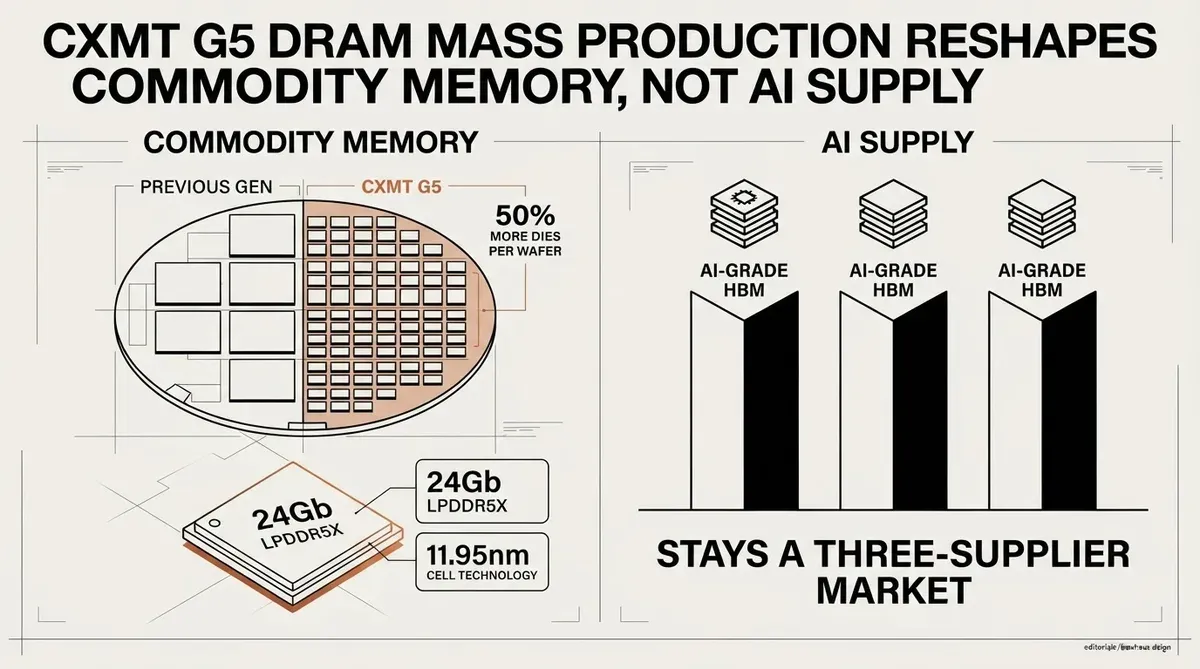
ChangXin Memory Technologies has moved its fifth-generation DRAM platform into mass production, a step the Hefei-based chipmaker says brings its process technology close to the most advanced designs in commercial memory. The CXMT G5 DRAM mass production ramp was disclosed at the 2026 World Manufacturing Convention in Hefei on September 20, alongside a new family of 24-gigabit LPDDR5X chips aimed at smartphones and portable electronics. The platform uses 11.95-nanometre memory-cell feature spacing, and CXMT says gross die output per wafer rises by at least 50 percent against the previous generation on a standardised capacity basis.
The die-per-wafer figure is the one that matters commercially. In commodity DRAM, cost per bit is set by how many usable dies come off each wafer and how much of that output can be sold into a market where prices follow supply rather than brand. CXMT has not disclosed pricing for the new parts, their PC availability timeline, or the yields it is reaching at volume.
Two separate 50 percent figures are circulating around the launch, and conflating them distorts the story in both directions. One is the die-per-wafer gain versus CXMT's previous generation on a standardised capacity basis. The other is the capacity of a single 24Gb die against a standard 16Gb part. The first is a manufacturing improvement that lowers cost; the second is a product specification that changes what a phone can hold. Only the first alters CXMT's competitive position.
Inside the CXMT G5 DRAM Mass Production Push
G5 reaches its 11.95nm cell spacing through quadruple patterning instead of extreme ultraviolet lithography. Export controls cut CXMT off from ASML's EUV scanners, so the company built the node on deep-ultraviolet tools that remain available to it. The route carries a visible cost: each critical layer is exposed and etched across multiple passes, which lengthens cycle time and increases mask and defect-management overhead.
That trade-off explains why a 50 percent die gain is not a 50 percent cost reduction. Extra patterning steps consume fab capacity and add process risk, so part of the density advantage is absorbed before a wafer is sold. It also separates CXMT's 11.95nm figure from the node names used in logic manufacturing, where the number tracks a different set of design rules. Here it describes memory-cell spacing.
Quadruple patterning is viable at all because deep-ultraviolet immersion lithography sits outside the tightest export restrictions. That keeps CXMT on a tool generation several steps behind the logic leading edge, but it also means the company can keep adding passes as long as its process engineers hold the overlay budget. The 11.95nm figure is the outcome of that approach, not a shortcut around it.
Die density matters more than usual for CXMT because wafer capacity is its binding constraint. Restrictions on the most advanced lithography mean the company cannot simply buy its way to more bits. Lifting dies per wafer by half delivers more output from the same installed tool base, which is the cheaper path to a larger share of industry bit supply.
What ships first is mobile memory. The new LPDDR5X line uses 24-gigabit dies and comes in 496-ball and 245-ball packages, giving handset makers two footprints to design around. The G5 platform also produces DDR5, the memory type used in PCs and servers. It does not produce high-bandwidth memory.
| Item | CXMT G5 detail |
|---|---|
| Memory-cell feature spacing | 11.95nm |
| Patterning route | Quadruple patterning, no EUV |
| Gross dies per wafer | At least 50% above previous generation |
| Lead product | 24Gb LPDDR5X |
| Package options | 496-ball and 245-ball |
| Other output | DDR5; no HBM |
| Global DRAM revenue share, Q2 2026 | 9.5%, fourth place |
The Commodity Squeeze on Samsung, SK Hynix and Micron
CXMT's place in the market is no longer marginal. The company held 9.5 percent of global DRAM revenue in the second quarter of 2026, ranking fourth worldwide behind Samsung, SK Hynix and Micron. A platform that raises dies per wafer by half, arriving as Chinese output is already loosening the commodity PC memory market, applies direct pressure to the pricing of standard DDR5 and LPDDR5X modules.
The tightness that defined commodity PC memory has given way to comfortable availability. For the three incumbents, that shifts the question from how much they can ship to how much each commodity wafer still earns. All three have been steering capacity toward higher-value products, and cheaper commodity supply from Hefei makes that reallocation more urgent rather than less.
Standard DDR5 also carries exposure to the server market, where memory content per system has climbed alongside processor core counts. A cheaper fourth source of that part number reaches beyond consumer PCs into the same installed base the incumbents count on for volume, without a single HBM wafer changing hands.
The defence strategy has a dependency built into it. Shifting wafer starts to HBM and dense server modules works only if commodity pricing holds up enough to cover the fixed costs of the lines that still run standard DRAM. A fourth supplier adding die density into that base erodes the buffer the reallocation depends on.
Mobile memory is the hardest segment in which to convert a specification into revenue quickly. Handset makers qualify memory against a specific platform and package, and a supplier change usually lands with a new device generation rather than a firmware update. The 245-ball option matters in that process: it offers a smaller footprint for space-constrained phones, widening the set of designs CXMT can bid for.
For PC and phone buyers, the nearer-term effect is negotiating leverage. Memory contracts are typically struck on quarterly or half-yearly cycles, and a credible fourth source of standard parts gives procurement teams an alternative to price increases from the incumbents. Whether that leverage materialises depends on how quickly CXMT's customers complete qualification, not on the density claim itself.
CXMT is also widening its base. The company plans a NAND flash research and development line in Beijing, which would take it beyond DRAM for the first time and into a second memory market with a different supplier structure. Bundling DRAM and NAND is how the incumbents hold system-level sockets in phones and PCs, and a research line points toward competing on that bundle rather than on DRAM alone.
Two data points will settle the question in coming quarters: CXMT's disclosed bit output and contract prices for standard DDR5 modules. Neither is public yet, which leaves a platform claim standing ahead of any volume commitment.
Why the AI Memory Chokepoint Holds
None of this touches the memory AI accelerators actually consume. High-bandwidth memory, the stacked DRAM packaged beside Nvidia and AMD data-centre chips, remains a three-supplier market shared by Samsung, SK Hynix and Micron. G5 makes LPDDR5X and DDR5, so the CXMT G5 DRAM mass production ramp does nothing to relieve the HBM constraint that governs allocation for AI training and inference systems.
CXMT has started trial production work on HBM3E, which would place it on the same product tier as the incumbents if it reaches volume. Trial output and qualified volume supply are different achievements. HBM qualification runs through accelerator vendors and their packaging partners rather than through a fab's own catalogue, and the distance between the two is measured in customer sign-offs, stacking yields and packaging capacity.
The result is a split market. Commodity DRAM gains supply and loses pricing power, with the damage concentrated in the least differentiated part of the incumbents' portfolios. AI memory keeps both its shortage and its margins.
Why this matters
CXMT's G5 ramp is a supply-side event in commodity memory, and its clearest consequence is margin pressure on Samsung, SK Hynix and Micron in the product lines where they have the least room to differentiate. Buyers of standard DDR5 and LPDDR5X, from handset makers to PC assemblers, gain a fourth supplier with genuine volume. The AI memory shortage that constrains accelerator supply is a separate market, and this launch leaves it intact.
AI-generated image.
Related Articles
- Samsung zHBM 3D memory targets 8x HBM5 performance to leapfrog SK Hynix and Micron
- AI Infrastructure Boom Triggers Massive Global Shortage of Memory Chips
- AI Memory Shortages Drive Long-Term Supply Deals and Surge in Laptop Costs
✔Human Verified
Researched and cross-referenced against primary sources by the Bytevyte editorial team. This article was generated with the assistance of artificial intelligence and reviewed by the Bytevyte editorial team.