
D.C. Circuit Reinstates Pentagon's Anthropic Supply Chain Risk Designation
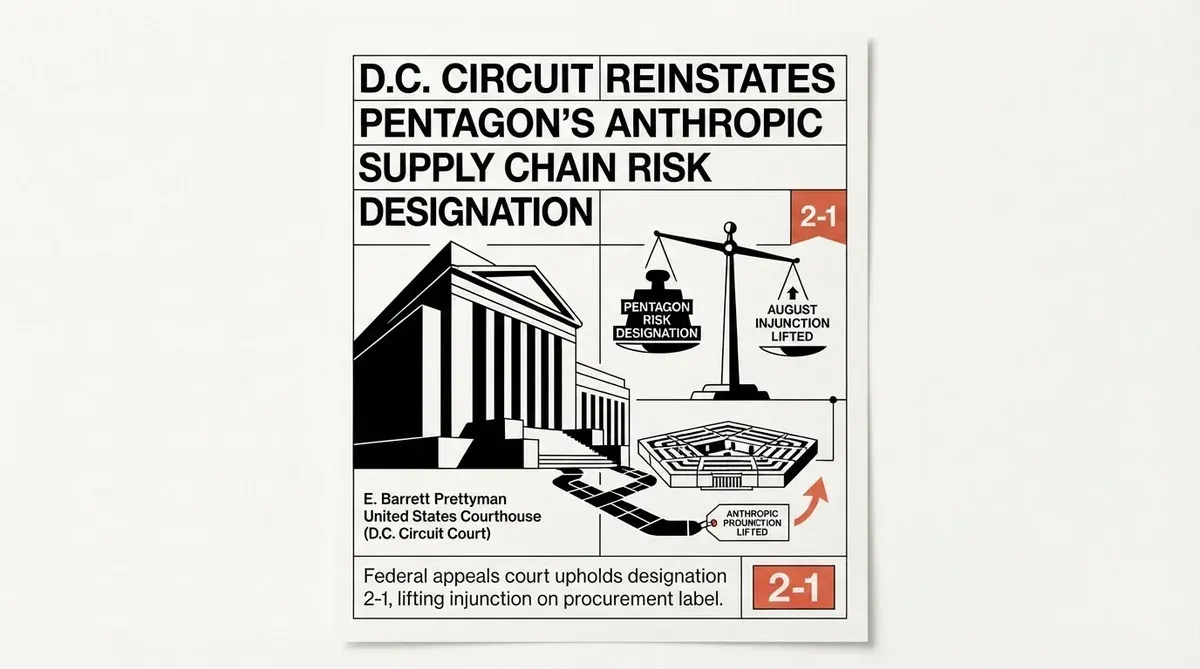
A federal appeals court has sided with the Pentagon over Anthropic, reinstating the government's Anthropic supply chain risk designation in a 2-1 decision that clears the way for the label to be enforced across federal contracting. The U.S. Court of Appeals for the D.C. Circuit issued the ruling on Friday, September 25, 2026, undoing the practical effect of a district-court order handed down less than four weeks earlier. The result restricts Anthropic's access to federal procurement and puts compliance duties back on contractors that build on its models.
The August 28 order had barred the Defense Department from acting on the designation while Anthropic's challenge worked through the courts. With that injunction removed, the label carries immediate operational weight. Federal buyers can treat the company's models as a dependency the government will not accept, and prime contractors that embed Claude in their systems must account for the classification.
The panel majority concluded that the department had ample support for finding that Anthropic's artificial intelligence products present a supply-chain risk to the agency and to the contractors serving it. The judges deferred to the Pentagon's national-security determination, treating the classification as a judgment the courts are not positioned to override.
Anthropic's separate argument that the designation amounted to retaliation for its advocacy on AI regulation did not survive. The majority framed the dispute as a disagreement over a contract term the Pentagon regarded as essential and which Anthropic refused to accept. That framing moves the matter out of First Amendment analysis and into procurement law, where agencies hold broad discretion over whom they buy from.
What the Anthropic Supply Chain Risk Designation Actually Blocks
A supply-chain-risk finding is not a fine and not a product ban. It is a procurement instruction. Once applied, it signals to contracting officers and prime vendors that a relationship with the named company carries risk the government declines to absorb. For Anthropic, the practical consequence is exclusion from military systems and contracts that might otherwise have run on Claude.
The company's route back into that market now runs through the procurement process rather than the courtroom. That is a harder path. Agencies set their own requirements, and a vendor that fails a supply-chain review has far less leverage than a litigant pressing a constitutional claim.
The Contract Term at the Center of the Fight
Beneath the litigation sits a narrower commercial question: the conditions under which a frontier AI developer will sell model access to the armed services. The contested term concerns the use limits Anthropic attaches to its models. The Pentagon considered that restriction essential, and Anthropic would not sign up to it. The appeals panel found the impasse, rather than the company's public position on regulation, produced the designation.
That distinction carries weight beyond this case. If a supplier's refusal of a contract term can justify a risk label, agencies gain a direct mechanism for excluding vendors whose commercial terms they dislike, without having to argue that the vendor's speech or politics motivated the move.
The dispute has run alongside a wider argument between the lab and the department over the terms on which frontier models can be procured for military use. The appeals ruling addresses one label and one contract term, not the broader question of how the two sides will work together.
Why the District Court and the Appeals Court Split
Much of the outcome rests on the standard of review. Courts give agencies wide berth on national-security classifications, and the D.C. Circuit applied that deference to the department's risk finding. The bar for a supplier challenging such a label is high: it is not enough to show the government was wrong, only that the government lacked an adequate basis. The panel found the department cleared that bar.
The same record produced two different results within four weeks. The district court found enough doubt to pause enforcement on August 28. The appeals court found enough support to let the label stand on September 25. The difference is less about new evidence than about how much weight each court gave the department's own assessment of risk.
The deference question also shapes what comes next. A challenge built on procedure or on the scope of the department's authority faces the same headwind the panel just described, while a challenge built on the facts of the risk finding runs into the court's refusal to substitute its own assessment. Neither leaves much room for a second attempt on the same grounds.
What Changes for Contractors and Federal Buyers
| Dimension | August 28 district ruling | September 25 appeals ruling |
|---|---|---|
| Designation status | Enforcement blocked by injunction | Upheld; injunction removed |
| Practical effect | Label paused | Label enforceable; procurement access restricted |
| Contractor duties | No compliance obligation in force | Compliance obligations reimposed |
For the primes and subcontractors that already run Anthropic models inside government work, the reinstated Anthropic supply chain risk designation creates a compliance question rather than a technical one. They must document how a flagged supplier sits in their stack, and in some cases show that the dependency has been mitigated or removed.
Contractors face the sharper commercial problem. A prime that has standardised on Claude across a programme must weigh the compliance burden of a flagged supplier against the cost of migrating to an alternative. Migration touches model evaluations, safety documentation and, in some cases, system architecture.
For agencies, the decision removes a complication. Contracting officers who had been told to hold off applying the Anthropic supply chain risk designation can now do so, and programme offices that were waiting on the litigation have their answer. The immediate effect is administrative: the designation becomes usable.
For Anthropic, the cost shows up in pipeline rather than in a single contract. The label applies to the department's contracting decisions going forward, which means the exclusion compounds as new programmes are scoped and existing ones come up for renewal.
Timing matters for both sides. Procurement cycles for defence programmes run for years, and a supplier that can be flagged, un-flagged and flagged again inside a single quarter is difficult to write into a long-term requirement. That instability carries its own commercial price.
Rivals that have kept their federal posture uncontroversial gain relative ground. A competitor with no flagged supplier anywhere in its chain can bid on programmes where Anthropic has become a complication, and that advantage holds for as long as the designation stands.
What Rival Labs Should Read Into the Ruling
The decision does more than settle Anthropic's immediate status. It establishes that refusing a term the Pentagon treats as essential can be met with a supply-chain finding rather than a negotiation, and that courts will defer to the department's risk assessment. Competitors weighing how firmly to hold their own usage terms now have a concrete measure of what that stance can cost.
Anthropic's remaining options are administrative. A flagged vendor can seek reconsideration, adjust the terms that triggered the finding, or accept that federal business is closed while the designation stands. Each route runs through the department that issued the label, which concentrates leverage with the agency.
The appeals ruling does not settle the underlying question of how frontier models should be governed when the buyer is the military. It decides who holds the pen in the near term.
Why this matters
The ruling confirms that access to the largest technology buyer in the United States can be withdrawn through a procurement finding, with limited judicial recourse. For AI labs weighing government work, that raises the cost of holding firm on contract terms. For the contractors and agencies that depend on those models, supply-chain reviews now carry real exclusion power, and planning around a single-vendor dependency stops being a theoretical exercise.
AI-generated image.
Related Articles
- Court Voids Pentagon's Anthropic Blacklist as Retaliation
- Anthropic Supply-Chain Risk Case: Judge Signals Overreach
- Pentagon AI Contracts Awarded to Seven Tech Giants as Anthropic Faces Exclusion
✔Human Verified
Researched and cross-referenced against primary sources by the Bytevyte editorial team. This article was generated with the assistance of artificial intelligence and reviewed by the Bytevyte editorial team.