
Databricks and AWS Launch New AI Governance Tools for Agentic Workloads
Databricks and AWS launch new AI governance tools to manage agentic AI workloads, focusing on spend controls, data capture, and regulatory compliance.
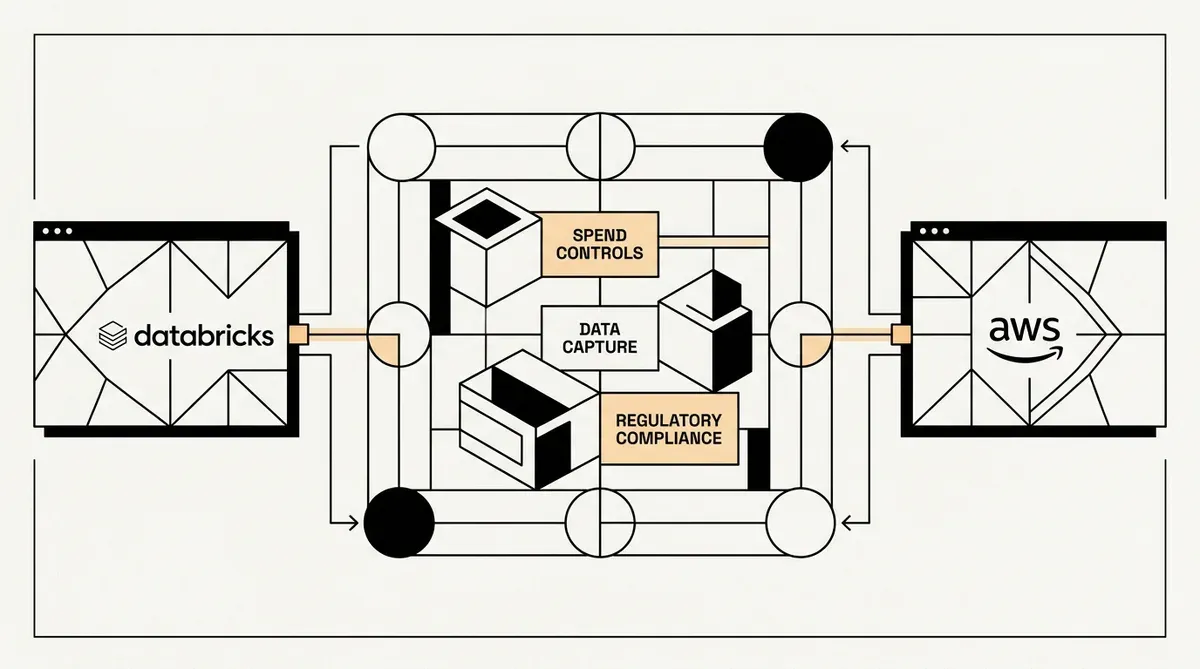
Databricks has introduced AI Spend Controls within its Unity AI Gateway, addressing the growing financial and operational risks associated with autonomous agents. This release, announced on May 19, 2026, allows enterprise teams to establish strict budgets and usage limits for large language models (LLMs) used in agentic workflows. As these agents transition from experimental phases to production environments, the ability to prevent unexpected costs and unmonitored actions is a requirement for corporate governance.
The new AI governance tools provide a framework for managing the Model Context Protocol (MCP) and other agentic systems. By implementing service policies and guardrails, organizations can ensure that AI agents operate within predefined boundaries. This development is particularly relevant for businesses deploying complex, multi-step AI processes where a single error or loop could lead to significant financial overruns. Databricks stated that these controls are designed to provide the observability necessary to manage agents at scale.
Strengthening Enterprise AI Compliance
Simultaneously, Amazon Web Services (AWS) has expanded the capabilities of Amazon SageMaker HyperPod to include data capture for inference workloads. This update, effective May 20, 2026, enables customers to record the payloads of inference requests and responses. Such visibility is essential for model monitoring, debugging, and maintaining compliance with evolving regulatory standards. By capturing this data, organizations can more effectively identify model drift and perform offline analysis to improve system accuracy.
The integration of these AI governance tools across major platforms highlights a shift in the industry toward production-ready AI. While the previous year focused on model performance and raw capabilities, the current priority for tech leaders is the infrastructure required to manage these models safely. AWS noted that systematic visibility into inputs and outputs is a prerequisite for organizations that must satisfy strict regulatory requirements while deploying generative AI on HyperPod.
Strategic Implications for Decision-Makers
For CTOs and AI strategists, these updates from Databricks and AWS signal that the era of unconstrained AI experimentation is ending. The introduction of budget limits and data capture mechanisms suggests that vendors are responding to enterprise demands for "predictable AI." Companies can now move away from siloed tests and toward integrated agentic systems with the confidence that they have the tools to stop a "rogue" agent before it impacts the bottom line.
The support for the Model Context Protocol in Unity AI Gateway further suggests a move toward standardization in how agents interact with data sources. As more enterprises adopt these AI governance tools, the competitive advantage will likely shift from those who simply have the best models to those who can most efficiently govern and audit their AI operations. Organizations should evaluate their current inference stacks to ensure they support these emerging standards for cost control and data transparency.
While we strive for accuracy, bytevyte can make mistakes. Users are advised to verify all information independently. We accept no liability for errors or omissions.
Sources
Introducing AI spend controls with Unity AI Gateway
Amazon SageMaker HyperPod now supports data capture for inference workloads
AI-generated image.
Related Articles
- Databricks Debuts Agent Bricks for Managed Corporate AI Workflows
- Databricks Launches Genie Agent Mode for Data Analysis
- Databricks Unity AI Gateway Adds Agentic AI Governance
✔Human Verified