
Databricks Automates Data Integration with New Native Lakehouse Sync Feature
Databricks launches Native Lakehouse Sync to automate data integration from Postgres to Unity Catalog with one-minute latency and serverless efficiency.
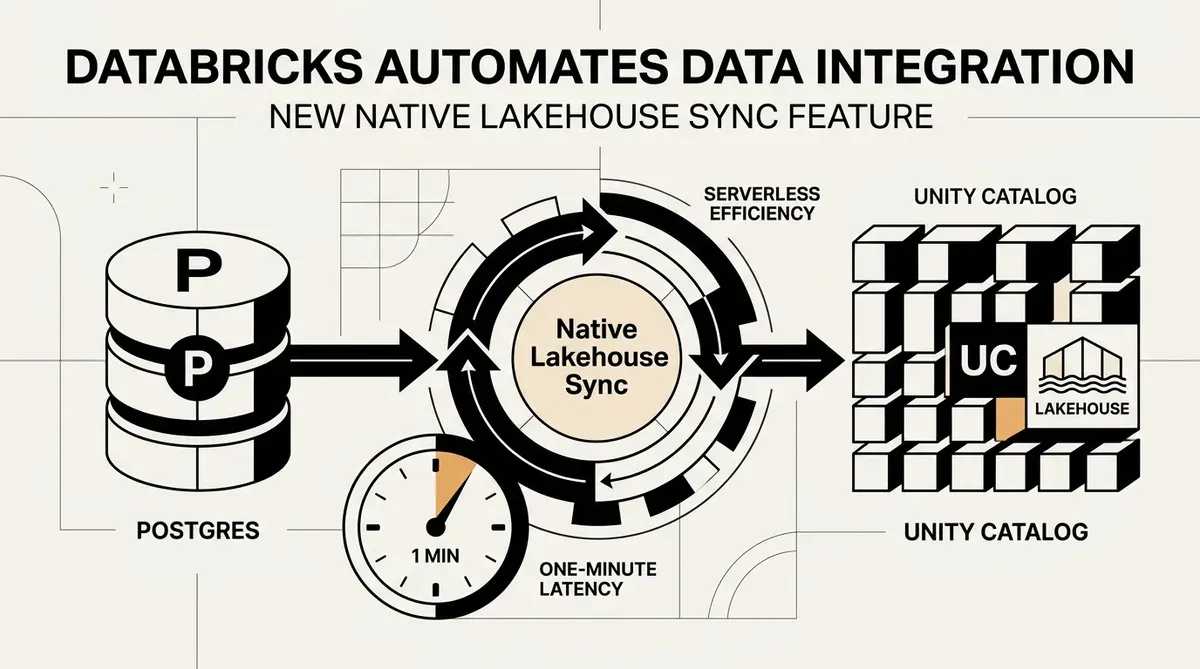
Databricks has launched the public preview of Native Lakehouse Sync, a serverless capability designed to automate data integration from external databases directly into the Unity Catalog. This new feature, announced on May 12, 2026, allows organizations to replicate data from sources such as Postgres into managed tables without maintaining external compute resources or building custom ETL pipelines. By removing these infrastructure requirements, the platform aims to reduce the technical debt typically associated with maintaining data freshness for machine learning and operational analytics.
The introduction of Native Lakehouse Sync addresses a persistent bottleneck in enterprise data architecture: the lag between operational databases and analytical environments. Databricks states that the system achieves synchronization latency of approximately one minute. This near-real-time performance is intended to support live machine learning features and operational data history tracking through Slowly Changing Dimension (SCD) Type 2 support. Because the architecture is serverless, it scales to zero when not in use, potentially lowering the total cost of ownership for data ingestion tasks.
Strategic Impact of Native Lakehouse Sync
For technical leaders, the primary value of Native Lakehouse Sync lies in its ability to handle automatic schema propagation. When source tables change, the Unity Catalog managed tables update accordingly, reducing the manual intervention required by data engineers. This automation is a key part of the Databricks strategy to consolidate data governance and processing within a single environment, further distancing the lakehouse model from traditional, fragmented data warehouse architectures.
The move also intensifies the competition in the automated data movement market. By building native ingestion directly into the platform, Databricks is reducing the reliance on third-party integration tools. This integration ensures that data remains within the security and governance perimeter of the Unity Catalog from the moment of ingestion. For businesses, this means a more streamlined path from raw data in a transactional database to a production-ready model or dashboard.
As of May 2026, the service is available in public preview for Postgres sources via Lakebase. Databricks has indicated that this is the first step in a broader rollout of native connectors designed to simplify the data lifecycle. Organizations looking to implement this feature can now access it through their existing workspace configurations to begin migrating workloads into the serverless synchronization framework.
While we strive for accuracy, bytevyte can make mistakes. Users are advised to verify all information independently. We accept no liability for errors or omissions.
AI-generated image.
Related Articles
- Databricks Launches No-Code Excel Integration to Democratize Lakehouse Data Access
- Databricks Launches Genie Agent Mode for Data Analysis
- Databricks Unity AI Gateway Adds Agentic AI Governance
✔Human Verified