
Databricks Launches Context Engineer Associate Certification to Standardize AI Agent Reliability
Databricks debuts the Context Engineer Associate certification to help enterprises build reliable, context-aware AI agents with standardized data governance.
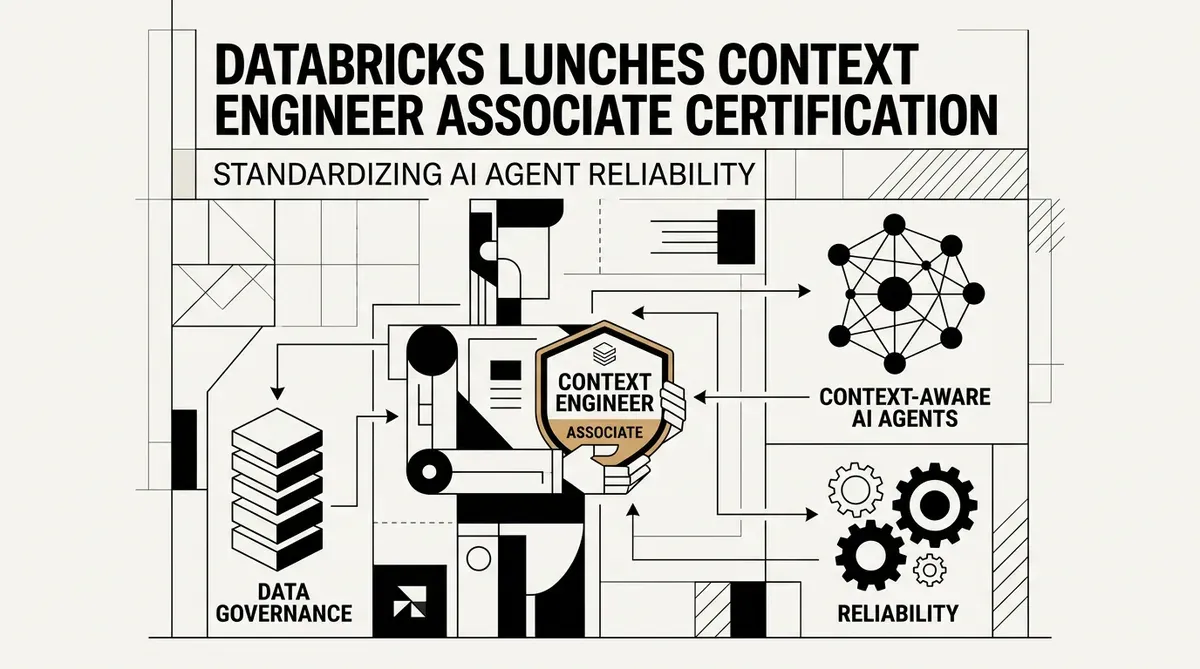
Databricks has launched the Context Engineer Associate certification, marking the first industry credential focused specifically on the management of data context for autonomous AI agents. This new program arrives as enterprise leaders shift from experimental generative AI projects toward deploying reliable AI systems that can operate within strict corporate guardrails. The certification aims to standardize the skills required to design and govern the information environments that power agentic workflows.
The introduction of the Context Engineer Associate certification addresses a growing technical gap in the AI market. While many developers understand how to prompt a large language model, few possess the specialized knowledge needed to curate the high-quality, real-time data feeds that allow AI agents to make accurate decisions. By formalizing this role, Databricks is positioning context engineering as a distinct discipline essential for the next phase of enterprise automation.
The Strategic Importance of the Context Engineer Associate
Reliability remains the primary hurdle for businesses looking to move AI agents into production. Unlike standard chatbots, autonomous agents require precise data retrieval and governance to avoid hallucinations and security breaches. The Context Engineer Associate program focuses on three core pillars: designing context-aware architectures, managing data freshness, and implementing safety protocols. These skills ensure that AI systems have access to the right information at the right time while adhering to compliance standards.
This move by Databricks signals a broader industry trend where the value of AI is shifting from the model itself to the data that surrounds it. As foundation models become increasingly commoditized, the competitive advantage for enterprises lies in how effectively they can ground these models in their proprietary data. The certification provides a framework for organizations to verify that their technical teams can handle the complexities of RAG (Retrieval-Augmented Generation) and agentic orchestration at scale.
The curriculum for the Context Engineer Associate credential covers the full lifecycle of AI context management. This includes the technical nuances of vector databases, semantic search, and the integration of structured and unstructured data sources. By mastering these areas, engineers can reduce the latency of AI responses and improve the overall accuracy of automated tasks. This technical proficiency is necessary for industries like finance and healthcare, where even minor data inaccuracies can lead to significant operational risks.
The launch comes just ahead of the Data + AI Summit 2026, where the company is expected to further integrate these context-focused tools into its core platform. For CTOs and technology strategists, this certification offers a roadmap for workforce development. Investing in context engineering expertise allows firms to build more resilient AI applications that are less prone to error and easier to audit. As autonomous systems become more prevalent, the ability to manage AI context will likely become a standard requirement for data engineering and AI development teams. Organizations that prioritize these skills early will be better positioned to capitalize on the efficiency gains promised by the next generation of agentic AI.
While we strive for accuracy, bytevyte can make mistakes. Users are advised to verify all information independently. We accept no liability for errors or omissions.
Sources
AI-generated image.
Related Articles
- Databricks Debuts Agent Bricks for Managed Corporate AI Workflows
- Databricks Launches Genie Agent Mode for Data Analysis
- Databricks: Memory Scaling for AI Agents is Key Design Axis
✔Human Verified