
DeepSeek API Price Hike Signals End of Ultra-Cheap AI Era
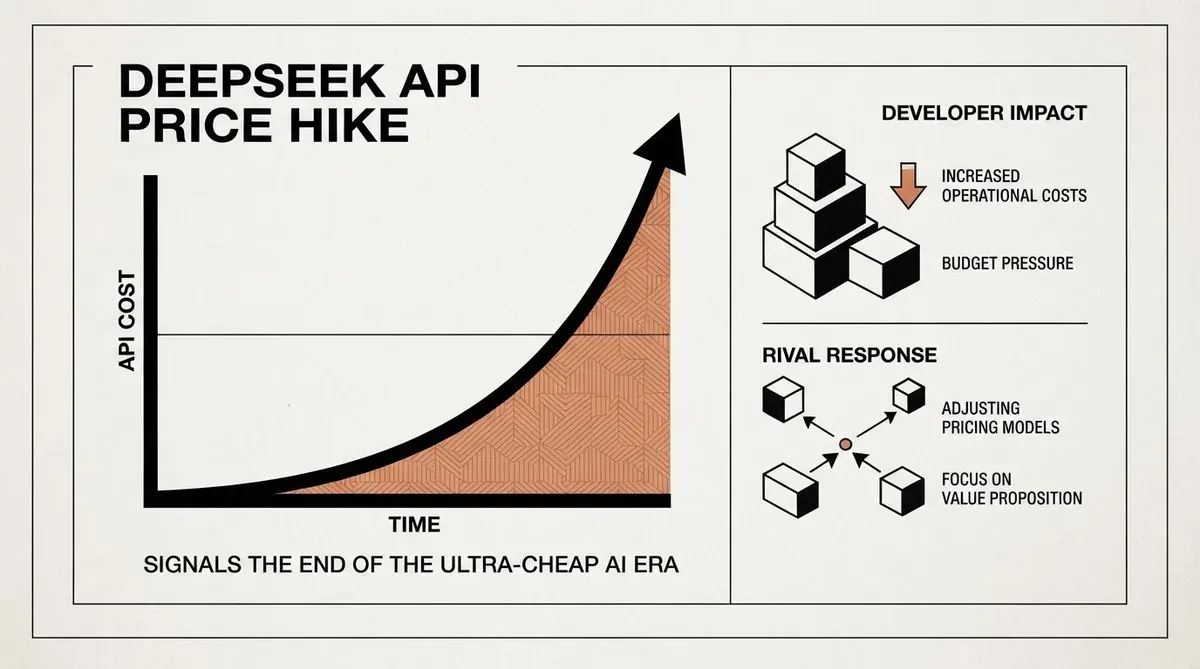
Developers using DeepSeek's API will soon pay more. The Hangzhou-based lab, whose low-cost models set the floor for global inference pricing, posted a developer notice last week saying the increase will be substantial. It disclosed no percentage and no effective date. The DeepSeek API price hike is the clearest signal yet that the AI price war the company started is moving into a new phase.
DeepSeek built its reputation on being the cheapest credible model provider in the market. Earlier this year it matched an 80 percent price cut from OpenAI within hours, and aggressive discounting on its v4-flash model unleashed demand that its infrastructure could not absorb. Traffic climbed to roughly 7 trillion tokens per week, straining a compute fleet of about 20,000 GPUs and exposing the gap between giveaway pricing and the real cost of serving that volume.
The demand surge is the root cause of the DeepSeek API price hike. When compute is fixed and traffic keeps climbing, price is the only rationing tool a vendor has, and DeepSeek appears to be reaching for it. At 7 trillion tokens a week, giveaway pricing becomes a subsidy the company now has to unwind.
What is driving the DeepSeek API price hike
The company's own documentation names the pressure points: rising compute costs, capacity bottlenecks, and heavy traffic on the v4-flash and v4-pro models. The warning lands less than a month after DeepSeek introduced time-of-day billing in mid-July, with peak-hour rates set at twice the off-peak price. Read together, the two steps describe a vendor shifting from a volume-at-any-cost strategy to one that prices according to demand and scarcity.
Current published rates show how far below market DeepSeek has been operating.
| Tier | Input tokens (per 1M, cache miss) | Output tokens (per 1M) |
|---|---|---|
| DeepSeek v4-flash | $0.14 | $0.28 |
| DeepSeek v4-pro | $0.435 | $0.87 |
Both tiers carry a 1 million-token context window with a maximum output of 384,000 tokens, plus JSON output, tool calls, and Anthropic-compatible API endpoints. Cached input is billed well below the miss rate, which matters for workloads with stable prompt prefixes. v4-pro support was scheduled to reach the platform in early August, so the hike arrives just as DeepSeek expands its higher-priced tier.
The notice itself was sparse. The warning appeared as a banner inside the API developer console, a placement that reaches active users directly, and told them to plan usage accordingly. DeepSeek said specific plans would be advised later, with no percentage and no effective date. What the company did disclose is the scope: the increase applies to overall pricing across the API, not to a single model or tier.
How large could the increase be
The word significant leaves a wide range, but the competitive math narrows how big the DeepSeek API price hike can be. Zhipu AI charges about $1.40 per million input tokens for its GLM-5.2 first-party API, roughly ten times DeepSeek's current v4-flash rate. Even a doubling of the v4-flash price would leave DeepSeek five times cheaper than that benchmark, and the company's pricing edge remains substantial on a global scale even after the planned adjustment. That margin is why DeepSeek can call the increase significant without pricing itself out of the market.
That room also explains why the hike reads as monetization rather than capitulation. The move prices the models closer to what demand allows after a year of subsidizing usage to win market share, while keeping the cost leadership position intact. Goldman Sachs argued in a research note published in early July that China's AI model price war was nearing its end, and the sequence since then, from time-of-day billing to the current warning, matches that call. The open question facing the whole industry is whether the era of subsidizing to scale up is over, and whether DeepSeek's pull comes from extreme cost performance or from the strength of the models themselves. The same question sits at the center of the company's identity under founder Liang Wenfeng, who built its reputation as the market's price slasher.
Who feels the hike
The DeepSeek API price hike lands first on developers and startups whose unit economics were built on DeepSeek's rates. Applications priced around $0.14 per million input tokens will need headroom scenarios, because the increase applies across the API surface rather than to a single tier. Teams running stable prompt prefixes have one cheaper lever: moving workloads to cached input, where DeepSeek bills far below the miss rate. Workloads dominated by cold-start traffic have no such lever and will feel the full increase. The practical effect is a rising floor: the ultra-low baseline that developers priced against for the past year is ending.
Self-hosting is the other escape route, and it caps how high DeepSeek can push prices. The models are open source, so any company with spare GPU capacity can run them at internal cost, and every price increase makes that option more attractive for high-volume workloads. If the hosted price rises too far, DeepSeek risks pushing its heaviest users onto their own infrastructure.
Switching costs are also lower than for most vendors, because the API speaks the same format as Anthropic's. Teams can retarget the same request structure at another provider without rewriting the integration layer, a pricing ceiling that proprietary rivals do not face.
Competitors are watching the same math. Moonshot, ByteDance, and Tencent can follow the hike upward and repair their own margins, or hold their discounts and try to pull price-sensitive customers away from the market's best-known low-cost brand. Either outcome reshapes competition across China and the wider Asia-Pacific market, where DeepSeek's prices have been the reference point for months.
DeepSeek's position in the market explains why the announcement matters beyond the company itself. Its open-source models became the reference price for the entire industry, the benchmark that rivals had to match or undercut, and companies around the world built products on its API. A price increase at that anchor resets the comparison point that every other provider's pricing is measured against, and its effects reach beyond DeepSeek's own customers.
What to watch next
Because the size and date of the DeepSeek API price hike are still unannounced, developers are pricing against an unknown. The size of the hike will reveal intent: a correction toward breakeven looks different from a repositioning of the models as premium products. Either way, the move tests the core of DeepSeek's appeal, namely whether its pull comes from cost performance or from the quality of the models themselves.
For decision-makers, the practical step is to model several pricing scenarios now and track how Moonshot, ByteDance, and Tencent respond, since their moves will set the next price floor. Enterprises with large inference spend should treat the announcement as a trigger to revisit vendor contracts and internal cost models. Review cache utilization, revisit the self-hosting case for high-volume workloads, and keep the Anthropic-compatible integration portable. The competitive gap will narrow without closing, but the direction is set: the vendor that anchored the price floor is signaling that the floor is moving up, which gives every other provider room to raise their own prices.
Why this matters
The DeepSeek API price hike is the moment the AI price war flips direction. Companies that budgeted for ultra-low inference costs must reprice, and the direction of the curve matters more than the size of this one increase. If the low-cost leader is monetizing scarcity, the rest of the market has room to follow, and the cost of AI inference starts moving up instead of down.
Sources
Models & Pricing | DeepSeek API Docs
AI-generated image.
Related Articles
- DeepSeek V4 Pro Adoption Surges as US Firms Pivot to Low-Cost AI Models
- DeepSeek Funding Round Targets $7.4 Billion as Valuation Hits $59 Billion
- DeepSeek Funding Round Targets $10B Valuation
✔Human Verified
Researched and cross-referenced against primary sources by the Bytevyte editorial team. This article was generated with the assistance of artificial intelligence and reviewed by the Bytevyte editorial team.