
DeepSeek Funding Round Tops $12 Billion, Led by Tencent and CATL
DeepSeek funding round tops $12 billion, led by Tencent and CATL, ahead of an early-2027 IPO that will test China's AI capital concentration.
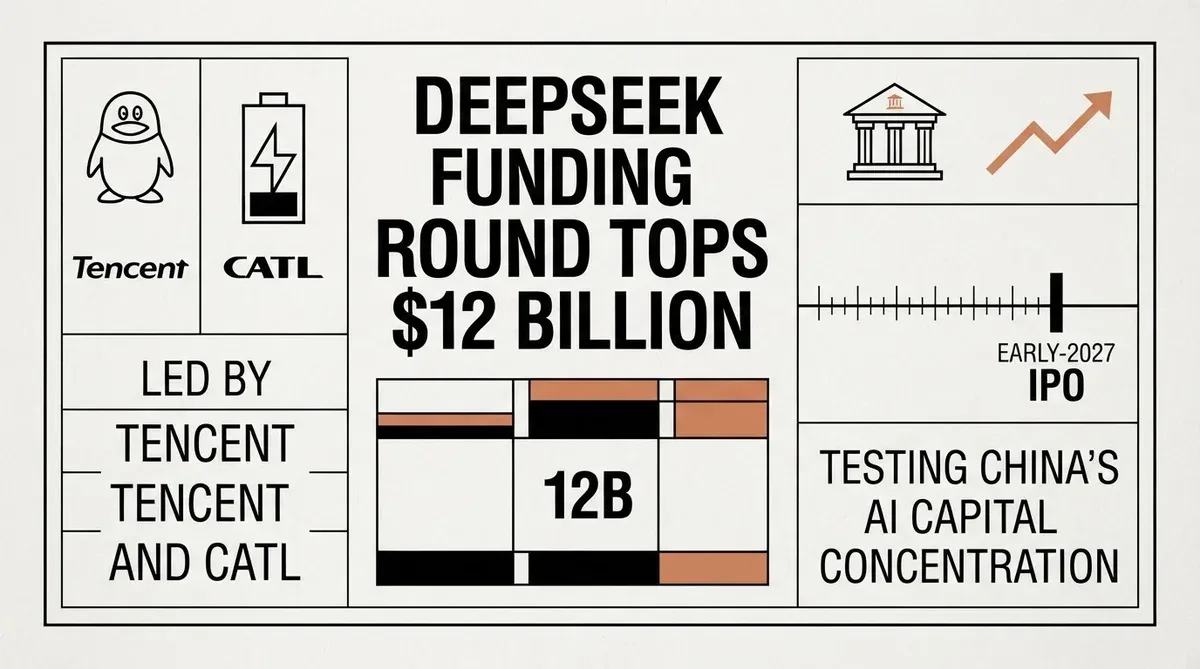
DeepSeek has outrun its own fundraising target. The Chinese model developer is finalizing a DeepSeek funding round worth at least 80 billion yuan, or roughly $12 billion, ahead of a share listing planned for early 2027. Tencent Holdings and battery manufacturer CATL are leading the deal, which clears the ceiling DeepSeek set for itself and ranks among the largest private AI financings ever assembled in Asia.
I want to be precise about what this raise is and what it is not. It is not a verdict on DeepSeek's models alone. It is a bet that China's frontier-model market will consolidate around two or three domestic labs, and that DeepSeek is one of them. The valuation, the listing timetable and the benchmark claims all hang off that single thesis.
Inside the DeepSeek Funding Round
The headline figure is the 80 billion yuan floor, and the fact that it exceeds the company's own target tells you how much demand the book attracted. DeepSeek's last known valuation sat near $74 billion before these talks. Raising $12 billion against that base implies the company and its backers expect a meaningfully higher number by the time it lists.
| Item | Detail |
|---|---|
| Round size | At least 80 billion yuan (~$12 billion) |
| Lead investors | Tencent Holdings, CATL |
| Last known valuation | About $74 billion |
| IPO target | Early 2027 |
The structure of the deal matters as much as the size. Having Tencent and CATL anchor the round lets DeepSeek raise at a scale few single Chinese funds could comfortably underwrite alone, and it spreads the concentration risk that regulators and investors have grown sensitive to. It also ties the company to two of the most strategically important corporate balance sheets in the country.
Tencent's presence is the easier one to read. The company runs one of China's largest cloud and consumer internet businesses, and a stake in DeepSeek gives it early access to a model family it can embed across its messaging, cloud and enterprise tools. Tencent has already invested across a wide slice of China's AI sector, so this looks less like a single bet than an extension of an existing strategy.
CATL is the more interesting name. The world's largest battery maker has spent the past two years pushing into energy storage and data-centre power, and AI training clusters are now among the most power-hungry infrastructure categories on earth. A financial stake in a model developer gives CATL a commercial relationship with a class of customer whose electricity and backup-storage needs are growing fast.
The $74 Billion Question
Here is the strongest argument against my read. DeepSeek has repeatedly done more with less. Its models have been trained at costs Western labs struggle to match, and the recent V4 Flash release reinforced its reputation for shipping capable systems on a constrained budget. If any Chinese lab can turn $12 billion into a durable franchise, the bulls argue, it is this one.
I take that point seriously, and I still think it misses what the DeepSeek funding round is actually testing. Cheap training gets you a competitive model. It does not get you a distribution network, a compliance apparatus, a developer ecosystem or the compute to serve hundreds of millions of users. Those are the things $12 billion buys, and they are the things DeepSeek has historically been thinnest on.
Valuation is where the arithmetic gets uncomfortable. A $74 billion mark already prices DeepSeek alongside listed software companies with years of recurring revenue. Every incremental dollar of the new round raises the bar for the 2027 listing, because public-market investors will apply a discount to a business whose revenue base is still largely unproven at that scale.
Why China's Capital Is Concentrating
The consolidation pattern is the real story here, and it reaches well beyond one company. Chinese capital is clustering behind a small number of domestic model developers rather than spreading across dozens of hopefuls, the way US venture money did during the last wave. That concentration has a logic: frontier training is capital-intensive, export controls limit access to the most advanced chips, and a fragmented field wastes scarce compute.
The consequence is a two-tier market. A handful of labs, DeepSeek among them alongside the teams behind Alibaba's Qwen and a few well-funded challengers, will have the balance sheets to keep training at scale. Everyone else either specializes in narrow applications or gets absorbed. For enterprise buyers in China, that narrows the vendor shortlist and raises switching costs once a model is embedded in production.
There is a counterweight to all this momentum, and it is hardware. Export controls continue to shape how much leading-edge compute Chinese labs can buy, which caps how fast any of them can scale training runs. A $12 billion balance sheet helps, but money does not manufacture advanced accelerators. That constraint is why the round reads as a race for position rather than a solved problem.
For buyers outside China, the practical question is different. A DeepSeek flush with Tencent and CATL money will keep pricing aggressively, which pressures Western labs to defend their own cost-per-token figures. It also means the compliance and data-residency questions that already surround Chinese models will not fade; if anything, deeper domestic backing makes them sharper.
Competitors will feel it first at the API layer. DeepSeek has built a following among developers who care about cost per million tokens, and a larger balance sheet lets it hold prices down longer than rivals that need each training run to pay for itself. That is a direct threat to labs whose margins depend on premium pricing.
The Road to a 2027 Listing
The early-2027 IPO target gives the round a clear purpose. This is pre-listing capital, sized to carry the company through disclosure and diligence without a follow-on. That timing also leaves DeepSeek roughly a year to convert a larger war chest into revenue lines a public-market investor can underwrite, whether that is API usage, enterprise contracts or licensing.
The word DeepSeek's own framing keeps returning to is landmark, and the label holds up. A successful listing would give China's AI sector its first true public benchmark, a listed comparable that investors can use to price every private lab behind it. That is why the round size matters less than what the eventual prospectus discloses.
Three signals are worth tracking from here. Whether the final round lands above the $12 billion floor, which would point to even heavier demand. Whether Tencent or CATL take board seats or strategic-partnership roles beyond the equity. And whether DeepSeek publishes revenue or usage figures ahead of the listing, because that disclosure is where the $74 billion valuation gets tested in public.
Why this matters
For anyone building on or competing with Chinese AI, this raise reframes the next year. The money in China is consolidating rather than spreading, and DeepSeek will enter 2027 with more capital and more powerful backers than at any point in its history. Companies that planned around a fragmented Chinese market should plan instead around a shortlist.
AI-generated image.
Related Articles
- DeepSeek Funding Nears $7.4 Billion Record with Tencent and CATL Support
- DeepSeek Targets $45 Billion Valuation in $10 Billion Funding Round
- DeepSeek IPO Valuation Hits $71 Billion as Capital Needs Surge
✔Human Verified
Researched and cross-referenced against primary sources by the Bytevyte editorial team. This article was generated with the assistance of artificial intelligence and reviewed by the Bytevyte editorial team.