
Deutsche Börse Automates Migration of 2,000 Data Notebooks Using Databricks Genie
Deutsche Börse uses Databricks Genie to automate the migration of 2,000 notebooks, cutting developer workload by 80% and meeting a critical 2027 deadline.
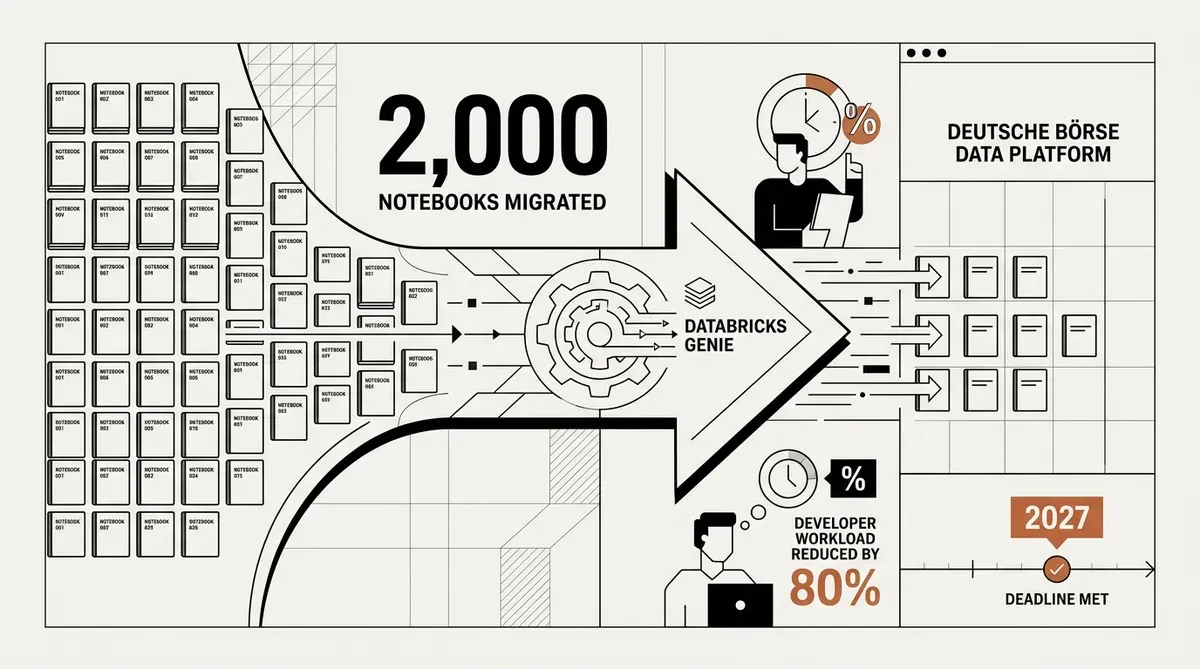
Deutsche Börse Group has deployed a custom generative AI solution to automate the migration of more than 2,000 data notebooks to the Databricks Data Intelligence Platform. The initiative, led by the company's StatistiX team, addresses a 2027 deadline triggered by the decommissioning of its existing Cloudera-based Zeppelin environment. By using Databricks Genie and specialized prompting techniques, the financial services provider reduced the manual effort required for each notebook migration by approximately 80%.
The migration project involves transitioning business logic, SQL queries, and Python code from legacy Zeppelin notebooks. Deutsche Börse developed a dedicated Databricks App to manage this process, focusing on high-quality prompting rather than complex agentic architectures. This choice allows the system to reconstruct logic while maintaining the context necessary for financial data processing. The automated tool completes in 20 minutes what previously required hours of developer time.
Strategic Impact of Databricks Genie in Financial Services
The use of Databricks Genie is central to the technical success of this migration. By separating structural conversion from logic reconstruction, the StatistiX team ensured that the generative AI could handle the nuances of financial calculations without losing structural integrity. This approach reflects a trend among enterprise leaders to favor targeted AI applications over broad, general-purpose implementations for legacy modernization.
For CTOs and technology strategists, the Deutsche Börse case study provides a blueprint for handling large-scale technical debt. The project demonstrates that generative AI is a bridge between legacy infrastructure and modern cloud platforms. By automating the most repetitive aspects of code translation, the group has freed its engineering talent to focus on higher-value data products and analytics. This shift is necessary for maintaining a competitive edge in financial markets where data agility is a primary differentiator.
The technical architecture of the migration tool includes a user interface built with shadcn, providing a streamlined experience for the developers overseeing the transition. This interface allows users to trigger the structural conversion and then pass the more complex logic tasks to the AI engine. By keeping a human in the loop for final verification, the group maintains the high standards of accuracy required for financial reporting and statistical analysis.
The 2027 deadline for the Cloudera decommissioning remains a firm target for the group. With the new AI-driven workflow in place, Deutsche Börse is positioned to complete the transition of its 2,000 notebooks ahead of schedule. This deployment demonstrates the effectiveness of the Databricks ecosystem in executing rapid, large-scale digital transformations within highly regulated industries. The group will continue refining these AI tools as it moves more core statistical workloads to the cloud.
While we strive for accuracy, bytevyte can make mistakes. Users are advised to verify all information independently. We accept no liability for errors or omissions.
Sources
AI-generated image.
Related Articles
- Databricks Launches Genie Agent Mode for Data Analysis
- Mercedes-Benz Cloud Egress Costs Cut 66% via Data Mesh
- Databricks Debuts Agent Bricks for Managed Corporate AI Workflows
✔Human Verified