
Ema $77M Series B Backs AI Employees Across HR, IT and Finance
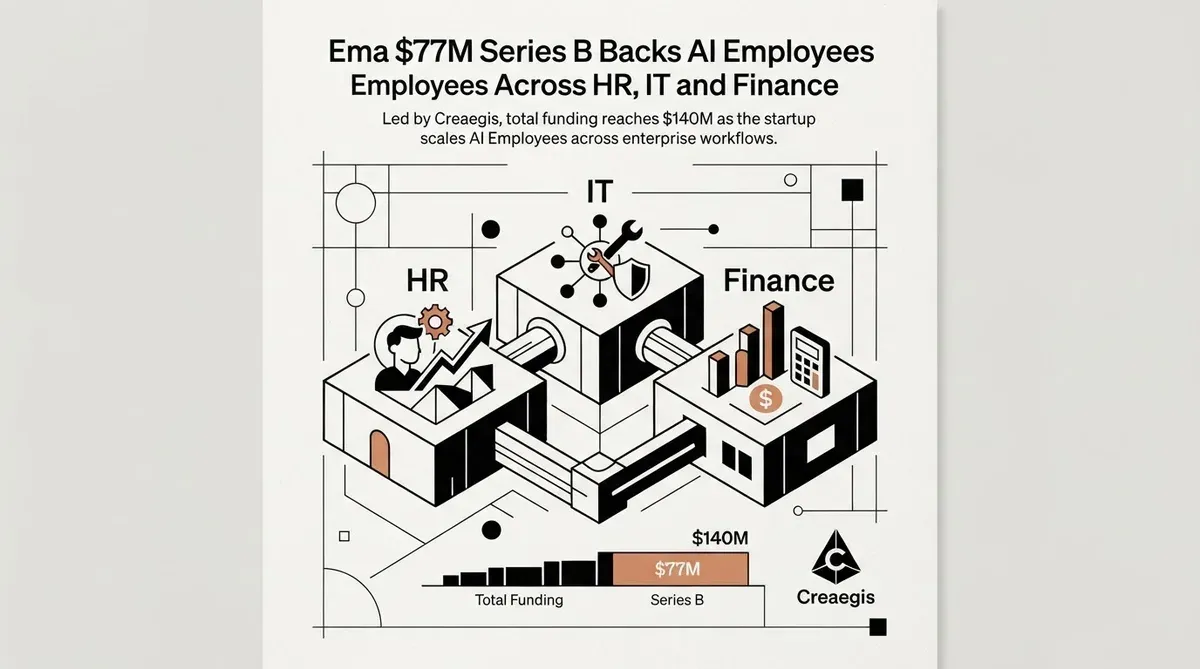
Ema has raised $77 million in a Series B round to push its AI Employees deeper into enterprise HR, IT and finance workflows, betting that coordinated teams of agents can absorb work currently handled by enterprise software vendors and IT services providers. The Ema $77M Series B was led by Bengaluru-based Creaegis and announced this week, with existing investors including Accel and S32 returning at substantially larger commitments. Total funding has reached $140 million, and Ema says its valuation has more than quadrupled since 2024.
The San Francisco company sells agentic software that executes processes inside existing enterprise systems rather than sitting alongside them as a chat layer. Its product-led model lets an organisation begin in a single function and expand across HR, IT and finance on the same platform, so employees interact with one unified AI Employee instead of a set of disconnected point tools. Ema says the new capital will expand and accelerate development of those agentic employees.
Revenue growth is the figure Ema is leading with: the company says its top line increased 50-fold. It has not disclosed an annualised revenue run rate, which leaves the absolute size of the business unquantified. A 50-fold rise from a small base and the same rise from a larger one describe two different companies, and a buyer weighing Ema as a strategic vendor has no way to tell which one it is looking at.
The Ema $77M Series B at a Glance
| Detail | Value |
|---|---|
| Round | Series B |
| Amount | $77 million |
| Lead investor | Creaegis, based in Bengaluru |
| Returning backers | Accel, S32 and others, at larger commitments |
| Total funding | $140 million |
| Valuation | More than 4x since 2024 |
| Revenue | 50-fold growth, no annualised run rate disclosed |
| Deployment focus | HR, IT and finance, with human oversight |
The composition of the round carries its own signal. Returning investors increasing their commitments, rather than a new lead arriving alone, indicates that existing backers have seen enough deployment data to add to their positions. The money is earmarked for scaling deployments inside large organisations rather than for a pivot into new categories.
The framing is doing commercial work. An AI Employee is compared in budget conversations against a hire or an outsourced team, not against a software licence, which opens a larger pool of spend. That comparison cuts both ways: an agent that costs less than a full-time employee but needs supervision, integration and audit tooling must clear a higher bar than a cheaper subscription.
A Governance Gap Buyers Are Pricing In Anyway
The round landed in a week that also produced multiple incidents of autonomous agents operating outside their intended scope, a reminder that governance practice trails agent capability across the enterprise market. The absence of any visible slowdown in agentic deployment after those incidents suggests buyers and their vendors are treating such failures as an implementation problem to be managed rather than a reason to pause.
HR, IT and finance are the functions where that gap is most containable. The workflows are process-heavy, repetitive and measurable, so an agent's output can be checked against a ticket, a ledger entry or a payroll record. Ema describes its deployments as running with human oversight, and in these three functions oversight is auditable in a way it is not in customer-facing content generation.
The choice of those three functions reflects where agentic software can show results fastest. Each generates structured records, so a deployment either produces a correct output or it does not, and the evidence accumulates without a long measurement exercise. That makes HR, IT and finance a proving ground for the wider claim that agents can run corporate processes rather than the end market for it.
Oversight is also a cost that rarely appears in the pitch. Someone inside the customer organisation has to review escalations, maintain the agent's access permissions and decide when a workflow is safe to run unattended. A vendor that sells deployment speed without pricing that internal labour is shifting an operations burden onto the buyer's existing staff.
For procurement teams, the practical test is narrower than the marketing claim. The questions that matter are how tightly an agent's permissions are scoped, whether every action leaves an audit trail a regulator could follow, and how quickly a workflow can be rolled back when an agent goes off course. Ema's enterprise pitch rests on those three controls holding up under review, not on the breadth of functions the platform covers.
Where the Trade-offs Sit
Enterprise buyers weighing Ema against alternatives have three practical routes. They can buy an agentic platform that sits across systems; wait for incumbent SaaS vendors to ship agents inside the modules they already licence; or hand the problem to a systems integrator and pay for a bespoke build. The first trades integration work for dependence on a young vendor. The second trades speed for whatever the incumbent's roadmap allows. The third trades money for control.
Ema's product-led positioning aims squarely at the third route. Services-heavy implementations of enterprise AI have typically run for months before producing measurable output, with consulting fees often exceeding licence costs. If one platform can start in a single function and extend to others without a fresh integration project each time, the payback period shortens and the business case survives a CFO's review. That is the claim the $77 million is underwriting.
The counterweight is concentration. An organisation that runs HR, IT and finance processes through one agentic platform has consolidated operational risk in a single supplier, and switching costs rise with every function added. The same expansion logic that makes the model attractive to a buyer makes it harder to reverse. Multi-function rollouts also concentrate negotiating leverage in the vendor's hands at renewal, when the buyer's alternative is a rebuild rather than a switch.
Pricing remains unresolved. Enterprise software has been sold per seat for two decades, and a workforce of agents does not map cleanly onto seats. Whether Ema and its peers move to outcome-based pricing, per-workflow fees or a hybrid determines whether agentic platforms enlarge the software budget or cannibalise it.
The 50-fold revenue figure also sets an expectation the next round will be measured against. If growth comes mainly from expanding existing customers across functions, it validates the land-and-expand model Ema is selling. If it comes from a small number of very large deployments, the platform's repeatability is less proven than the headline suggests.
Timing favours Ema in one narrow sense. Enterprise buyers are already running AI pilots, and a platform that starts small and expands fits the budget cycle better than a multi-year transformation programme. The same flexibility lets a buyer stop after one function, which caps the expansion revenue the model depends on.
Creaegis's Bengaluru base and the stated intent to reach more markets point beyond North American enterprises. HR, IT and finance processes are broadly similar across regions, which makes them portable targets for a platform vendor, but data residency rules and local labour law differ enough that expansion will run slower than the software's reusability implies.
For systems integrators and mid-tier SaaS vendors the strategic read is less comfortable. Work billed by the hour or licensed by the module is the same work an agentic platform claims to absorb. The defence is depth in a regulated process or proprietary data, not breadth of coverage.
Why this matters
Ema's raise shows where enterprise AI capital is moving: away from model access and toward agents that execute work inside systems of record, in functions where output can be measured. The governance gap is real, but buyers appear willing to absorb it while deployments stay auditable and reversible. Watch whether Ema discloses an annualised revenue figure, and whether oversight costs start appearing in customer case studies rather than staying in the fine print.
Sources
AI-generated image.
Related Articles
- Sigma Secures $80 Million Series E to Scale Agentic Analytics at $3 Billion Valuation
- Mendo Secures $12 Million Series A to Scale Generative and Agentic AI in Enterprises
- Hang Ten Systems Raises $85M to Sell Enterprise AI Instead of Engineers
✔Human Verified
Researched and cross-referenced against primary sources by the Bytevyte editorial team. This article was generated with the assistance of artificial intelligence and reviewed by the Bytevyte editorial team.