
Etched transformer-only chip nears $20B valuation
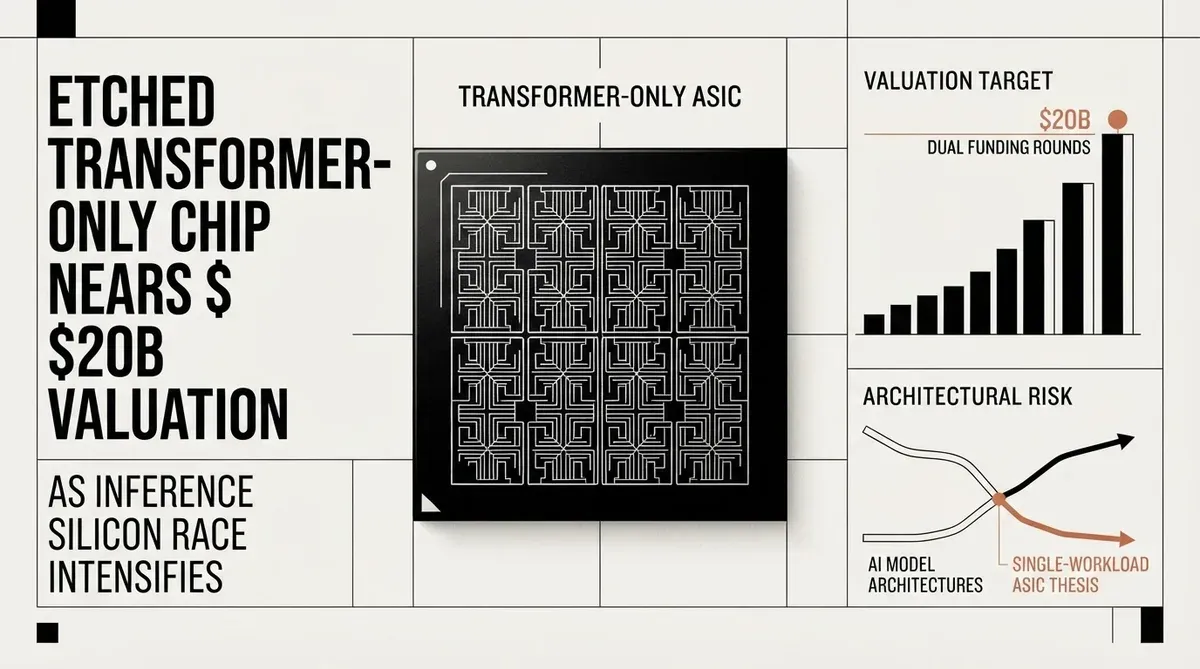
Etched has entered the top tier of AI hardware startups with a dual-round funding structure unusual even for the inference-silicon market. The company builds a custom ASIC called Sohu that is a hard-coded Etched transformer-only chip, designed at the silicon level for transformer-model inference and nothing else. The startup is simultaneously pursuing two funding rounds: one at a $10 billion valuation led by Sequoia Capital and another at a $20 billion valuation led by Jane Street. This comes just weeks after the startup exited stealth around June 30 at a $5 billion valuation. The quadrupling of its mark in days says more about investor hunger for Nvidia alternatives than about the company's revenue trajectory.
Etched has reported $800 million in total funding and about $1 billion in customer orders for the chip. Founders Gavin Uberti and Robert Wachen, both Harvard dropouts and Thiel fellows, built the Sohu ASIC with TSMC as the manufacturer. Production on the chip began earlier this year, reflecting a rapid transition from design to silicon for a startup that only entered public view two weeks ago.
The Architecture Bet Behind the Etched Transformer-Only Chip
The valuation surge reflects a specific thesis about the future of AI inference hardware that carries both promise and risk. The Sohu chip eliminates all programmable circuitry that a general GPU would need to handle different types of neural network computations. By locking the silicon at the transistor level to only run transformer attention mechanisms, the company claims it can deliver faster and cheaper per-token inference than an equivalently priced Nvidia GPU cluster.
This is a legitimate engineering trade-off. A general-purpose GPU like Nvidia's H100 or B200 must allocate transistors to handle CUDA flexibility, memory management across multiple kernel types, and a broad instruction set. The Etched transformer-only chip strips all of that away, dedicating every transistor to the matrix multiply and attention operations that power transformer architectures. For a narrow slice of the total AI market (pure transformer inference), this approach can achieve higher throughput at lower cost per token. The question is how narrow that slice remains over time.
Why the Dual-Round Structure Matters
The concurrent pursuit of rounds at two different valuations is where the story becomes more interesting than a standard funding announcement. Raising money at $10 billion with Sequoia while simultaneously negotiating a $20 billion round led by Jane Street suggests investor demand for access to this company is not uniform. Some backers are willing to pay a steep premium, while others anchor at a lower mark.
This structure allows Etched to bring in strategic partners at different price points without forcing all investors to agree on a single valuation. But it signals something about the market's assessment of the company's risk profile. The $10 billion round, anchored by a top-tier venture firm, may represent a more cautious base case for what the company is worth today. The $20 billion round reflects a premium paid by investors who believe the transformer-only thesis will dominate the inference market before competitors can respond.
I find this dual structure telling. It suggests that even the investors most enthusiastic about Etched could not agree on a single price. When a company has to raise money at two different valuations simultaneously, it usually means the clearing price for its equity is ambiguous. Some buyers are willing to pay more for a larger allocation, while others want a discount. The signal is not uniformly bullish.
The Architectural Concentration Risk
Here is where my position diverges from the prevailing enthusiasm. The entire Etched thesis depends on one assumption: that transformer architectures will remain the dominant paradigm for AI models for the lifespan of the Sohu chip's relevance. This is a bet worth examining critically.
Transformers are currently the foundation of virtually every major language model, including GPT, Claude, Gemini, Llama, and their derivatives. The attention mechanism that transformers popularized has proven remarkably effective across text, vision, and multimodal tasks. But the history of AI research suggests that architectural dominance is rarely permanent. Convolutional networks once seemed unbeatable for vision tasks. Recurrent networks were the standard for sequence modeling. Both were displaced by transformers within a few years.
Etched's ASIC approach means the company cannot pivot if a new architecture emerges. A general GPU can run any algorithm a developer writes. The Sohu chip can run only transformer inference. If the next paradigm-shifting model architecture, whether a state-space model like Mamba or a recurrent alternative, gains adoption, Etched's silicon loses its value proposition. The company would need a new tape-out, a new manufacturing run, and a new sales cycle to respond. That cycle takes years in the semiconductor industry.
This is not a hypothetical concern. Several research groups have published work on alternatives to the transformer architecture that match or exceed its efficiency on specific tasks. Linear attention mechanisms, state-space models, and hybrid approaches have all shown promise. None has yet displaced the transformer at scale, but the pace of AI research means that architectural risk is real and material. The Etched transformer-only chip is a bet on the status quo holding long enough to recoup the investment.
What the $1 Billion in Orders Actually Means
The reported $1 billion in customer orders provides real validation of the thesis. Customers who are buying the Sohu chip are making a bet of their own: that their inference workloads will remain transformer-based long enough to justify investing in specialized hardware. For hyperscale inference providers running known transformer architectures at high volume, the cost savings from purpose-built silicon may outweigh the risk of architectural lock-in.
But the size of the order book, while impressive, should be read in context. Nvidia's data center revenue in the most recent quarter was well over $30 billion. The broader inference silicon market is orders of magnitude larger than $1 billion. Etched has secured a toehold in a market dominated by a company with vastly more resources and a roadmap that includes purpose-built inference chips of its own, including the B200 and future architectures designed specifically for transformer workloads.
Nvidia is not standing still. The company's silicon roadmap includes increasingly specialized tensor core designs that narrow the efficiency gap between general-purpose GPUs and ASICs for transformer inference. Nvidia can also bundle its hardware with a software ecosystem, including CUDA, TensorRT, and Triton Inference Server, that Etched cannot hope to replicate in the short term. Customers evaluating the Etched transformer-only chip must weigh the hardware performance advantage against the software integration cost.
Why this matters
Etched is a genuine attempt to challenge the GPU monoculture in AI hardware, and the market's willingness to assign a $20 billion valuation to a company that has not yet shipped at scale shows how desperate investors are for alternatives to Nvidia's dominance. But the single-workload ASIC thesis carries architectural risk that no amount of funding can eliminate. If transformers remain dominant, Etched's backers will look prescient. If the architecture shifts (and the history of AI suggests it will eventually), the company's valuation could collapse as quickly as it rose. For decision-makers evaluating inference infrastructure, the central question is not whether Etched can deliver superior transformer performance. The question is whether betting on a single architectural future is the right move in a field where the only constant is change.
AI-generated image.
Related Articles
- Intel and Musk Unite for $25 Billion Terafab AI Chip Manufacturing Venture
- Applied Materials and TSMC Partner at EPIC Center to Advance AI Chip Scaling
- Intel Surpasses $300 Billion Valuation and Confirms Intel Terafab Partnership
✔Human Verified
Researched and cross-referenced against primary sources by the Bytevyte editorial team.