
EU AI Gigafactory Project Stalls as Funding Gaps and Delays Alienate Partners
The EU's €20B AI Gigafactory plan faces critical delays and a collapse in partner interest, threatening Europe's goal of AI infrastructure independence.
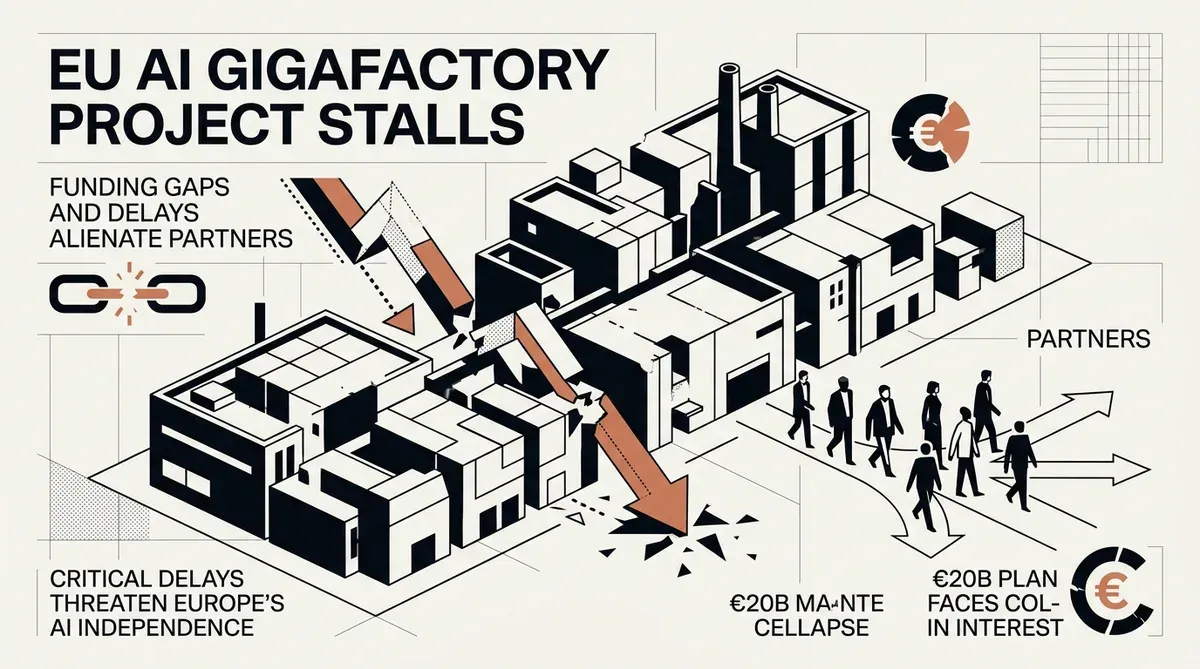
The European Union faces a significant setback in its attempt to establish domestic high-performance computing infrastructure as its AI Gigafactory initiative encounters severe delays. This week, the bidding deadline for the €20 billion project was pushed to July 2026, a move that has reportedly caused a sharp decline in private sector interest. The plan, which aims to build five massive data centers across the continent, is a cornerstone of the EU strategy to reduce reliance on American hyperscalers like Microsoft and Amazon Web Services.
The AI Gigafactory project was originally designed to provide the massive compute power necessary for training frontier AI models within European borders. However, the number of interested corporate partners has collapsed from an initial 70 companies to approximately 10. This exodus of potential collaborators stems from a combination of shifting deadlines and unresolved funding gaps that have made the multi-billion euro investment less attractive to private consortia.
Strategic Implications of the AI Gigafactory Delays
The primary goal of the AI Gigafactory network is to encourage European technological sovereignty. By providing local infrastructure, the EU intended to support regional startups and research institutions that currently depend on foreign cloud providers. The current stall in the bidding process threatens to widen the competitive gap between European AI developers and their counterparts in the United States and China, who benefit from more established and rapidly expanding data center footprints.
Industry analysts suggest that the funding issues are particularly damaging because of the capital-intensive nature of AI hardware. Building five world-class facilities requires not only the €20 billion in public and private capital but also a stable regulatory and financial environment. As the bidding window moves further into 2026, the risk is that the technology slated for these centers may become outdated before construction even begins.
Challenges for European Sovereignty
The struggle to maintain partner interest highlights the difficulty of coordinating large-scale industrial policy across the member states. While the EU has been proactive in regulating artificial intelligence through the AI Act, the physical infrastructure required to power these systems is proving harder to secure. The reduction in the number of active bidders suggests that the remaining consortia may have increased leverage in negotiations, potentially requiring even more public subsidies to move forward.
The European Union now faces a difficult choice between further delaying the project to find more partners or proceeding with a diminished group of stakeholders. With the new July 2026 deadline, the next twelve months will determine whether the AI Gigafactory remains a viable path for European compute independence or if the region will remain tethered to external infrastructure for the foreseeable future.
While we strive for accuracy, bytevyte can make mistakes. Users are advised to verify all information independently. We accept no liability for errors or omissions.
AI-generated image.
Related Articles
- Phoenix Group and DC Max Launch $8 Billion European AI Data Center Platform
- SoftBank and France Negotiate $100 Billion AI Infrastructure Partnership
- Earlybird Venture Capital Closes Record €360 Million Fund for AI and Deeptech
✔Human Verified