
Exein's $270M Raise Turns Physical AI Security Into a Standalone Market
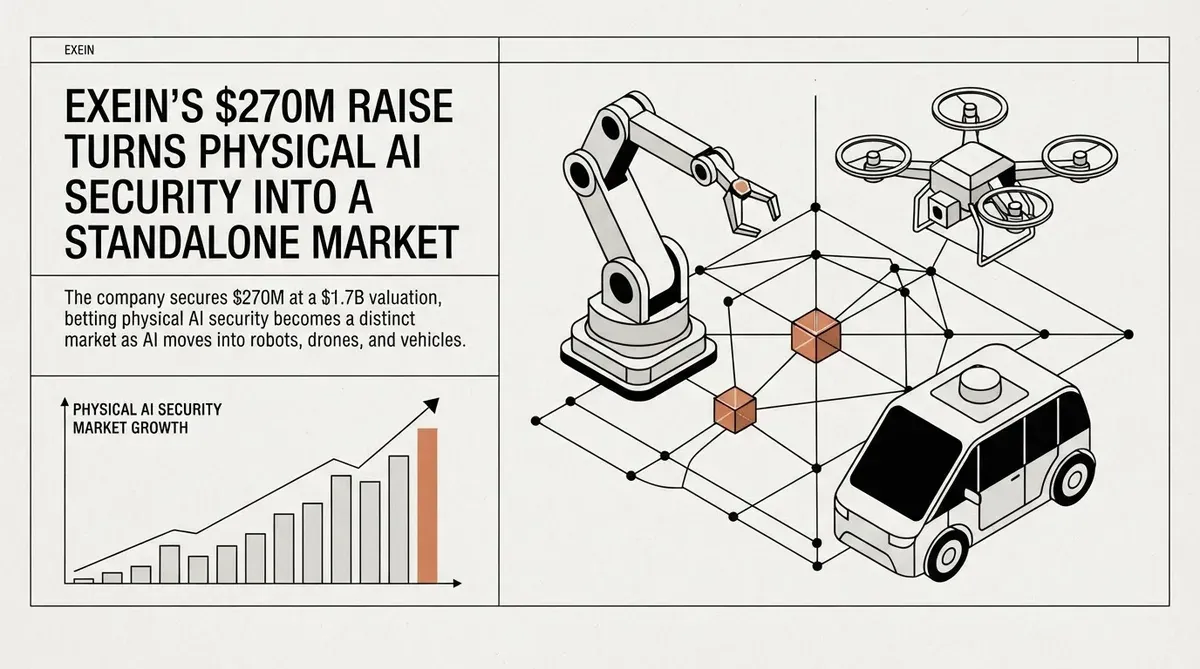
Exein has raised $270 million at a $1.7 billion valuation in a Series C led by Headline, a round that makes the Rome-based company the highest-valued cybersecurity startup in Europe. The deal, announced this week, pushes Exein's total funding past $600 million and prices it roughly thirty times higher than its Series B from about two years ago. The company's central claim is that physical AI security is a distinct market, separate from the endpoint and cloud protection that dominates the sector.
Exein was founded by Gianni Cuozzo and spent its early years in IoT security, protecting connected devices in factories, buildings and homes. As AI workloads moved out of data centers and into machinery, the company repositioned around robots, drones, autonomous vehicles and other intelligent machines running software in the physical world. It now reports coverage across more than 1.5 billion connected devices and about 5,000 new attack attempts each week.
The Layer Most Buyers Never Inspect
Exein's software sits in two places that rarely appear on a procurement checklist: firmware and the runtime. Firmware is the code baked into a device at manufacture. The runtime is what executes while the machine operates. Both sit below the operating system, out of reach for a conventional endpoint agent installed after the fact.
That placement drives the commercial logic. A robot arm on a production line, a delivery drone or a vehicle running inference at the edge cannot wait for a cloud security service to complete a round trip. Detection and response have to happen on the device, which is what Exein means when it describes protection at machine speed.
The threat model differs too. A compromised sensor feed or a tampered firmware image can turn a working machine into a hazard rather than a data breach. For buyers in manufacturing, logistics and automotive, the cost of a slow response shows up as halted output and physical damage.
Why Physical AI Security Is a Separate Market
Exein's route from IoT to physical AI is not a rebrand. Early IoT security mostly protected devices that reported data upward, and a breach meant corrupted readings or a hijacked sensor. Machines that run models locally make decisions and act, so a compromised runtime can produce motion rather than bad data. That difference changes what a security product has to do: it must bound behaviour on the device, in real time, without a human in the loop.
It also changes who pays. In conventional IT security, the buyer is a security team with a central budget. In industrial and automotive settings, the buyer is often an engineering or product organisation that owns the machine's certification and safety case. Exein's design-in model, where protection is embedded at manufacture, means revenue depends on long OEM sales cycles rather than self-serve adoption. The 1.5 billion device figure is the output of those relationships, accumulated over years.
What the Round Actually Contains
The headline number is $270 million, but the structure around it carries the strategy.
| Detail | Figure |
|---|---|
| Round | $270 million Series C (about €234 million), led by Headline |
| Post-money valuation | $1.7 billion (about €1.4 billion) |
| Total raised | More than $600 million |
| Prior round comparison | Roughly 30x valuation increase since Series B, about two years ago |
| Devices protected | More than 1.5 billion connected devices |
| Attack attempts | About 5,000 new attempts per week |
| Expansion targets | United States, Japan, South Korea |
The oversubscribed round and the geographic targets point to the same priority. Exein intends to convert a European base into a global sales footprint, with the United States and APAC named as the two regions for expansion.
Where the Growth Has to Come From
The capital is earmarked for two things: accelerating Exein's push into the United States and APAC, and deepening the platform itself. That combination is less common in a Series C for security, where growth rounds typically fund sales headcount first. Exein is spending on distribution and research at the same time, which raises the execution burden on a company that must now sell into automotive and industrial accounts with long qualification cycles. The oversubscription Exein reports suggests investor demand outran the amount on offer, which gives the company room to set its own pace on hiring rather than chase a fixed growth plan.
A thirty-fold valuation step in two years sets a demanding bar, and it rests on a specific assumption: that buyers treat firmware and runtime protection as a standing budget line rather than a one-off compliance checkbox. If physical AI security remains a feature bundled into a hardware purchase, Exein's pricing power is limited. If regulators and insurers begin asking for evidence of device-level protection, it becomes a recurring cost of doing business.
Exein is also building a proprietary foundation model for physical AI security, a project it says has been in development for two years. The model is trained on machine telemetry gathered across the company's device footprint, data that describes how machines behave in operation rather than how humans type and click.
That data set is the part competitors would struggle to copy. Conventional security vendors train on network traffic, endpoint logs and human-generated content. A model built from machine behaviour inside industrial equipment and vehicles addresses a narrower problem with material Exein has collected at scale. The company also describes work on autonomous security agents, which would move response from rule-based automation toward systems that decide on their own.
The trade-offs are real. Machine telemetry from operational equipment is sensitive, and manufacturers are cautious about sharing data that reveals how their lines run. Long device lifecycles cut both ways: firmware shipped today stays in the field for a decade or more, which creates durable demand for updates and also means a vulnerability, once found, has a long window in which to be exploited.
Incumbents in endpoint and operational technology security have distribution Exein lacks, and large equipment makers can build protection in-house. Exein's answer is the layer argument: whoever owns firmware and the runtime holds a position that sits beneath every application a customer later deploys, and that position is hard to displace once it is embedded at manufacture.
The Verdict
Exein's raise is best read as a repricing of physical AI security as its own category. The company is not competing for the same budget line as laptop antivirus or cloud workload scanning; it is asking industrial and automotive buyers to fund a control point inside the machine. On the evidence, the bet is credible. Coverage across 1.5 billion devices and about 5,000 weekly attack attempts describe a live threat surface rather than a projected one.
What remains unproven is whether that threat surface converts into pricing power at the scale a $1.7 billion valuation requires. The foundation model is the clearest signal of intent, because it shifts Exein from a protection vendor into a data business built on machine behaviour.
For decision-makers, the practical question is where device-level security sits in their own stack. Teams deploying robots, drones or connected vehicles should map which supplier owns firmware updates and runtime monitoring, and whether that supplier can respond without a cloud round trip. Buyers evaluating Exein specifically should weigh its telemetry advantage against the concentration risk of depending on a single startup for a layer that is difficult to replace after deployment.
Why this matters
As AI moves from software into machines, the security control point shifts from the data center to firmware and the runtime. Exein's valuation is an early price on who controls that layer, and it recasts physical AI security as a market in its own right rather than an extension of endpoint protection. The foundation model now in development is the next checkpoint: if it ships and industrial customers accept it, device-level protection stops being a bundled feature and becomes infrastructure that buyers budget for directly.
Sources
AI-generated image.
Related Articles
- Exaforce Secures $125M to Scale Agentic Security Operations Platform
- XPeng Robotics Funding Round: Humanoid Unit Valued at $6.3B in Record Raise
- Generalist AI Funding Round Secures $400 Million to Advance Physical AGI
✔Human Verified
Researched and cross-referenced against primary sources by the Bytevyte editorial team. This article was generated with the assistance of artificial intelligence and reviewed by the Bytevyte editorial team.