
Firmus IPO Seeks $5 Billion as Losses Test AI Data-Center Appetite
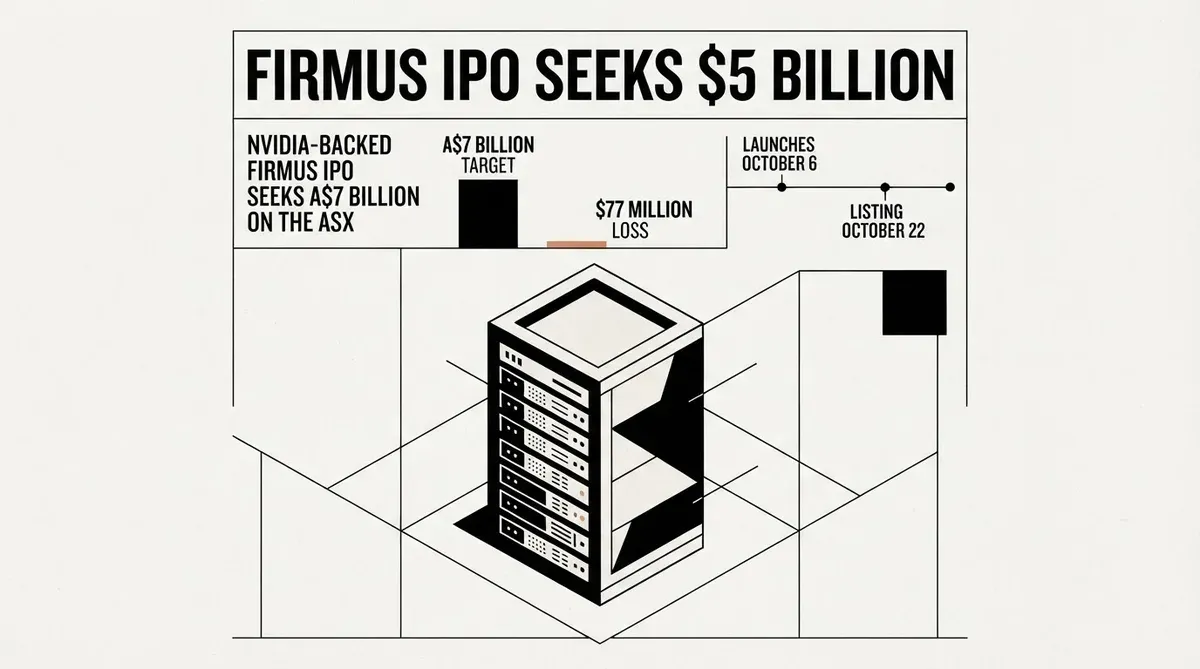
The Firmus IPO will test a question the AI infrastructure trade has spent two years avoiding: can a data-center operator with no profit list at a multi-billion-dollar valuation? Firmus Grid Ltd., an Nvidia-backed operator running AI capacity in Australia and Singapore, is seeking at least A$7 billion, roughly $5 billion, on the Australian Securities Exchange. The institutional offer opens on October 6, the prospectus is due on October 8, and trading is scheduled to begin on October 22.
I think the deal says more about the market than about the company. A raise this large, the second-biggest in Australian history behind Telstra's 1997 float, is possible only while capital is hungry for AI exposure. Firmus is asking investors to buy forward capacity rather than earnings, and it is doing so while carrying a pro forma first-half loss of about $77 million.
That combination is either the defining feature of the AI buildout or the definition of a bubble. I lean toward the first, with conditions attached.
Inside the Firmus IPO
Strip out the headline figure and the Firmus IPO has an unusually specific shape. The base deal targets A$7 billion, and a greenshoe could add up to A$500 million if demand runs hot. Retail bidding runs from October 12 to 19, wedged between the institutional launch and the debut.
| Deal term | Detail |
|---|---|
| Target proceeds | A$7 billion (about $5 billion) |
| Greenshoe option | Up to A$500 million |
| Institutional launch | October 6 |
| Prospectus lodgement | October 8 |
| Retail bidding window | October 12 to 19 |
| ASX trading debut | October 22 |
| Founder escrow | 10% of shares released after year one |
The escrow terms deserve more attention than they are getting. Founders cannot sell down freely, with only a tenth of their holdings released after the first year. That cuts against the standard criticism of infrastructure listings, where early backers treat the float as an exit ramp. It also keeps the free float thin, which tends to amplify price swings during the first year of trading.
The schedule is compressed in a way worth noting. Firmus lodges its prospectus on October 8, opens retail bidding four days later, and lists two weeks after that. Institutional investors get roughly a fortnight between launch and debut, a short window for the scrutiny a raise of this size would normally attract. Speed favours the issuer when appetite is strong and the window could close.
The Loss Is Not a Footnote
Firmus expects a pro forma loss of roughly $77 million in the first half. For a data-center operator, early losses are structural. Accelerators and halls are depreciated over years while revenue ramps, so a company building five new Asia-Pacific sites on top of existing Australian and Singapore capacity will report red ink long before it reports margins.
Whether Firmus loses money today matters less than whether the capacity behind those losses is already contracted. Every site under development is a capital commitment before it becomes a revenue line, and the gap between the two is what the October 8 prospectus has to close. If it discloses long-term agreements with creditworthy buyers, the loss is a timing artifact. If it discloses a pipeline and a demand thesis, the loss is the business model.
That distinction determines whether A$7 billion is a fair price or an act of faith.
The $10 Billion Backstop
Firmus is negotiating a $10 billion financing package that combines debt and equity ahead of the listing. I read that as the load-bearing element of the whole story. If the package closes, IPO proceeds become expansion capital. If it does not, the raise has to carry more of the buildout on its own, and the equity story gets thinner with every quarter of construction.
The debt half of that package carries its own logic. Infrastructure lenders price against contracted cash flows, so the size of the facility Firmus can close is itself a signal about how much of its revenue book is locked in. A large debt tranche would suggest banks have seen contracts. An equity-heavy structure would suggest they have not.
Nvidia's involvement is why this listing draws attention well beyond Sydney. The company is a backer, and for an operator buying accelerators by the rack, proximity to the largest supplier of AI compute hardware is an operational advantage rather than a branding exercise. It is also a signal about where Nvidia expects compute demand to land geographically.
The proceeds are earmarked for expansion rather than for paying down obligations, which says a lot about how Firmus reads its own runway. A pipeline of five sites under development across Asia-Pacific demands continuous capital, not a single cheque. That also explains the timing: capacity is being signed now, and the company would rather raise equity while buyers are still committing than wait for the window to narrow.
An ASX Test, Not Just a Firmus Test
The comparison that will be made for years is Telstra's 1997 privatisation, still the largest listing in Australian market history. Firmus would slot in behind it. That framing flatters the deal and obscures a real difference: Telstra listed a mature, cash-generative incumbent, while Firmus is listing construction and contracts. The question is not whether the ASX can absorb A$7 billion, but whether Australian public markets have the institutional depth to track a company whose assets span several jurisdictions and whose earnings depend on compute pricing that moves quickly.
For other operators in the region, the outcome sets a benchmark. If the Firmus IPO prices well and trades up, Asia-Pacific data-center developers get a public-market comparable to point at when raising. If it breaks issue price, the private market's willingness to fund new capacity at current valuations faces its first real test in this cycle. Either way, the price it clears at will be quoted as a market signal long after October 22.
The Case Against My Caution
The strongest counter-argument is that AI capacity is sold before it is built. If Firmus has pre-committed its halls to hyperscalers and AI labs on multi-year terms, the reported loss reflects depreciation on assets that are already spoken for, and the economics look far better than the headline suggests. Australia and Singapore both sit close to the Southeast Asian demand corridor, and power-constrained markets in the region have made available capacity scarce.
I find that argument plausible and still insufficient. Pre-commitment only matters if counterparties are named and terms are disclosed. A term sheet tells you the size of a raise; it does not tell you the quality of the revenue behind it. Until the prospectus lands, the deal is priced on appetite, not on evidence.
My position is straightforward. I would rather pay a higher multiple for a company with disclosed contracted revenue than a lower one for a compelling demand narrative. The listing is also a referendum on the ASX's ability to host large technology infrastructure deals, which matters for every Australian operator that follows.
Watch the escrow release schedule and the debt component of the financing package as closely as the headline number. Those two details will say more about the risk in this deal than the A$7 billion figure will.
Why this matters
The Firmus IPO is the first chance for ordinary public investors in Australia to buy direct exposure to AI data-center capacity, and the terms they accept will set the price for every operator that follows. A successful listing tells the market that forward capacity is bankable; a weak one tells founders that the private capital which built this cycle will not be replaced by public money at the same valuations. For anyone trying to judge whether AI infrastructure spending is sustainable, the October 22 debut is a cleaner read than any forecast.
AI-generated image.
Related Articles
- Firmus AI Infrastructure Funding Reaches $10.5B Valuation
- Data Center Opposition Meets Wall Street: Why $198B in Stalled Projects Is Now an IPO Problem
- Nvidia, OpenAI and Anthropic line up for the Australian AI data center push
✔Human Verified
Researched and cross-referenced against primary sources by the Bytevyte editorial team. This article was generated with the assistance of artificial intelligence and reviewed by the Bytevyte editorial team.