
Fujitsu Launches Self-Evolving Multi-Agent AI for Autonomous Enterprise Workflows
Fujitsu unveils a self-evolving multi-agent AI that adapts to business changes autonomously, optimizing enterprise workflows through continuous learning.
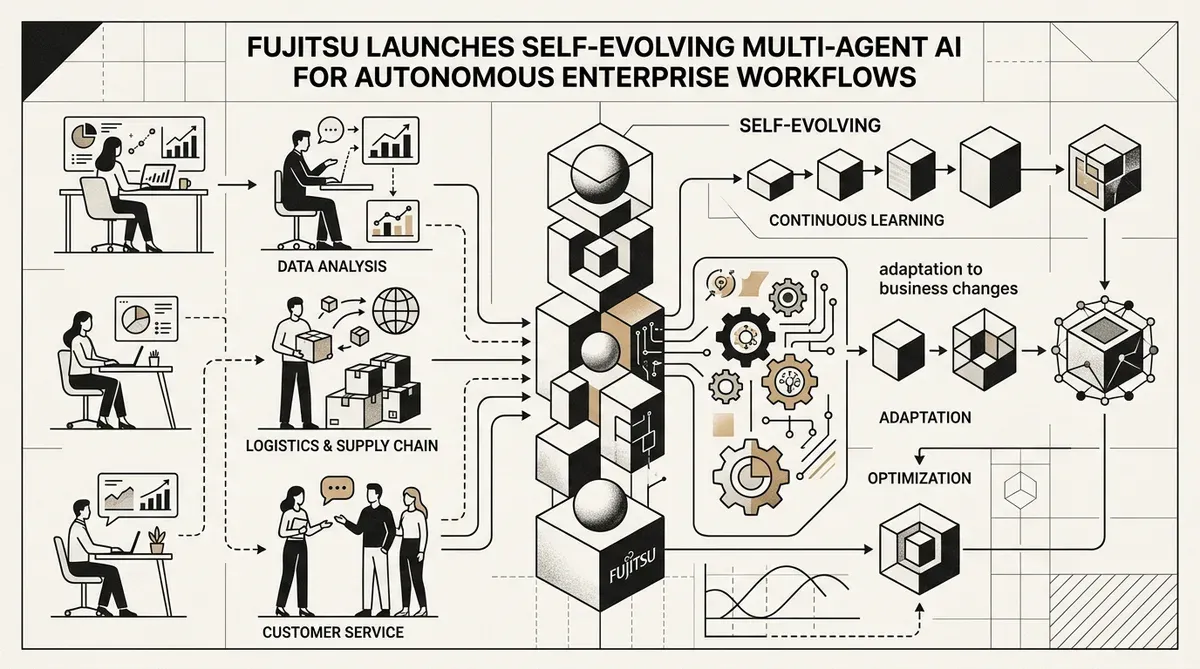
Fujitsu has introduced a self-evolving multi-agent AI system designed to automate and optimize complex business processes without constant manual intervention. The technology, announced on May 25, 2026, uses a network of specialized AI agents that learn from operational outcomes and human feedback to refine their own workflows. This platform aims to solve the rigidity often found in traditional enterprise automation by allowing systems to adapt to changing business rules and environmental shifts autonomously.
The core of the system is its ability to analyze the specific reasons behind the success or failure of a given task. When a group of agents executes a business process, the technology evaluates the results against established specifications and human input. If a failure occurs or a more efficient path is identified, the agents generate and apply operational improvements across the entire multi-agent ecosystem. This feedback loop ensures that the AI does not just repeat tasks but improves its performance over time based on real-world data.
Strategic Impact of Self-Evolving Multi-Agent AI
For enterprise leaders, the self-evolving multi-agent AI is a shift from static robotic process automation toward dynamic, autonomous orchestration. Traditional AI deployments often require significant manual updates when business specifications change or when new regulations are introduced. Fujitsu's approach minimizes this maintenance burden by enabling the AI to incorporate new rules and specifications into its learning model automatically. This capability is particularly relevant for sectors with high volatility or complex compliance requirements, such as finance and logistics.
The technology also addresses the transparency gap in multi-agent systems. By identifying the factors that lead to specific outcomes, the system provides a level of explainability that is often missing in "black box" AI models. Decision-makers can see why an agent chose a particular action and how human feedback influenced subsequent improvements. This transparency is a key requirement for scaling AI in regulated industries where accountability is paramount.
Fujitsu plans to integrate this technology into its broader suite of business process optimization tools. The system is designed to handle large-scale enterprise task orchestration, where multiple departments and software platforms must interact seamlessly. As of May 2026, the company is focusing on deploying the technology for clients looking to automate complex workflows that previously required constant human oversight to manage exceptions and updates.
While we strive for accuracy, bytevyte can make mistakes. Users are advised to verify all information independently. We accept no liability for errors or omissions.
AI-generated image.
Related Articles
- Fujitsu and CMU Launch Physical AI Research Center
- Microsoft Debuts Frontier Success Framework
- Lenovo AI Library Debuts to Speed Up Enterprise Agentic AI Deployment
✔Human Verified