Gemini 4 Hydrogen is now available from Google at a cost of $1.50 for input and $7.50 for output per million tokens
Google has set the price of Gemini 4 Hydrogen at $1.50 for every million input tokens and $7.50 for every million output tokens, one rate that applies…
Listen
Google has set the price of Gemini 4 Hydrogen at $1.50 for every million input tokens and $7.50 for every million output tokens, one rate that applies across the entire 1-million-token context window. The model launched on November 12, 2026, and takes the place of Gemini 3.8 Flash throughout Google's products. For developers, cost is the key consideration: the model is quicker and more capable than its predecessor, yet it charges more per token than the low-cost tier that many teams rely on for everyday tasks.
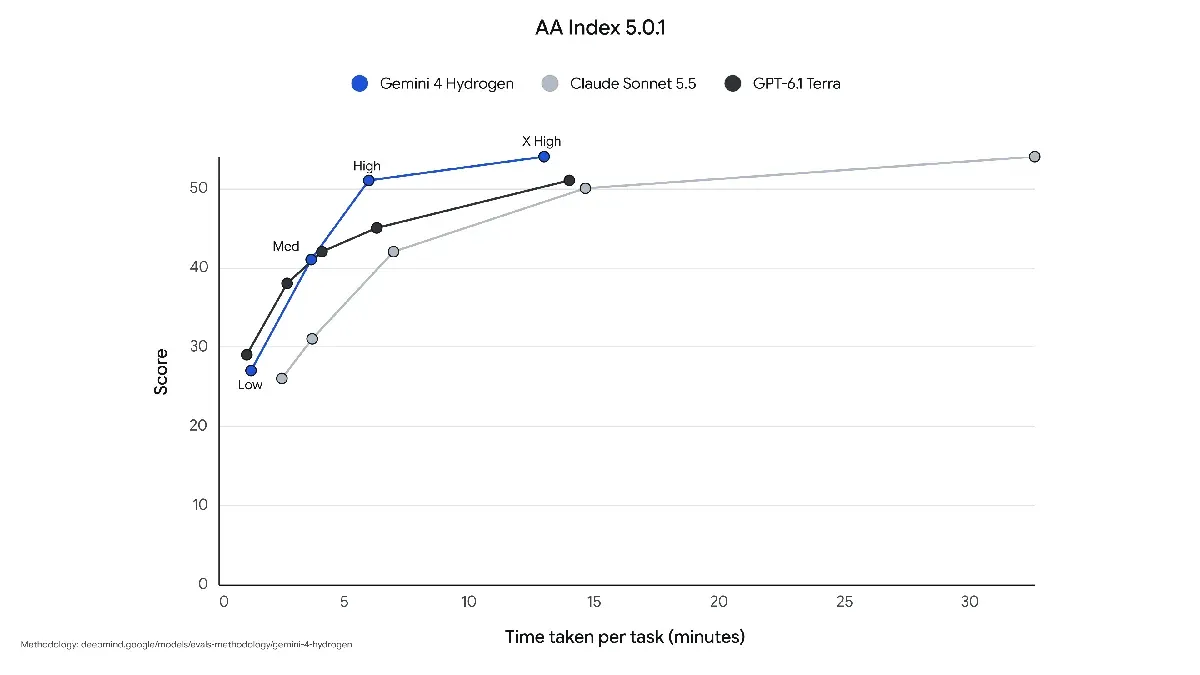
Google says Hydrogen finishes jobs 2.5 times faster than Gemini 3.8 Flash at its default high thinking level. On the Artificial Analysis Intelligence Index, Google reports a score of 51 at that setting, one point above Gemini 4 Argon, and 54 at the xhigh setting. Hydrogen sits below the Carbon and Argon models in Google's lineup, which the company positions for long-horizon reasoning.
Price against the budget tier
The price gap is the main trade-off. VentureBeat reports that Hydrogen costs about 15 times the lowest standard uncached rates of Claude Haiku 5.5, GPT-6 Luna and Muse Ember, which are reportedly $0.10 per million input tokens and $0.50 per million output tokens. Google lists a cached input rate of $0.075 per million tokens and no introductory promotion for the standard tier. Batch and Flex are reportedly priced at half the standard rates, with Batch targeting a 24-hour turnaround.
Google also reports that Orchestrator, a feature in Google Antigravity that switches between Carbon and Hydrogen in one session, reached near-Carbon task success on Terminal-Bench 4.0 while using 24% less quota and finishing 19% faster. Those figures come from Google's own testing. For teams that already run Carbon, a mixed setup could shift routine execution to the cheaper model without changing the frontier model used for architecture decisions.
What the performance claims do not show
Most of the speed and quality figures are vendor-reported. Google states that Hydrogen more than triples the Terminal-Bench 4.1 score of 3.8 Flash, at 57% against 18.2%, and that it cuts fabricated claims by more than 5x. Partner testing on graph, SQL and data-heavy workflows reportedly showed 2x to 2.8x speedups and 12% to 23% lower token use. Google has not published per-task cost data, so the effective cost of a finished task against rivals remains unmeasured.
The access terms also differ by product. Hydrogen is available in the Gemini API, Google AI Studio, Gemini for business and Google Search, while paid AI Pro and Ultra subscribers get it in Google Antigravity. Ars Technica reports that Carbon and Argon, currently priced at $2 and $10 per million tokens, rise to $4 and $20 next month. If that change lands as reported, Hydrogen's price advantage over the frontier models would shrink from the current 1-to-1.
We would not treat Hydrogen as a like-for-like Flash replacement until teams have measured cost per completed task on their own workloads. The $1.50 and $7.50 rates are the figures to model, and the Carbon and Argon price change scheduled for next month is the next checkpoint for judging how Google positions the tier.
Sources
Related Articles
- Google's Gemini Live API Pricing Turns Voice Agents Into a Metered Commodity [Update]
- Google Hands Gemini 4 Argon to Cyber Defenders First, and Everyone Else Waits
- Gemini 4 Carbon Posts Top Ranking, Limits Early Access to Cyber Defenders
✔Human Verified
Researched and cross-referenced against primary sources by the Bytevyte editorial team. This article was generated with the assistance of artificial intelligence and reviewed by the Bytevyte editorial team.