
Google Custom AI Chip Gemini Development Targets Inference Cost Reduction
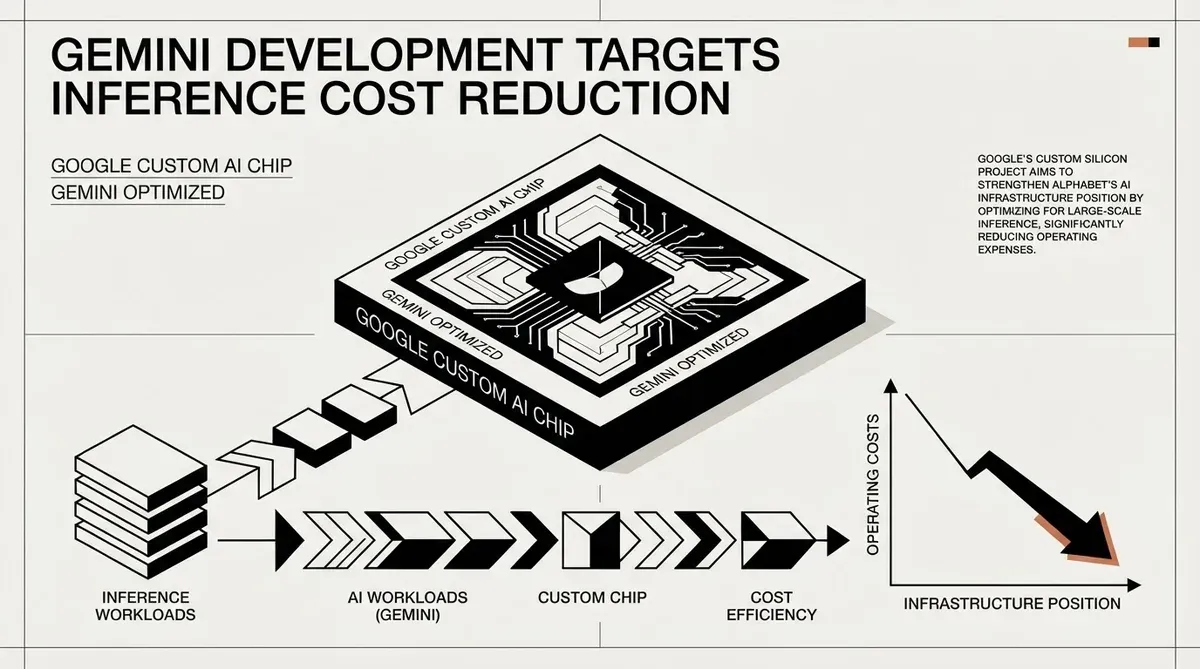
Google has begun building a custom semiconductor designed specifically to accelerate and reduce the cost of inference workloads for its Gemini large language models. The Google custom AI chip Gemini project, which multiple reports described as active within the company's internal hardware teams, focuses on optimizing the compute path from model weights to end-user response rather than relying on merchant silicon from NVIDIA, AMD, or Google's own Tensor Processing Units in their current form.
The move signals that Google sees inference efficiency as the next battleground in the AI infrastructure race. As of mid-July 2026, the chip effort is understood to be in development, with no public timeline for deployment. Alphabet shares rose on the news, reflecting investor confidence that tighter hardware-software integration can improve margin profiles in the company's rapidly growing AI services business.
Why Google Needs a Dedicated Inference Chip
Inference, the process of running a trained model to generate a response, accounts for the majority of compute cost once a model reaches production scale. Every Gemini query, whether through the consumer chatbot, enterprise API, or embedded Google Workspace features, consumes GPU or TPU cycles. At Google's deployment scale, even fractional per-query efficiency gains translate into hundreds of millions of dollars in annual infrastructure savings.
General-purpose GPUs, while dominant for training, are overprovisioned for many inference tasks. They carry memory bandwidth, parallel processing, and precision capabilities that large-scale serving does not always need. A custom inference chip can strip away unused features, add specialized datapath logic for transformer attention mechanisms, and integrate tightly with Google's in-house software stack including the TensorFlow and JAX ecosystems.
Google is not a newcomer to custom silicon. The company's TPU line, now in its sixth generation, has powered both training and inference for years. But the TPU was architected as a general-purpose accelerator for TensorFlow workloads writ large. The new chip, by contrast, appears purpose-built for the specific computational patterns of large transformer-based language models, a narrower but increasingly dominant workload class.
Market Reaction and Competitive Context for the Google Custom AI Chip Gemini
Alphabet's stock price gained ground following the report, a sign that the market views custom inference silicon as a lever for sustaining AI gross margins. Analysts have pointed out that as Google, Microsoft, Amazon, and Meta deploy AI at scale, infrastructure cost is emerging as a key differentiator. Companies that can serve a high-quality model for a fraction of the per-query cost gain pricing flexibility and can afford to offer more generous free tiers to capture users.
The competitive environment in inference silicon is heating up. Amazon has its Trainium and Inferentia chips running inside AWS. Microsoft has co-developed the Maia accelerator. Meta is investing in custom silicon through its internal infrastructure group. The Google custom AI chip Gemini initiative would place the company in direct competition with all three cloud rivals on the hardware layer, not just the model layer.
What sets Google apart is the depth of its full-stack integration. The company designs the model architecture (Gemini), the training framework (JAX), the deployment platform (Vertex AI), and the serving infrastructure (Cloud TPU). Adding a custom inference chip tuned specifically to Gemini's transformer topology closes the loop. Every layer of the stack can be co-optimized without the abstraction penalties that come with off-the-shelf hardware.
What the Chip Likely Targets
While Google has not released technical specifications, industry patterns suggest several design priorities for a Gemini-optimized inference chip. Sparse computation support would allow the chip to skip zero-weight connections in pruned or distilled models, reducing effective FLOPs per query. Lower-precision arithmetic, INT4 or even binary precision for certain layers, can cut memory bandwidth requirements dramatically when model quality permits. A large on-chip SRAM cache optimized for transformer attention matrices would reduce off-chip memory hops, which are the dominant latency cost in autoregressive generation.
The chip may also incorporate dedicated decoding logic for speculative decoding and other latency-reduction techniques that Google has published research on. These methods use a smaller draft model to predict multiple tokens per forward pass, then verify them against the full model, a pattern that benefits from tight coupling between a small, fast compute unit and the larger model's attention engine.
Efficiency improvements in inference do not just cut costs. They enable product decisions that would otherwise be prohibitive. Longer context windows, real-time voice interactions, and multi-turn agentic workflows all multiply the compute cost per session. A chip that halves the per-token cost makes these features financially viable at scale, which directly expands the addressable use cases for Gemini across Google's product suite.
Strategic Implications for Google's AI Roadmap
The custom chip initiative fits a broader pattern at Google: bringing critical AI infrastructure in-house to escape dependency on external suppliers and to capture the integration margin. NVIDIA's H100 and B200 GPUs command premium pricing partly because they are general-purpose, and partly because the CUDA ecosystem locks in software dependencies. A Google inference chip that runs Gemini models with higher efficiency than any purchased GPU would serve as both a cost shield and a competitive moat.
The timing also aligns with the maturation of the RISC-V architecture as a viable foundation for custom accelerators. Google has been an active contributor to the RISC-V ecosystem, and an inference chip built on an open ISA would give the company full architectural control without licensing fees tied to Arm or x86. This would represent a departure from the TPU lineage, which uses a proprietary systolic array design.
For Google Cloud customers, the implications are significant. If the inference chip becomes available through Vertex AI, it could offer lower per-token pricing for Gemini models compared to competing offerings from AWS and Azure, creating a pricing wedge in the cloud AI market. Enterprises running large-scale summarization, classification, or agent workflows would be the primary beneficiaries.
There is execution risk. Custom silicon development cycles are measured in years, not quarters. Tape-out, validation, and qualification of a new chip at data-center scale is a multi-billion-dollar bet that can go wrong if the model architecture shifts faster than the hardware can adapt. Google's research teams continue to push the boundaries of transformer alternatives such as state-space models, mixture-of-experts routing, and recurrent architectures, any of which could change the compute profile that the chip was designed to optimize.
Nevertheless, the strategic logic is clear. The companies that win the AI platform war will be those that deliver the best intelligence at the lowest cost. Hardware is the largest variable in that equation, and Google's decision to build custom inference silicon for Gemini is a bet that vertical integration, covering model, chip, and cloud, produces an advantage that no single-layer competitor can replicate.
Why this matters
For decision-makers evaluating AI infrastructure strategy, Google's move underscores a fundamental shift. Inference cost, not model capability, is becoming the binding constraint on AI deployment at scale. A company that can serve high-quality model responses at a fraction of today's per-token cost reshapes the economics of every AI application, from customer service automation to code generation to real-time document analysis. The winners in this next phase will be determined not by who builds the smartest model, but by who can operate it most cheaply.
AI-generated image.
Related Articles
- Marvell and Alphabet Co-Develop Custom AI Inference Silicon
- Google Shifts to Agentic Gemini with TPU 8th Generation and $100 AI Ultra Tier
- Google Gemini 3.5 Pro Delay Signals Deeper AI Troubles
✔Human Verified
Researched and cross-referenced against primary sources by the Bytevyte editorial team.