
Great Rationalization AI: Beyond the GPU Land Grab Toward Resource Sovereignty
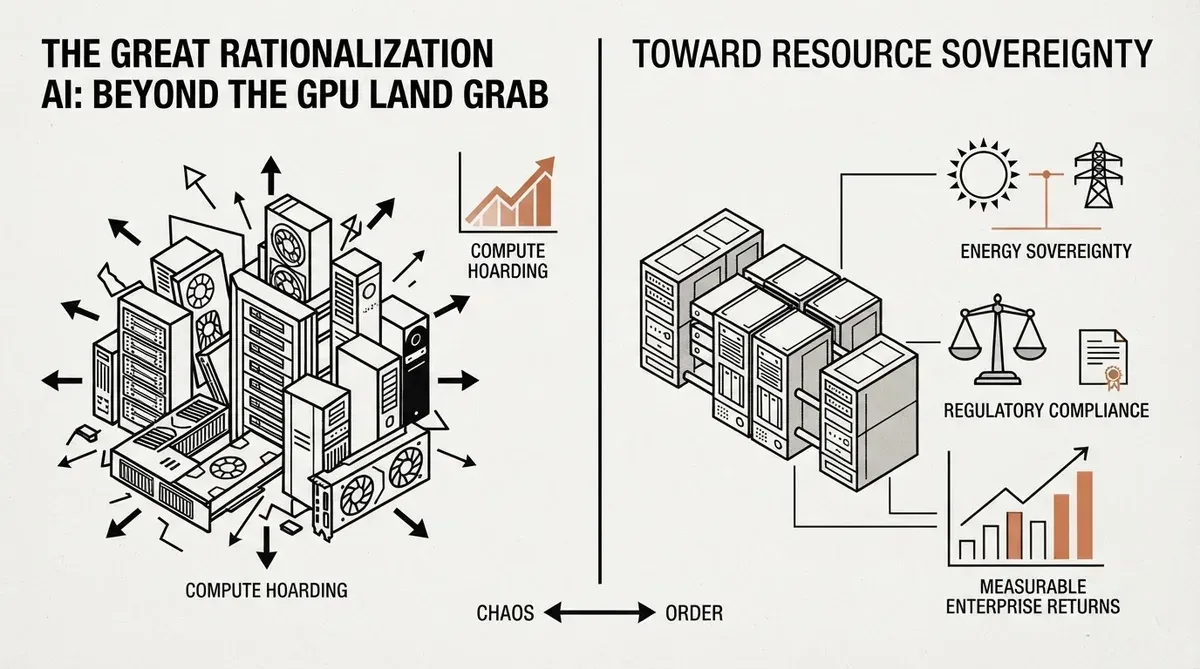
The era of unconstrained AI expansion is giving way to something far more disciplined. For the past two years, the dominant narrative in artificial intelligence has revolved around a frantic race for graphics processing units. That land grab was fueled by the belief that more compute was the only path to better models. That phase, characterized by massive general-purpose releases and speculative infrastructure spending, has reached a structural inflection point. What is emerging in its place is a transition defined by the hard constraints of energy, regulation, and enterprise pragmatism. Analysts at Goldman Sachs have termed this shift the Great Rationalization AI, and its implications reach far beyond the balance sheets of hyperscalers.
The transition is not a cooling of hype in the traditional sense. It is a forced maturation driven by three concrete pressures: the physical limits of powering dense compute clusters, the uncompromising architecture of new legal frameworks, and the rising demands of enterprise buyers who demand measurable returns. Understanding how these forces interact is essential for anyone tracking where the AI industry is headed and which players are positioned to survive the pivot.
What Is Driving the End of Compute Abundance
The economics of AI have been dominated by one scarcity story: the shortage of NVIDIA H100 GPUs. But the bottleneck is moving upstream from the chip to the infrastructure required to run it. Goldman Sachs research projects that combined capital expenditure by the four largest hyperscalers, which are Meta, Microsoft, Amazon, and Alphabet, will reach roughly $5.3 trillion by the end of the decade. That sum exceeds the individual gross domestic products of Japan or India. According to the same Goldman Sachs research, global power demand for data centers is projected to surge by 160 percent by 2030. In advanced economies where electricity consumption had remained relatively flat for a decade, this sudden spike is straining national grids and forcing a strategic reorientation. Hyperscalers are no longer content to act as passive utility customers. They are becoming active participants in energy generation, pursuing long-term power purchase agreements and exploring small modular nuclear reactors to secure consistent, carbon-neutral supply. The ability to secure power has become a more significant competitive differentiator than the ability to secure a chip allocation.
Return on investment for this unprecedented capital outlay is also under new scrutiny. While the build-out continues, financial markets are beginning to distinguish between companies that spend on infrastructure with a clear path to operating earnings growth and those that do not. Investors are rotating toward productivity beneficiaries, meaning firms that can demonstrate that AI is reducing costs or creating measurable new revenue streams. They are moving away from entities that treat AI infrastructure as an expensive experimental playground without a monetization strategy.
The era of spending on compute for its own sake is ending, replaced by a more stringent calculus that ties every dollar of infrastructure investment to a concrete business outcome. This shift in capital discipline is the first pillar of the Great Rationalization AI.
Regulatory Architecture and the New Compliance Moat
While the United States leads in model development and silicon design, the European Union has positioned itself as the world primary regulator of AI. The EU AI Act, which entered into force in August 2024, is a definitive end to the move-fast-and-break-things era for artificial intelligence. The legislation is expected to exert a Brussels Effect similar to that of the General Data Protection Regulation. Under that dynamic, global companies adopt EU standards as their baseline to avoid managing fragmented regional compliance regimes.
The implementation timeline is aggressive. The first prohibitions on unacceptable-risk systems, covering manipulative techniques and certain biometric categorization practices, took effect in February 2025. By August 2025, providers of general-purpose AI models were required to comply with transparency and systemic risk mitigation obligations. The full weight of the regulation, particularly for high-risk systems used in critical sectors such as healthcare, banking, and law enforcement, arrives in August 2026. Penalties for non-compliance reach up to 7 percent of a company total global sales, calculated at the group level rather than just for the EU subsidiary.
For enterprises, this regulatory shift is transforming compliance from a back-office cost into a strategic moat. Organizations that can demonstrate trustworthy AI, characterized by transparency, human oversight, and strong data governance, gain preferential access to regulated markets. Conversely, the black-box model is losing viability. The requirement for detailed technical documentation and conformity assessments for high-risk systems is pushing the industry toward more interpretable and auditable architectures. This pressure is also accelerating adoption of smaller, specialized models that are easier to govern than their massive, general-purpose counterparts.
The regulatory dimension of the Great Rationalization AI thus imposes a quality filter on the market. Models that cannot document their training data, explain their outputs, or demonstrate compliance with evolving standards will face shrinking commercial opportunities, regardless of their benchmark performance.
Enterprise Realism and the Rise of Agentic AI
In the enterprise sector, the initial fascination with conversational chatbots is giving way to a more pragmatic focus on autonomous task execution. Research from IDC and Gartner indicates that nearly 80 percent of organizations have begun implementing some form of AI agent. These are systems capable of navigating multiple software platforms, making decisions based on institutional memory, and executing end-to-end workflows without constant human oversight.
This shift toward agentic systems is fundamentally altering the economics of enterprise software. Gartner has identified a phenomenon it calls Agentic Arbitrage, where AI agents complete tasks across various systems, reducing the need for human users to interact with traditional software interfaces. This trend poses an existential threat to the seat-based licensing models that have dominated the SaaS industry for two decades. If an AI agent can perform the work of ten employees using a single software license or bypass the user interface entirely via APIs, the traditional link between headcount and software revenue is broken.
However, scaling these systems into production remains a significant challenge. Only a small fraction of organizations have successfully deployed AI agents at scale across multiple departments. The primary barriers are not merely technical but cultural and structural: a lack of skilled personnel, concerns about data security, and the difficulty of measuring return on investment. Enterprises are discovering that the last mile of AI integration, which involves connecting models to proprietary data and legacy systems, requires a level of data hygiene and process engineering that many were unprepared for.
The enterprise dimension of the Great Rationalization AI is therefore one of tempered ambition. The technology is advancing rapidly, but organizational readiness is lagging. The winners in this phase will be those that invest as heavily in operational change as they do in model procurement.
The Labor Paradox: Task Displacement and the High-Skill Shift
The impact of AI on employment is proving more nuanced than a simple replacement-versus-augmentation binary. Analysis from the International Monetary Fund suggests that approximately 40 percent of global employment is exposed to AI, with that figure rising to 60 percent in advanced economies. Unlike earlier waves of automation that primarily affected routine manual tasks, generative AI is uniquely capable of affecting high-skilled cognitive work.
This creates a paradox. AI can significantly boost the productivity of less experienced workers by providing expert-level assistance, but it also threatens to commoditize the skills that high-income professionals have spent years developing. The IMF research indicates that roughly half of exposed jobs will likely benefit from AI integration, leading to enhanced productivity and potentially higher wages. For the other half, however, AI applications may execute key tasks currently performed by humans, reducing labor demand and leading to slower hiring or wage stagnation.
Surveys from the OECD show that workers already using AI in their daily roles tend to report positive impacts on performance and working conditions, with many noting that AI has reduced the drudgery of routine tasks and allowed them to focus on more strategic work. But a generational and skill-based divide is evident. Older workers and those with less technical literacy face higher displacement risk, while younger AI-native workers are better positioned to exploit the opportunities the technology creates. The most significant impact is being felt in sectors like finance, manufacturing, and professional services, where task-level displacement is already occurring. An AI agent may not replace an entire legal team, but it may replace the junior associates responsible for document review and initial drafting.
The labor dimension of the Great Rationalization AI introduces a social constraint on AI deployment that markets alone cannot resolve. Productivity gains will be politically unsustainable if they concentrate among capital owners and high-skilled professionals while leaving a broad segment of the workforce behind.
Market Shifts: Custom Silicon and the Open-Source Challenge
NVIDIA continues to dominate the general-purpose GPU market, but its position is being challenged by two countervailing forces: the rise of custom silicon and the narrowing performance gap with open-source models. Hyperscalers are investing heavily in their own application-specific integrated circuits, including Google TPUs and Amazon Trainium chips. These custom processors are designed to run specific AI workloads more efficiently than general-purpose GPUs, offering better performance per watt and lower long-term costs. While NVIDIA CUDA software ecosystem remains a strong moat, the economic incentive for hyperscalers to reduce their dependence on a single hardware vendor is driving a diversification of the AI silicon market.
Simultaneously, the gap between proprietary closed-source models and open-source alternatives is shrinking. Meta Llama 3.1 release demonstrated that open-source systems can rival advanced proprietary models for many enterprise use cases. This is driving a commoditization of the frontier. For many organizations, the advantages of open-source models, which include greater control over data security, the ability to fine-tune on proprietary datasets, and the avoidance of vendor lock-in, now outweigh the marginal performance benefits of closed alternatives. Many enterprise decision-makers are targeting a balanced split between open and closed models to optimize for both cost and capability.
The open-source trend is also enabling Sovereign AI, which is the ability of nations and organizations to develop and run their own AI systems without relying on foreign technology providers. Governments in Europe and Asia view this as a priority for national security and economic competitiveness, further fragmenting the global AI market and accelerating the diversification away from single-vendor dependence.
Why This Matters
The Great Rationalization AI is a necessary maturation of the industry. The easy phase, which involved throwing more compute at larger datasets, has reached its practical limits. The next phase will be defined by the ability to handle the constraints of energy supply, regulatory compliance, and organizational change. The winning strategy is to translate AI potential into durable, compliant, and measurable utility. GPU hoarding is no longer a viable approach. For investors, policymakers, and enterprise leaders, the message is the same: the era of speculative abundance is over, and the era of disciplined deployment has begun.
AI-generated image.
Related Articles
- Beyond Bigger Models: The Sovereign Efficiency Pivot Reshaping AI's Future
- Nvidia OpenAI Circular Financing: $250 Billion Guarantee Reshapes AI Infrastructure Risk
✔Human Verified
Researched and cross-referenced against primary sources by the Bytevyte editorial team.