
Hugging Face's $399 Microduck Robot Duck Hits $2.6 Million in First-Day Orders
Hugging Face's $399 Microduck robot duck pulled in over $2.6 million in first-day pre-orders. Open-source RL training, ships before Christmas.
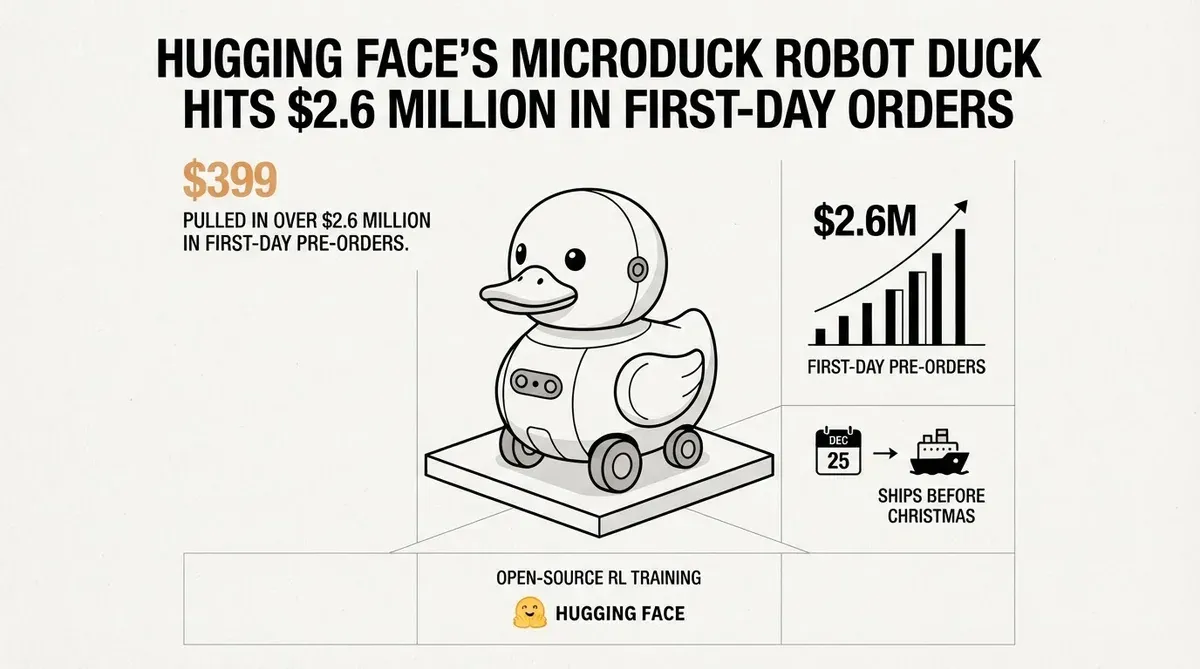
Hugging Face has opened pre-orders for the Microduck robot duck, a $399 bipedal device built by its French subsidiary Pollen Robotics, and first-day demand has already created a backlog. Cofounder Thomas Wolf said on X that orders exceeded $2.6 million in the first 24 hours after the August 27 launch, roughly 6,500 units at the $399 price point, after crossing $1 million within about six hours.
At roughly 25 centimeters high, the duck weighs under 800 grams and carries 15 motors for locomotion. Onboard hardware includes a camera, a small LiDAR sensor, two IMUs, 32GB of storage, 1GB of RAM, and a 2,600mAh battery rated for roughly an hour of continuous use. Its moves include waddling, crouching, righting itself after falls, roller skating, and picking up small objects with its beak, in four colorways: Cream, Graphite, Lavender, and Sky.
A training platform, not a toy
Microduck's defining feature is its open-source software stack. The SDK, the MuJoCo simulation environment, and the complete reinforcement learning training pipeline are published on GitHub under an Apache 2.0 license, and training a PPO policy for each gait takes roughly one to two hours. That setup targets hobbyists and researchers who want hands-on experience with physical AI, teaching a robot to learn behaviors through reinforcement learning instead of hand-coded routines.
Demand backed up that positioning. At its peak, orders arrived at a rate of one every four seconds, and first deliveries are targeted before Christmas 2026 in North America and Europe, with Canada, the UK, Norway, Switzerland, Japan, and South Korea also on the launch list. Pre-orders cost $399 in the US, or €340 for European buyers, before taxes and shipping; optional extras include spare motors, extra batteries, a dual-slot charger, NFC tags, roller attachments, and a laser pointer.
Is the Microduck robot duck worth it?
Buyers expecting a toy should recalibrate: this is a learning platform shaped like one. The hour-long battery life, 1GB of RAM, and the requirement to train behaviors yourself mean the duck rewards coding patience more than it delivers out-of-the-box tricks. The MuJoCo simulation lets owners test policies in software before running them on hardware, which keeps trial-and-error costs low.
The first-day numbers matter for Hugging Face as well. The company, often called the GitHub of the AI world, acquired Pollen Robotics last year, and the Microduck robot duck gives it a consumer-facing foothold in physical AI at a price well below most research-grade bipedal platforms. Whether the Christmas delivery window holds will be the first test of its production capacity and of whether early hype becomes repeat demand.
Why this matters
Microduck makes hands-on reinforcement learning affordable for a mainstream audience at roughly the price of a mid-range smartphone. If the backlog ships on time, it could become the default entry point for hobbyists learning how robots actually learn.
AI-generated image.
Related Articles
- NVIDIA and Hugging Face Unite to Open-Source Humanoid Robotics Development
- Hugging Face Sale Talks Signal a New Prize in AI Infrastructure
- Nvidia Hugging Face Acquisition: A $12.9B Open-Source Test [Update]
✔Human Verified
Researched and cross-referenced against primary sources by the Bytevyte editorial team. This article was generated with the assistance of artificial intelligence and reviewed by the Bytevyte editorial team.