
Hyperscale Data's Michigan AI Data Center Tops $70 Million
Hyperscale Data has invested over $70 million in its Michigan AI data center, with operations under a master services agreement set to begin in November 2026.
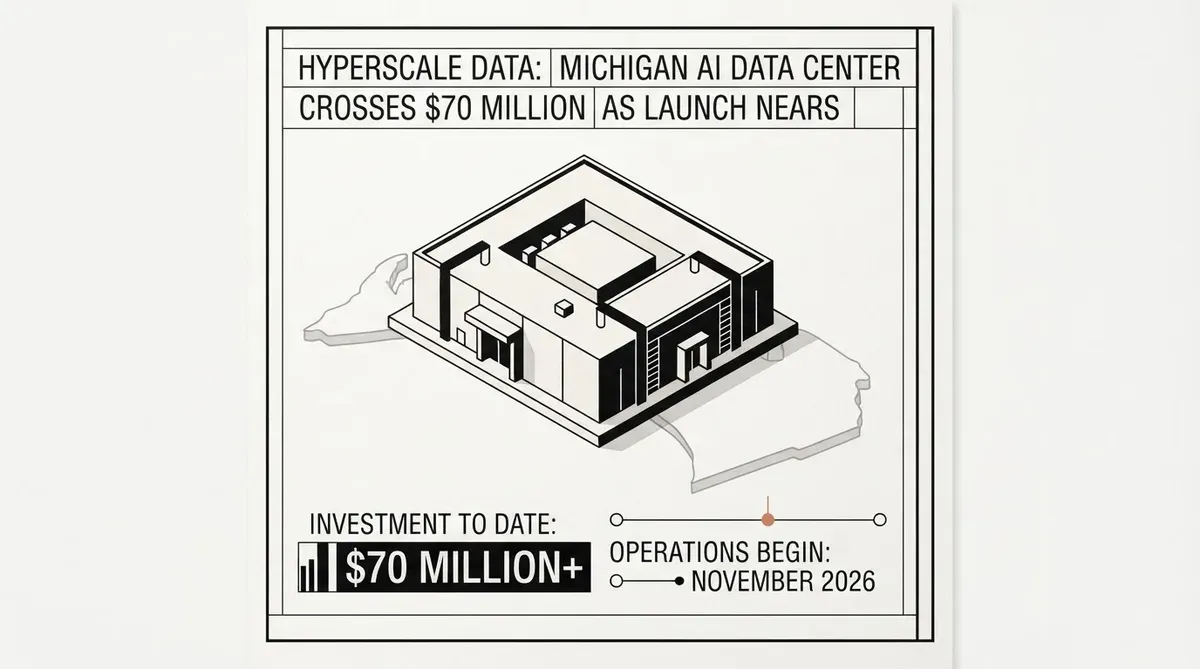
Hyperscale Data says it has spent more than $70 million on its Michigan AI data center and on Alliance Cloud Services, the subsidiary that will sell capacity from it. The company dated that figure to September 15, 2026, and says the site will start commercial operations within weeks of the disclosure.
Hyperscale Data trades on the New York Stock Exchange under the ticker GPUS. It is building the Michigan site through Alliance Cloud Services (ACS). The company describes the $70 million as cumulative spending and as a large share of the capital the project requires. It has not said what the finished buildout will cost.
Service under a master services agreement the company announced earlier is set to begin in November 2026, according to the company. The contract sets the terms on which ACS will supply capacity to a customer.
What the Spending Number Does and Does Not Say
AI data centers cost more to build than ordinary server halls. Racks that train models draw more power and produce more heat, so money goes into electrical distribution, cooling, and the network that ties accelerators into one cluster. Because the $70 million covers both ACS and the Michigan site, the disclosure does not break out land, shell, power equipment, and compute.
The number still places the project in its schedule. Hyperscale Data calling the outlay a substantial part of the required capital tells investors the build is past its early phase and that most of what remains is probably committed or planned. The company has not named a total cost, which is the figure an investor needs to judge a return.
When the money was spent also matters. Capital that goes out before a facility earns anything sits on the balance sheet while the site is still being finished. That reverses in November 2026 if the schedule holds. For a smaller operator, the gap between spending and revenue is where financing and execution risk accumulate.
The timing of the disclosure carries information too. Listed operators tend to report progress once a project passes a threshold worth flagging, and September 15 falls in the third quarter. A November start would put the first revenue from the master services agreement near the end of the calendar year, leaving little room to show utilization before the period closes.
The master services agreement is what turns a building into a business. Agreements of this kind typically fix capacity, service levels, and pricing over a multi-year term, which gives the operator predictable revenue and gives the customer assured access to compute. In a tight market the deal suits both sides: the buyer secures supply, and the seller secures utilization.
Most of the risk sits with the provider. If the Michigan AI data center misses November, the operator absorbs the cost of the delay while the customer's demand goes elsewhere. That imbalance is why investors treat a spending update as a credibility check on the company.
The disclosure names two entities for a reason. ACS is the business that signs customer contracts, and the Michigan facility is the asset that backs them. Counting the $70 million across both reflects the fact that the commercial side and the physical build move together.
About six weeks separate the September 15 figure from the November start. For a data center, that is a short runway. Commissioning means energizing electrical systems, proving cooling under load, and testing the network that AI workloads run on. Any of those steps can slip, and each slip moves the revenue date.
Capacity as Leverage
Compute is scarce enough that physical footprints work as leverage. Operators holding power, land, and grid interconnection can rent that position to model developers and enterprises that would rather buy capacity than build it. Hyperscale Data's plan follows that logic: own the physical layer, then sell access through ACS on long-term contracts.
That is why modest progress updates draw outsized attention. A $70 million milestone is small next to the broader AI infrastructure buildout, but it is a hard marker of execution for a company whose value turns on converting land and power into billable capacity on time.
The Michigan AI data center sits inside a wider race to add AI infrastructure for training and inference. Compute demand has run ahead of supply for several years, and the gap has pulled money toward power, land, and interconnection as much as toward chips. Sites that already have power and good siting have become the bottleneck deciding who can serve AI customers.
Scarcity sets pricing. When operators cannot add capacity fast enough, contracts signed in a tight market tend to carry better terms than those struck during a glut. The master services agreement behind the Michigan facility was announced before the site opened, which favors the seller only if capacity stays hard to get.
For a company of Hyperscale Data's size, capital and time are the constraints, not ambition. Capacity takes years and money up front, while customer demand can shift in quarters. Operators that commit early to a site risk finding demand or pricing different by the time the doors open.
What to Watch
Three items will show whether the project is on plan. The first is confirmation that operations begin in November 2026. The second is any disclosure of the total capital program, which would let investors weigh the $70 million against the full cost. The third is whether ACS signs customers beyond the counterparty in the existing master services agreement.
Until then, the $70 million is the best evidence of how far the Michigan facility has come. It is a waypoint, and the company's wording leaves room for more spending before the site books its first revenue.
Why this matters
The $70 million is a checkpoint rather than a verdict. It shows an operator willing to spend ahead of revenue and confident enough to name a start date. November is when the Michigan AI data center stops being a construction project and becomes a test of whether smaller operators can hold ground in a market shaped by scale.
AI-generated image.
Related Articles
- Applied Digital Secures $5.2 Billion AI Data Center Lease with Hyperscaler
- Microsoft Data Center Expansion Adds 26 GW as AI Shortages Force Its Hand
- Applied Digital Secures $7.5 Billion Contract for 300MW AI Infrastructure Campus
✔Human Verified
Researched and cross-referenced against primary sources by the Bytevyte editorial team. This article was generated with the assistance of artificial intelligence and reviewed by the Bytevyte editorial team.