
Manus-Meta Deal Unwind: Beijing's Veto Forces User Data Deletion
Beijing forced Meta to unwind its $2B Manus purchase; users must export agent data by Aug 22. Manus-Meta deal unwind analysis.
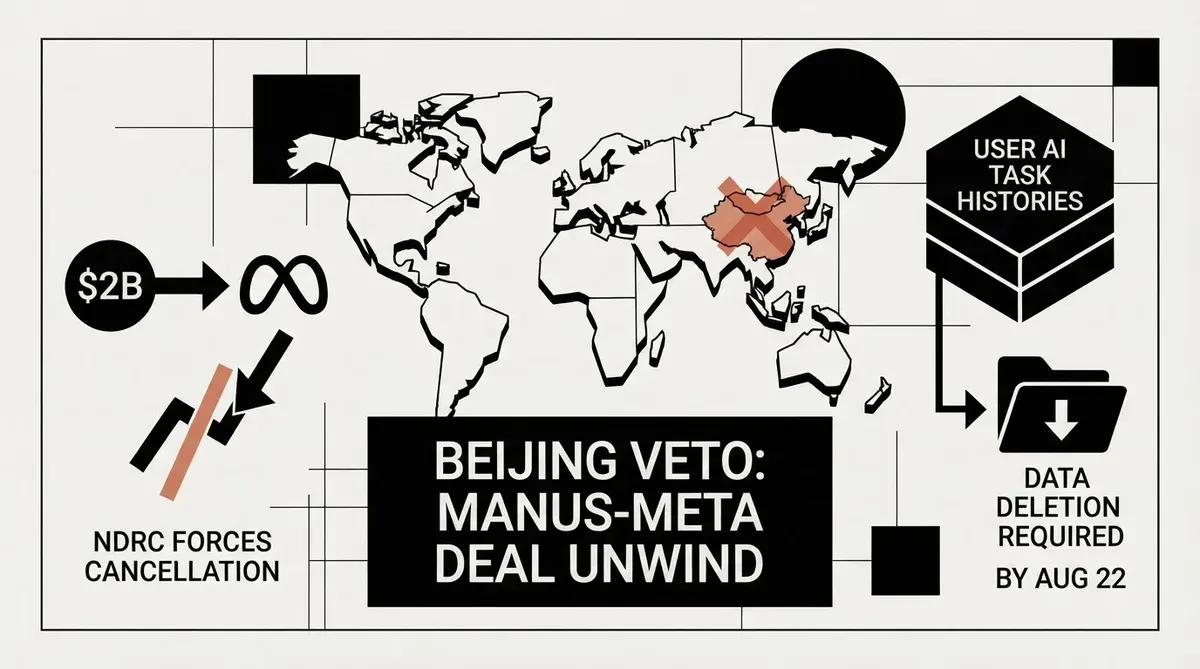
Manus is returning to independent operation after China's National Development and Reform Commission ordered Meta to reverse its $2 billion acquisition of the AI agent startup. The Manus-Meta deal unwind, confirmed on Tuesday, hits end users with a cost that few cross-border tech splits have imposed: deletion of the data created during the roughly eight months Meta owned the company.
The deal closed in December 2025, and Beijing ordered it unwound in April 2026 under foreign investment rules that treat the startup's talent and technology as Chinese. Manus began in China in 2022 and later moved its headquarters to Singapore, yet regulators judged its technology Chinese for the review. The block was justified on national security grounds. It is one of the most prominent AI acquisitions a host-country veto has forced apart.
What the Manus-Meta Deal Unwind Means for User Data
The separation reaches into the data layer as well as the share registry. Manus builds general-purpose agents that automate desktop tasks, and its task histories, files, and configurations record what those agents executed. Part of that record is being deleted: records generated on or after December 29, 2025, when the deal closed, are being removed as part of the regulatory separation, while pre-acquisition data survives.
Affected users have an export window that closes at 7:59 p.m. EDT on August 22, about eleven days after the announcement. Deletion is scheduled for August 23-24, and restoration portals are set to open August 25. Manus is waiving charges for affected users during the backup period and says it will offer bonuses once data is restored. Users outside the affected group can keep using the service as normal.
For an agentic platform, this is more than a routine cache purge. Task histories and configurations are the accumulated state of an autonomous agent, the context that lets it pick up a job where it left off. Losing them means workflows must be rebuilt from scratch, and the decisions an agent made on a user's behalf disappear with them. For teams that had automated recurring tasks, the export window is the only chance to keep those workflows.
The date stamp is the telling detail. Data generated under Meta's ownership is destroyed; pre-acquisition data is kept. That boundary frames the deletion as a jurisdictional act, not a technical cleanup. Regulators are severing everything produced while a foreign owner controlled the company, a contrast with most data-erasure regimes, from GDPR deletion requests to account closure, which are initiated by users or companies rather than by states.
That distinction carries compliance weight for enterprises. Because task histories can contain sensitive business information, a forced deletion is a compliance event as well as a technical loss. Export tooling, defined retention rules, and contractual data-portability rights are the practical defense when a change in ownership moves agent data across borders.
For users inside the window, the sequence is straightforward: export task histories, files, and configurations before the August 22 deadline, then restore through the portals that open August 25. Manus has said affected users will not be billed during the backup period and that bonuses will follow restoration, an acknowledgment that the erasure disrupts paying customers.
Why Beijing Intervened
The pressure predates the announcement. Chinese officials interviewed Manus' co-founders and restricted their travel during the review, and staff were told to migrate ongoing projects off the platform and stop starting new work on it while the unwind proceeded. Meta, for its part, cut Manus staff off from internal data as part of the separation.
China's National Development and Reform Commission, the country's top economic planning agency, treated AI platform ownership as industrial policy. The Singapore move did not shield Manus: jurisdiction followed the technology and the people who built it, not the registered address. The review spanned months, from the December close to the April order, and it ended with conditions attached to the unwinding, including the data-separation requirement. The decision also fits a broader effort to keep U.S. firms from acquiring Chinese AI technology under tightened foreign investment rules, and the travel restrictions on the founders show the personal stakes behind a state-level review of agent technology transfer.
The strategic cost to Meta is real. Manus' agent technology was the reason for the price: at $2 billion, the deal valued a platform that could automate desktop work for consumers and businesses. Meta planned to make that technology the engine of its consumer and enterprise AI subscription models. The unwind closes the path, and the product roadmaps that assumed the integration now need a different technology base.
The episode also sharpens what agent memory is worth commercially. For a general-purpose agent platform, accumulated task state is a switching cost, the practical lock-in that keeps users on the service. Deleting that state resets the relationship, so the re-independent Manus starts with a thinner hold on the users it keeps.
The Road Back to Independence
The sequence of events, from closing to data deletion, shows how quickly a completed deal can be reversed when a regulator moves. The deletion steps in the timeline below are still ahead as of this writing.
| Milestone | Date |
|---|---|
| Meta acquisition closes | December 29, 2025 |
| Beijing orders the deal unwound | April 2026 |
| Tencent-led buyback consortium reported | Early July 2026 |
| Manus announces independent operations | August 11, 2026 |
| Backup deadline | August 22, 2026 |
| Data deletion window | August 23-24, 2026 |
| Restoration portals open | August 25, 2026 |
A consortium led by Tencent is buying back Meta's stake at the original $2 billion valuation, so Meta exits at the price it paid, avoiding a paper loss. Buying back at the original price erases the premium Meta's bid had created and hands the platform to Chinese investors at the same valuation the U.S. owner paid, before any of the integration work bore fruit. Early investors HSG, formerly Sequoia China, and ZhenFund are part of the buyback group, while U.S. investor Benchmark, which was paid out when the deal closed, is not. The structure resets the ownership record with Chinese capital in place of U.S. capital.
Manus is also weighing a buyback of about $1 billion and a possible Hong Kong listing down the road, with Tencent potentially seeking a controlling stake. A Hong Kong IPO would give the consortium a liquid exit while keeping the company outside U.S. capital markets, the opposite of the ownership structure Meta had negotiated. The Manus-Meta deal unwind thus ends with the startup back in Chinese hands, intact as a product but stripped of the data its users generated during the Meta period. For acquirers of China-linked AI assets, the episode adds a diligence item: whether a target's user data is separable from its ownership history, and at what cost. The combination of founder scrutiny, staff migration orders, and a data-separation requirement gives other boards a template for what a veto looks like.
Why This Matters
Beijing has shown it can reach inside a completed AI acquisition and dictate what happens to user data. The Manus-Meta deal unwind sets a precedent for how agentic AI memories are treated when ownership changes across borders, and the forced deletion is the operational cost of decoupling. Enterprises running agent workloads should treat task histories and configurations as exportable assets, because a regulator's veto can erase them with days of notice.
AI-generated image.
Related Articles
- China Blocks Meta's Manus Acquisition Over National Security Concerns
- China AI Export Controls Under Review as Beijing Tightens Tech Restrictions
- SpaceX and AI Firms Enforce US AI Investment Ban
✔Human Verified
Researched and cross-referenced against primary sources by the Bytevyte editorial team. This article was generated with the assistance of artificial intelligence and reviewed by the Bytevyte editorial team.