
Marvell Secures GlobalFoundries SiGe Supply as AI Data Center Optical Interconnects Tighten
GlobalFoundries and Marvell expand SiGe chip capacity in Vermont for AI data center optical interconnects, targeting 200G-per-lane optical links.
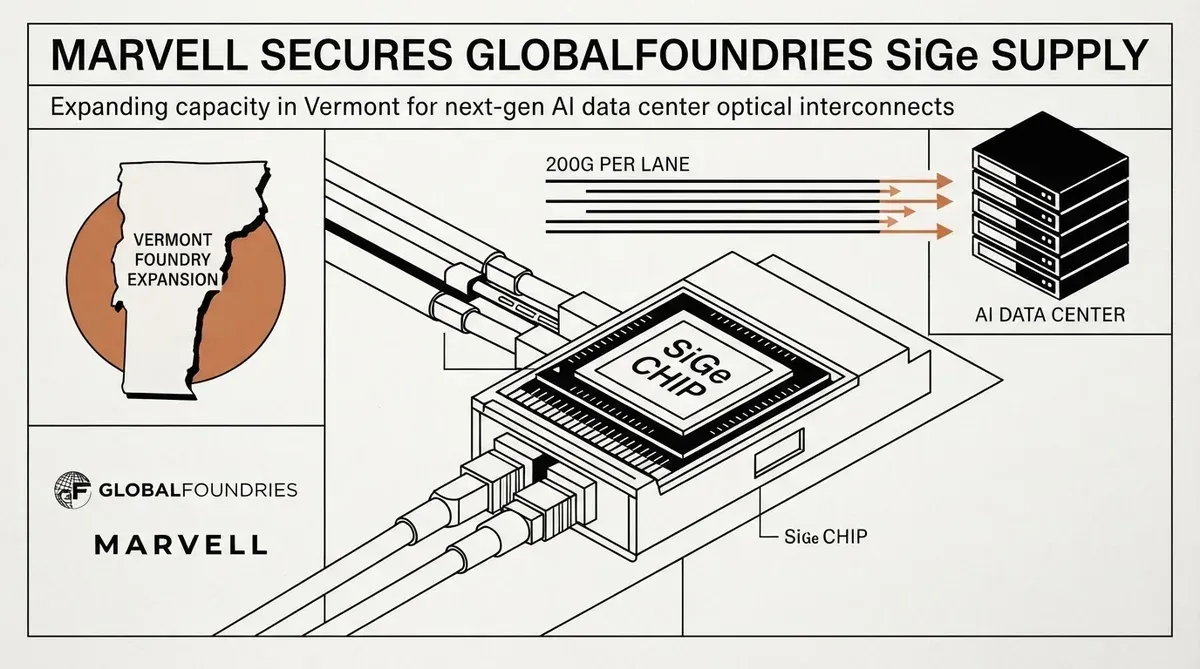
GlobalFoundries and Marvell Technology have widened a multi-year manufacturing agreement to raise output of silicon-germanium (SiGe) chips that carry data between the servers packed inside AI data centers. The expansion, announced Sept. 17, 2026, adds capacity for GF's SiGe process at its Burlington, Vermont fab. No financial terms were disclosed.
The arrangement centers on AI data center optical interconnects, the components that turn electrical signals into light and back again so racks, clusters, and buildings can exchange data at high speed. GlobalFoundries and Marvell said the added capacity is meant to serve operators building larger AI clusters, where bandwidth needs and power budgets are tightening at the same time.
SiGe blends silicon with germanium to make devices that switch and amplify signals at very high frequencies. Marvell uses the process for the analog and mixed-signal front ends inside optical modules, the parts that drive and read the light moving through a data center's fiber.
Why AI Data Center Optical Interconnects Are the New Bottleneck
Data center networks have outgrown traditional copper wiring. Copper carries high-speed signals over short distances, but as clusters scale, the reach and lane speeds required push the metal past the point where signal loss and power draw stay manageable. Optical links take over where copper cannot follow.
That shift moves the constraint. For years the hardest problem in AI infrastructure was supplying enough compute. As clusters grow, moving data between and inside those clusters has become the harder one, and the optical components that do the moving now sit in a strategic part of the bill of materials.
The Energy Argument Behind Optics
Speed is only half the case for putting AI traffic on fiber. GlobalFoundries and Marvell describe the target as faster and more energy-efficient optical connections, and power has become the binding limit on data center design. Copper links lose more signal over distance, which forces the use of retimers and equalizers that add latency and watts. Optical links carry the same payload with less of that overhead, so an operator can run more accelerators on an unchanged power budget or push more traffic through an existing building. At cluster scale the difference compounds across every link the cluster contains.
Where the New SiGe Capacity Lands
The companies said the expanded collaboration increases capacity for high-performance SiGe technology used in next-generation pluggable optical transceivers, Near-Packaged Optics (NPO), and Co-Packaged Optics (CPO). The three formats sit at different points on the same path, moving optics closer to the switch silicon as speeds rise.
- Pluggable transceivers slot into switch and server ports and remain the most common way to add optical links.
- Near-Packaged Optics place the optical engine close to the switch ASIC, shortening the electrical path.
- Co-Packaged Optics integrate optics with the switch package itself.
Covering all three in one agreement matters because the industry has not settled on a single format. Pluggables stay popular for their serviceability, while co-packaged optics promise tighter integration for the densest switches. A supplier able to serve every option can follow customers whichever direction they move.
The Vermont capacity is aimed at 200G-per-lane optical interconnects. Lane speed sets how much bandwidth a module or fiber pair can carry, so each step up lets operators move more traffic through the same physical footprint and power envelope. Reaching 200G per lane is what makes the next generation of high-density switching viable.
Vermont, and the Case for Domestic Supply
GlobalFoundries is adding the capacity at its Burlington, Vermont facility, one of its US manufacturing sites. GF is headquartered in Malta, New York, and the Vermont fab has been the home of its SiGe work.
Capacity for AI data center optical interconnects is now scarce enough that access to it can decide which suppliers ship next-generation modules on time. A domestic fab shortens the loop between process development and volume production, and it gives US-based buyers a supply path that does not depend on overseas capacity.
The trade-off is concentration. Marvell's ability to ship depends on output from a single site, so a disruption there would ripple straight into its optical product line. Expanding a multi-year agreement is one way to reduce the risk that a competitor books the capacity first.
What Marvell Gets Out of the Deal
Marvell's data center connectivity business rests on optical interconnects. Securing multi-year SiGe capacity locks down a part of the supply chain that draws little public attention but sits in front of every module the company ships. Marvell is reserving manufacturing room before demand reaches the next speed step rather than competing for it afterward.
The move also says something about where Marvell sees growth. Its pitch to investors leans on AI data center networking, and optical links are the segment where that pitch either holds or does not. Capacity contracted years ahead is a hedge against being the supplier that cannot deliver when a hyperscaler wants to deploy.
Process capacity cannot be summoned on short notice. Qualifying a specialty line such as SiGe takes time, and adding volume means committing tools and engineering resources ahead of demand. A multi-year agreement gives Marvell a claim on output well before it needs to ship, while giving GlobalFoundries the demand visibility to keep the line busy. That mutual commitment is the substance of the deal, even without a disclosed dollar figure.
For a foundry, the value of a committed customer reaches past revenue. Specialty lines run most efficiently at high utilization, and idle capacity on an expensive line erodes margins fast. A multi-year volume commitment is what justifies keeping the SiGe line staffed and qualified for the next speed node.
The disclosure lifted shares of both companies, a sign that investors read expanded optical capacity as a gauge of AI infrastructure demand rather than a routine foundry arrangement.
Timing is part of the signal. Announcing capacity growth ahead of the demand curve, rather than in response to a shortage, suggests the companies expect the 200G-per-lane transition to arrive on schedule and at volume. If that read is right, the constraint on AI cluster growth shifts from how many accelerators can be built to how many high-speed links can be attached to them.
The scale of that demand is why the capacity question is urgent. Optical interconnects sit in the path of every byte that leaves a rack, so their supply has to grow roughly in step with the clusters they serve. Falling behind does not degrade a data center gradually; it caps how many accelerators an operator can usefully connect.
The beneficiaries extend past the two companies. Cloud operators and AI labs that buy optical modules gain a more predictable supply of the SiGe front ends inside them, though the deal does not guarantee any single buyer preferential access. The expansion also shows how far the AI supply chain has widened: the companies that matter to a cluster now include the foundries running specialty processes that few others offer.
Neither company has said how much new capacity the agreement adds or when it comes online, which leaves the size of the bet unclear. The multi-year structure does signal that both sides expect optical demand to keep climbing past the current generation of modules.
Why This Matters
The compute race gets the headlines, but the next constraint on AI scaling is moving data, not multiplying flops. Every accelerator added to a cluster creates links that have to carry its output, and those links increasingly run on light instead of copper. When a foundry and a chip designer expand SiGe capacity years in advance, they are betting that the interconnect supply chain, not the processor supply chain, becomes the chokepoint that decides how fast clusters can grow. For buyers planning AI capacity, the practical read is that AI data center optical interconnects belong on the same procurement risk list as GPU allocation.
AI-generated image.
Related Articles
- Marvell and Alphabet Co-Develop Custom AI Inference Silicon
- Google Marvell AI chip deal: $12.2B warrant turns customer into shareholder
- Tech Leaders Launch EBO MSA to Standardize AI Optical Interconnects
✔Human Verified
Researched and cross-referenced against primary sources by the Bytevyte editorial team. This article was generated with the assistance of artificial intelligence and reviewed by the Bytevyte editorial team.