
Mecka AI Series B: $60M to Scale the Robot Motion Data Layer
Mecka AI Series B: the robotics data startup raised $60M led by Sequoia, with Nvidia, Microsoft's M12, Qualcomm Ventures and Samsung backing motion data.
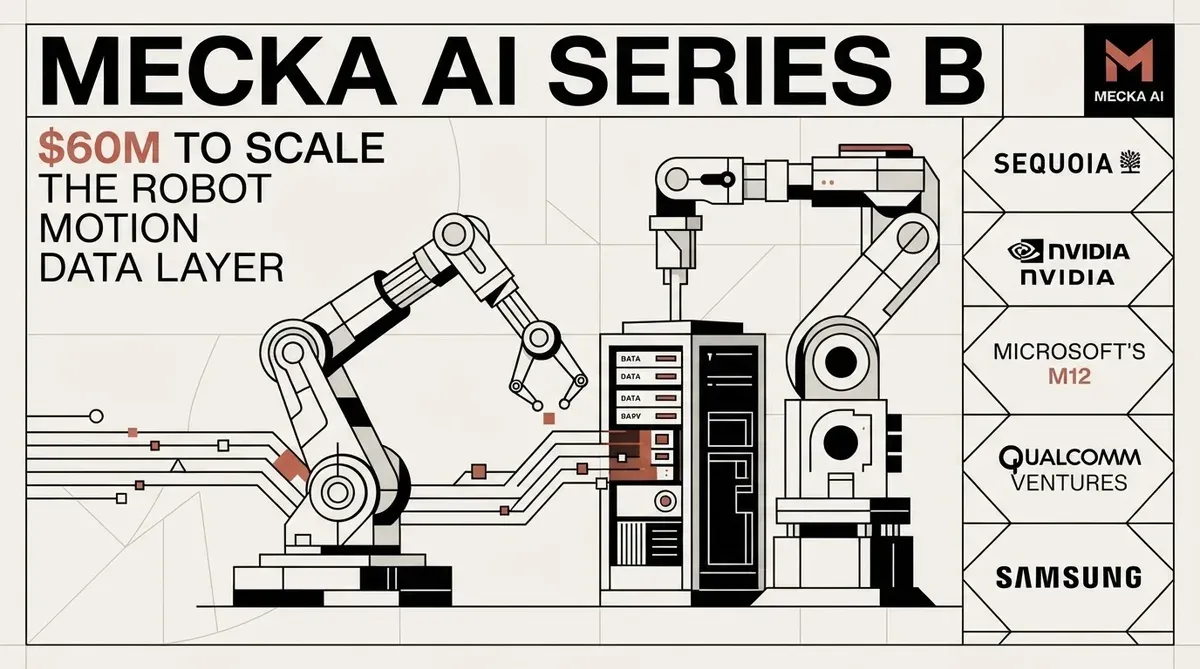
Mecka AI has raised $60 million in a Series B round led by Sequoia Capital, drawing Nvidia, Microsoft's venture arm M12, Qualcomm Ventures and Samsung onto a cap table that now spans most of the robotics stack. The Mecka AI Series B was disclosed on October 8, 2026, and takes the company's total disclosed funding to roughly $128 million. The money is earmarked for expanding a business that collects and processes human movement data used to train robots.
Kindred, Framework Ventures and Neo joined the round alongside a group of strategic angels. No valuation was attached to the announcement, and no full terms were published with it, which leaves the round's price and structure undisclosed.
What Mecka AI Actually Sells
Mecka AI operates in the data layer for physical AI. It gathers motion-capture and human-movement datasets and structures them so humanoid and industrial robot developers can use them as training inputs. The alternative for those developers is to build their own capture operations: rigs, operators, annotation staff, and the engineering time to turn raw recordings into something a policy network can learn from.
Teleoperation adds a second kind of record. When a human drives a robot arm or a bipedal platform through a task, the resulting sequence pairs an action with an outcome, which is the raw material that imitation-learning and reinforcement-learning pipelines consume. Collecting that at scale is slow, physical work. It does not compress the way software does.
Data collection of this kind is capital-intensive in a way that web-scale text scraping never was. Text can be crawled once and reused across thousands of models. Motion data has to be captured, sometimes with hardware in the loop, then cleaned and annotated before it is useful. Every additional hour of coverage costs money and calendar time, which is why the field has produced specialist vendors rather than being absorbed into general-purpose data platforms.
Geography is a quieter constraint. Motion capture needs physical facilities and trained operators, so a vendor's footprint sets the ceiling on how quickly it can add coverage. Expanding that footprint is one obvious use for the new capital.
Why the Mecka AI Series B Pulls In Chip Vendors
The investor list is the interesting part. Nvidia supplies the compute and simulation tooling that robot developers already depend on. Qualcomm Ventures sits inside a company selling edge silicon for robotics and automotive. Samsung manufactures the memory that large training runs consume and the consumer hardware that could eventually host robots. Microsoft's M12 invests across cloud and enterprise AI. Four strategic backers, four different reasons to want the supply of motion data to grow faster.
The Mecka AI Series B is best understood as a defensive move as much as a financial one. A robot platform is only as useful as the models running on it, and those models are only as good as the data behind them. If motion data stays scarce, deployment timelines stretch, and hardware that has already been designed sits idle longer. Funding the data layer shortens that gap without forcing a chip vendor to own the collection business.
There is a timing element too. Humanoid development has moved from research labs into funded product programmes, and those programmes need training corpora now. A strategic investor that waits for the data market to consolidate pays more later and gets less influence over which formats developers adopt.
Early visibility matters for the same reason. Backers get a view of how datasets are structured, where bottlenecks sit, and which tasks robot makers cannot yet train for. That information is worth something to companies that ship developer toolkits.
The Economics of Buying Versus Building
Robot developers face a build-or-buy decision on data, and the arithmetic pushes most of them toward buying. In-house collection means hiring operators, maintaining physical rigs, and paying for annotation on every hour captured. It also means duplicating work that a specialist can spread across many customers. A humanoid startup that spends two years building a capture pipeline has spent two years not shipping.
That asymmetry is the pitch. Mecka AI sells the same structured motion data to multiple robot developers, so the fixed cost of capture is spread across buyers. The more customers it signs, the cheaper each dataset becomes to serve, and the harder it is for any single customer to justify rebuilding the pipeline internally.
The Mecka AI Series B also says something about stage. Of the roughly $128 million Mecka AI has raised in total, this round accounts for close to half, which suggests the earlier rounds were smaller and that investors are now pricing a company with a working collection operation rather than a thesis.
Customer concentration is the risk inside that model. If a handful of well-funded robot makers account for most of the revenue, they hold the pricing power, and one decision to move collection in-house can remove a large share of a vendor's bookings. Mecka AI's ability to spread demand across humanoid and industrial customers, and across regions, is what determines whether it keeps margin.
The round also sets a benchmark for the sector. A $60 million Series B at a data company with no public product release cycle tells other motion-data startups that strategic capital is available at scale, and tells robot developers that the vendors they depend on are funded well enough to survive a long sales cycle.
The Case Against the Data Layer
The strongest argument against this round is that data businesses commoditise. If several vendors can capture human motion, prices fall, and the moat narrows to whatever proprietary rig or labelling process a company owns. Robot makers have an incentive to integrate backwards once their volumes justify it, and the largest ones have the balance sheets to do so.
Synthetic data is the other threat. Simulation can generate motion at a scale no human operator can match, and it costs almost nothing per additional sample. If simulated trajectories transfer well enough to real hardware, demand for expensive real-world capture shrinks.
Neither argument kills the category, and the reason is the gap simulation still leaves. Contact-rich manipulation, tool use, and recovery from failure are where simulated environments diverge most from the physical world. Real teleoperation captures the messy parts that simulators approximate badly, and that is the data a robot needs before it can work in an unstructured warehouse or a home. Until simulation closes that gap, recorded human movement remains a bottleneck that cannot be synthesised away.
What to Watch
Three signals will show whether this thesis holds. The first is repeat purchasing: a data vendor whose customers buy again each quarter is selling infrastructure, while one-off dataset sales look more like consulting. The second is whether Mecka AI publishes dataset specifications, since standardised formats attract developers and raise switching costs.
The third is the behaviour of its own investors. Nvidia, Qualcomm and Samsung are all capable of building collection arms or funding rivals. Strategic money buys alignment today and optionality later, and the companies in this round will be tracking deployment metrics closely.
Data provenance is the slower-moving factor. Motion-capture datasets contain recordings of identifiable people, which brings consent, retention and licensing questions into procurement. A vendor that can document clean provenance will have an advantage with enterprise customers that run their own compliance reviews.
Why This Matters
The physical AI stack has a hardware layer that is largely solved and a data layer that is not. When Nvidia, Qualcomm Ventures and Samsung all write checks into the same motion-data company in the same round, they are signalling where they expect the next constraint to bind. The answer is less about chips than about the recorded human behaviour that teaches a robot what to do with them. For buyers of robotics platforms, dataset access becomes a procurement question alongside silicon. For the companies selling robots, deployment speed may depend less on their own engineering and more on how fast a third party can scale a library of human movement.
AI-generated image.
Related Articles
- Nvidia, Microsoft and Samsung Back Nous Research Series B at $1.5B Valuation
- PsiBot Series A: Industrial Capital Funds Embodied AI
- Generalist AI Funding Round Secures $400 Million to Advance Physical AGI
✔Human Verified
Researched and cross-referenced against primary sources by the Bytevyte editorial team. This article was generated with the assistance of artificial intelligence and reviewed by the Bytevyte editorial team.