
Meta AI Layoffs: 8,000 Jobs Cut as Company Shifts to AI-Native Structure
Meta AI layoffs affect 8,000 workers as the company pivots to an AI-native structure. Learn about the strategic shift and the widening legal gap in AI disclosure.
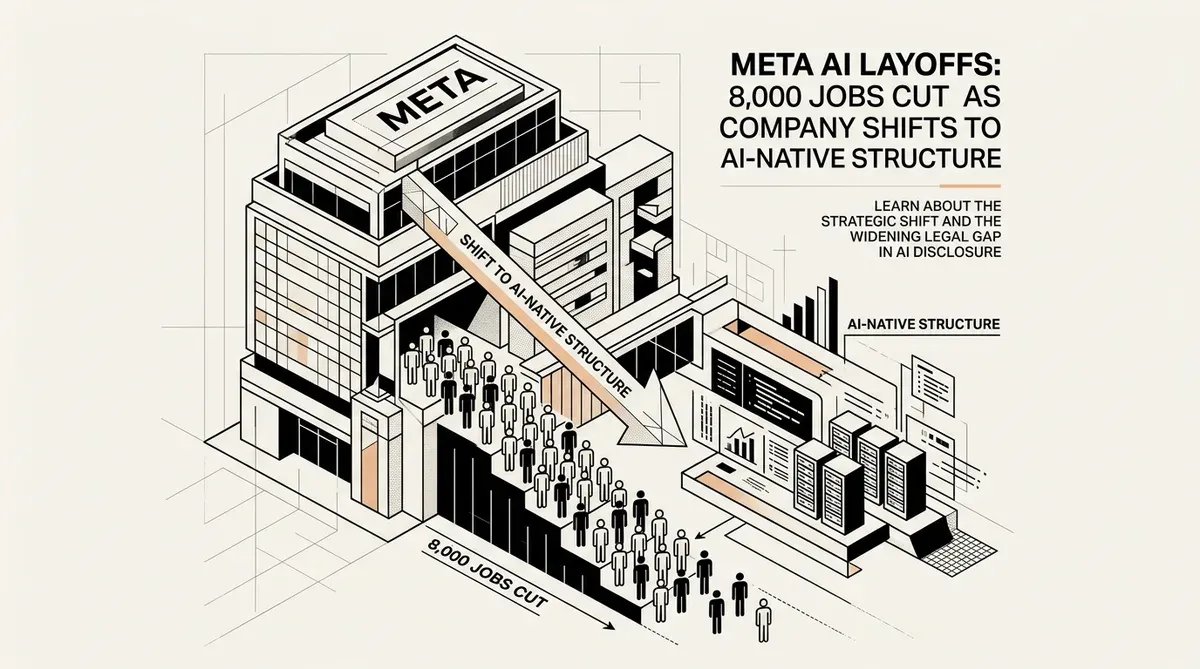
Meta has initiated a significant workforce reduction affecting 8,000 employees, representing approximately 10% of its global staff. The restructuring, which began on May 20, 2026, involves notifying affected workers in three distinct waves starting at 4 a.m. local time. This move coincides with a broader organizational shift toward an AI-native structure, as the company seeks to prioritize efficiency through automated systems and specialized intelligence units.
The Meta AI layoffs are part of a massive internal reorganization. While 8,000 positions are being eliminated, the company is simultaneously redeploying roughly 7,000 other employees into new divisions. These include the Applied AI Engineering group and the Agentic Transformation Accelerator. Janelle Gale, Meta's head of human resources, informed staff that leadership would announce these organizational changes in direct coordination with the job cuts.
Strategic Shift Toward AI-Native Operations
This restructuring highlights a growing trend where major technology firms replace traditional roles with automated workflows. By moving thousands of workers into the Agentic Transformation Accelerator, the company is signaling a pivot toward autonomous agents that can handle complex operational tasks. This strategy aims to reduce long-term overhead while accelerating the development of generative intelligence products.
The broader industry context reveals a sharp increase in workforce reductions linked to automation. Total technology sector job losses have surpassed 113,000 in the first five months of 2026. Companies are increasingly citing the integration of artificial intelligence as a primary driver for these cuts, yet the lack of specific reporting requirements remains a point of contention for regulators.
The Regulatory Gap in AI Disclosure
The Meta AI layoffs occur at a time when federal oversight regarding automation-driven job loss is virtually non-existent. Currently, no federal law requires corporations to provide data proving that AI is actually performing the work previously handled by human employees. This governance gap allows firms to attribute restructuring to technological advancement without facing mandatory audits of their operational reality.
Regulators are beginning to investigate the phenomenon of AI washing, where companies might use the narrative of technological efficiency to mask standard cost-cutting measures. Without a legal framework for AI disclosure, the true impact of automation on the labor market remains difficult to quantify. For decision-makers, this lack of transparency creates a complex environment for assessing the actual productivity gains of AI-first strategies.
As Meta continues its transition, the focus shifts to the performance of its new specialized units. The success of the Applied AI Engineering team will likely determine if this aggressive restructuring delivers the promised efficiency. Industry observers expect more firms to follow this blueprint as the 2026 fiscal year progresses.
While we strive for accuracy, bytevyte can make mistakes. Users are advised to verify all information independently. We accept no liability for errors or omissions.
AI-generated image.
Related Articles
- Meta Realigns Workforce with $135 Billion AI Infrastructure Push
- Meta, Microsoft Cut Staff for AI infrastructure investments
- Meta Implements MCI Tracking to Train Autonomous AI Agents Using Employee Behavior
✔Human Verified