
Miro Accelerates Bug Resolution Fivefold Using Amazon Bedrock AI Agents
Miro uses Amazon Bedrock AI agents to cut bug resolution time by 5x and save 42 years of productivity annually through automated triaging and RAG integration.
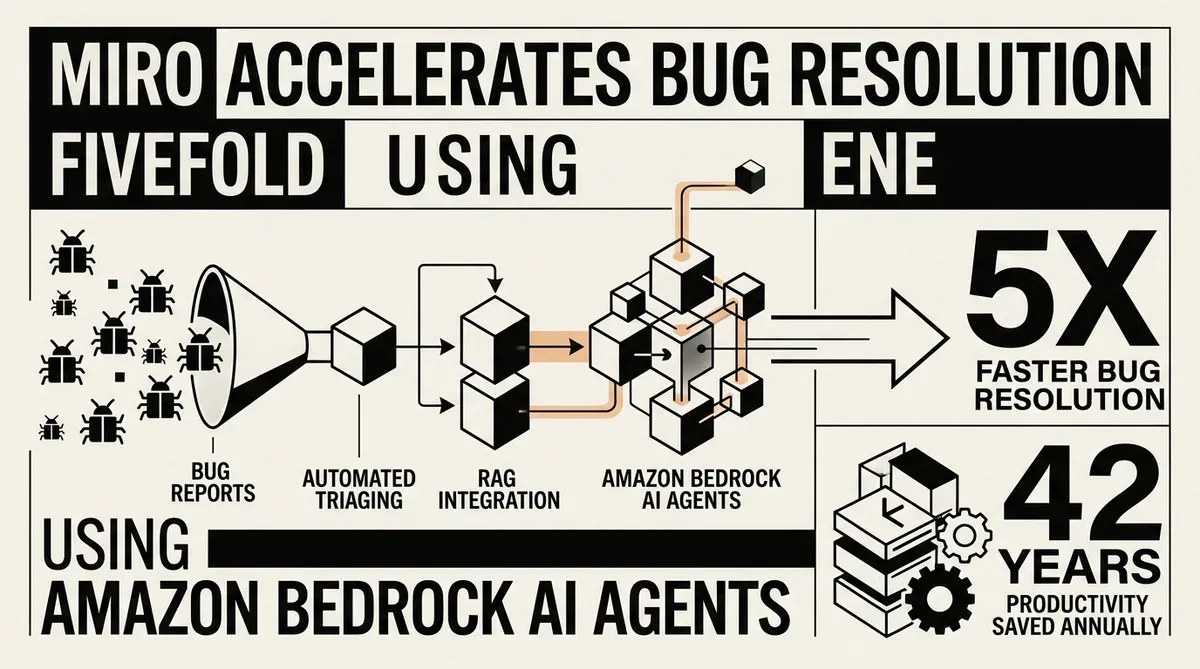
Miro has successfully deployed an automated bug triaging system that reduces the time required to resolve software issues from days to hours. By utilizing Amazon Bedrock, the visual collaboration platform has achieved a fivefold increase in resolution speed, addressing the logistical challenge of managing bug reports for its 95 million users. The system, known as BugManager, was developed in collaboration with the AWS Prototyping and Cloud Engineering team to streamline how technical issues are routed across more than 100 internal software teams.
The implementation of Amazon Bedrock AI agents has significantly improved operational efficiency by reducing team reassignments by six times. Before this deployment, Miro faced a complex manual triaging process where reports often bounced between different engineering groups before reaching the correct developers. The company estimates that this automated approach saves approximately 42 years of cumulative productivity that would otherwise be lost to inefficient routing and resolution delays annually.
Technical Architecture and RAG Integration
The BugManager solution relies on Amazon Bedrock and the Amazon Nova model to process incoming reports. To ensure the AI provides accurate routing, Miro uses Retrieval-Augmented Generation (RAG) to ground the system in its own internal data. This includes product documentation and technical screenshots, allowing the AI to understand the context of a bug within the specific architecture of the Miro platform. By connecting these models to internal Knowledge Bases, the system can identify which team owns the specific code or feature mentioned in a report with high precision.
This deployment highlights a growing trend among enterprise software companies to use generative AI for internal developer productivity. Rather than relying on static rules or manual oversight, Miro uses AI agents to interpret unstructured data from user reports. The integration of Amazon Bedrock AI agents allows the system to not only categorize the issue but also to execute the routing logic required to place the ticket in the correct engineering queue immediately.
Strategic Impact on Enterprise Productivity
For large-scale platforms, the cost of technical debt and slow bug resolution can impact user retention and engineering morale. Miro's move to automate this workflow suggests that AI agents are moving beyond simple chatbots into functional roles that manage complex internal logistics. The ability to cut resolution times by 80% provides a competitive advantage in software delivery speed, allowing engineers to focus on feature development rather than administrative triaging.
The success of the BugManager project demonstrates the practical utility of grounding large language models in proprietary technical documentation. As of May 2026, Miro continues to refine these agents to handle increasingly complex diagnostic tasks. The shift from manual oversight to AI-driven routing is a significant milestone in how modern software organizations manage the scale of global user bases.
While we strive for accuracy, bytevyte can make mistakes. Users are advised to verify all information independently. We accept no liability for errors or omissions.
AI-generated image.
Related Articles
- Amazon Enhances Deadline Cloud with AI-Driven Troubleshooting for Render Pipelines
- AWS Introduces Automated Optimization Tools for Amazon Bedrock AI Agents
- OpenAI GPT-5.5 and Managed Agents Arrive on Amazon Bedrock
✔Human Verified