
Mitsubishi Heavy Industries Validates AIRIS AI System for Autonomous Ship Detection in Orbit
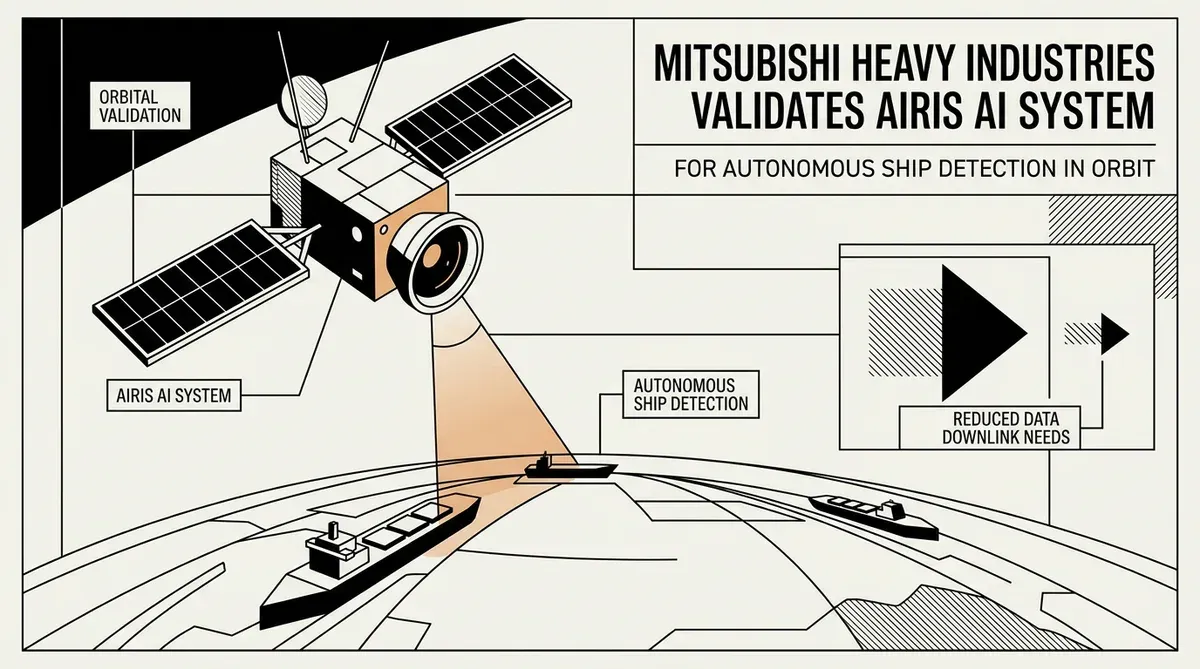
Mitsubishi Heavy Industries has successfully verified its AIRIS AI system in orbit, marking a significant step forward for edge computing in space. The demonstration, conducted aboard the RAISE-4 satellite, proved that the onboard AI could identify and classify ships from maritime imagery without relying on ground-based processing. This capability addresses a major bottleneck in satellite operations: the limited bandwidth available for downloading massive amounts of raw sensor data to Earth.
The AIRIS system, which stands for Artificial Intelligence-based Object Detector, utilizes the SOISOC4 microprocessor. This next-generation space-grade MPU was developed through a joint effort between JAXA and Mitsubishi Heavy Industries. By processing high-resolution images directly on the satellite, the system reduces the volume of data that must be transmitted to ground stations, as only the relevant classification results and metadata need to be sent down. The hardware suite also includes an earth observation camera provided by the Tokyo University of Science.
Strategic Implications for Space-Based Edge AI
The success of the AIRIS AI system mission highlights a shift toward autonomous satellite decision-making. Traditionally, satellites act as passive collectors, beaming raw data to Earth where it is processed hours or days later. Mitsubishi Heavy Industries has demonstrated that AI can operate reliably in the harsh radiation environment of space while maintaining the performance required for real-time object detection. This speed is essential for applications ranging from maritime security to rapid disaster response.
A key technical feature of this deployment is the ability to update the AI model while the satellite remains in orbit. Mitsubishi Heavy Industries intends to establish a continuous improvement cycle where ship images captured during operations are used to retrain the AI on the ground. These optimized models are then uploaded back to the AIRIS AI system, ensuring the system remains accurate as maritime patterns or environmental conditions change. This remote update capability extends the operational life and utility of the hardware.
The RAISE-4 satellite, which launched on December 14, 2025, is a testbed for the Innovative Satellite Technology Demonstration-4 mission. As of May 2026, the successful detection of maritime vessels confirms that the SOISOC4 MPU can handle complex neural network workloads in a vacuum. For the broader aerospace industry, this validates the move toward software-defined satellites that can be repurposed or improved long after they have left the launchpad.
Beyond ship detection, the AIRIS AI system provides a blueprint for future constellations that require inter-satellite coordination. When satellites can process their own data, they can trigger alerts or adjust their own sensors without waiting for instructions from a ground station. This autonomy is a requirement for the next generation of low-earth orbit networks that aim to provide real-time global monitoring. The integration of the SOISOC4 chip ensures that these computations do not compromise the power constraints or thermal limits of small satellites.
The collaboration between JAXA and Mitsubishi Heavy Industries also signals a competitive push in the global space economy. As more private and government entities deploy orbital assets, the ability to extract actionable intelligence at the edge becomes a primary differentiator. The AIRIS AI system demonstration proves that the hardware and software stack is ready for commercial scaling. Future iterations will likely expand to include other object classes, such as aircraft or specific land-based infrastructure, further broadening the market for high-cadence orbital intelligence.
While we strive for accuracy, bytevyte can make mistakes. Users are advised to verify all information independently. We accept no liability for errors or omissions.
AI-generated image.
Related Articles
- Navy Taps Domino Data Lab for $99.7 Million AI Mine Detection Initiative
- Singtel and Mistral AI Collaborate to Scale Sovereign AI Infrastructure in Southeast Asia
- Samsung SDS Drives Sovereign AI transformation
✔Human Verified