
Muse Shop Pay Checkout Goes Live Across Shopify Stores as Banks Raise Alarm [Update]
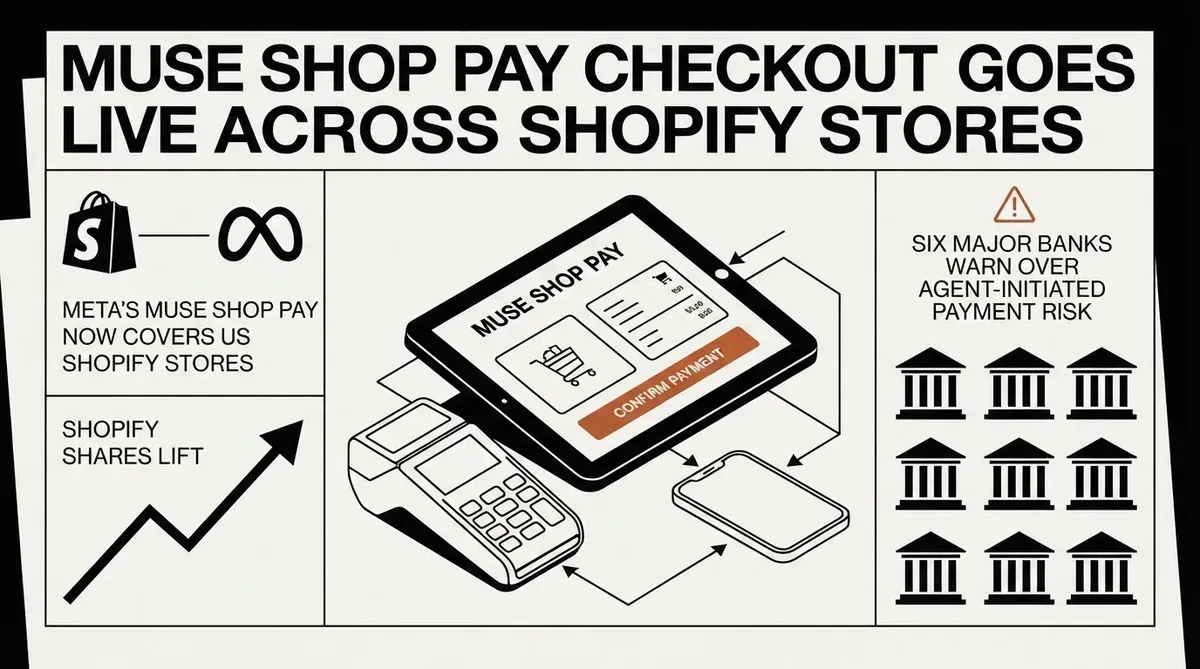
Shopify and Meta have switched on the Muse Shop Pay checkout, letting Meta's personal AI agent browse Shopify-powered storefronts and pay for items on a shopper's behalf. Shopify chief executive Tobi Lütke confirmed the partnership on Sept. 21, 2026, and Meta's Mark Zuckerberg said the same day that the pairing would make shopping and checkout easier inside Muse. Every Shopify store in the United States is covered, and merchants were not asked to opt in.
Investors split on the news. According to Yahoo Finance, Shopify shares climbed about 7% while Meta eased roughly 0.8%, a divergence that tracks where revenue lands once an agent rather than a human completes the purchase. The deal landed two days after we reported that Muse had overtaken ChatGPT to reach No. 1 in the US App Store.
Muse launched on Sept. 8, 2026, and Meta's launch notes promised Shop Pay support would follow. Meta joined Shopify's Agentic Storefronts as an AI sales channel the same day, which placed merchant products inside the Shopify Catalog that Muse reads. Checkout runs over Shopify's Universal Commerce Protocol, the layer that governs AI-driven product discovery and payment, and the shopper approves the order before money moves.
The mechanics are plain. A shopper describes what they want, the agent scans the catalog for matches, compares the options and presents a choice. Once the buyer approves, Shop Pay settles the order using stored payment and delivery details, so no card number is re-entered. Where Shop Pay is unavailable, checkout can run through Stripe Link or browser automation, and each route still requires buyer approval before the order is placed.
What the Muse Shop Pay checkout covers
| Detail | Status |
|---|---|
| Payment rail | Shop Pay |
| Product discovery | Shopify Catalog via Agentic Storefronts |
| Availability | US customers, eligible stores |
| Merchant setup | None; products shared by default |
| Extra fees | None beyond standard payment processing |
| Published launch date | Not announced |
Two details carry weight for merchants running the Muse Shop Pay checkout. Direct checkout is live by default for eligible US-selling stores, so a store owner who does nothing still has inventory purchasable inside Muse. Meta's checkout also does not trigger browser pixels: orders land in the admin attributed to Meta, while third-party attribution tags never fire, which leaves server-side events as the only way to see them. Neither company has published a rollout date, technical specifications, or the commercial terms behind the arrangement.
Amazon moved the other way. Two days before Shopify opened its doors, Amazon blocked Muse agents from its own storefront, so the agent that can now complete a purchase across millions of Shopify merchants cannot reach Amazon's catalog at all.
For shoppers, coverage is uneven. Muse can finish a purchase on a Shopify storefront but not on Amazon, so the same request may succeed or fail depending on which retailer stocks the item. The agent is strong for long-tail merchants and shut out of the largest catalog in US e-commerce.
Where the money actually moves
For merchants, the distribution argument is the selling point. Products already sitting in the Shopify Catalog become searchable and purchasable inside a consumer app that is drawing mainstream traffic, with no new integration and no new contract to sign. That is a different bargain from the paid-advertising model most store owners know, where discovery is bought per click and measured per impression.
Shopify's incentive reaches past checkout fees. The company sells payments, lending and merchant finance as an alternative to traditional banks, and payment volume is the raw input to that business. Every order completed through the Muse Shop Pay checkout adds volume Shopify can route and monetize, which is why the market read the announcement as a gain for Shopify and an open cost question for Meta.
Meta's side of the ledger is harder to parse. The company has not disclosed fees, revenue share or data terms, so it is unclear how a Muse-mediated purchase converts into Meta revenue beyond keeping shoppers inside its app. Meta shares eased while Shopify jumped, and Amazon, which had closed its storefront to Muse agents two days earlier, sat out the rally entirely.
Attribution is the quieter operational problem. Because agent checkout bypasses the browser, standard pixel measurement never fires, and the resulting orders appear in the Shopify admin credited to Meta. Merchants who lean on third-party ad platforms for reporting will see sales they cannot attribute without server-side event tracking, which changes how they weigh spending on the channel.
Banks flag the liability gap
Six major US banks, among them Bank of America and Capital One, have warned that rising autonomy in agentic commerce lifts the risk of scams, fraud and payment disputes, according to Moneycontrol. When software initiates a transaction instead of the cardholder, existing liability rules no longer map cleanly onto what happened. The warnings arrive as major festive shopping events approach, a stretch when transaction volume and fraud attempts both peak.
The banks' concern centers on the authorisation trail. Card network rules were written around a cardholder who taps, types or signs, and the dispute process assumes a customer who can describe a purchase they personally made. With an agent acting on a shopper's instruction, establishing intent, or the absence of it, becomes an evidence problem for the issuer rather than a paperwork exercise.
Dispute mechanics matter more than the demo. If Muse buys the wrong size or the wrong model, or from a seller that never ships, the customer's first call is likely to go to the bank rather than to Shopify or Meta. Chargeback rules, merchant-of-record questions, and the data-sharing terms between Meta and Shopify all need settling before agentic checkout scales past early adopters.
The September timing adds volume to the risk. Shopify's own changelog dated Sept. 8 lists Meta as an AI channel in Agentic Storefronts, and eligible US stores had direct checkout switched on before this week's announcement. Festive sales events in the coming weeks concentrate a large share of annual e-commerce spending, so any fraud or dispute spike tied to agent purchases would surface on bank dashboards during the busiest stretch of the retail calendar.
Why this matters
Meta has handed its consumer agent a wallet and Shopify has handed it a storefront, but neither has settled who pays when a purchase goes wrong. That gap, more than the convenience of a one-tap checkout, decides whether agentic commerce reaches mainstream shoppers. Until banks, platforms and merchants agree on liability for agent-initiated payments, every new Muse integration will be measured against the same unresolved question.
See our earlier coverage: Muse AI Agent Beats ChatGPT to No. 1 in the US App Store
AI-generated image.
Related Articles
- Meta's Muse AI agent sends emails, books trips and shops for $20 a month
- Muse AI Agent Beats ChatGPT to No. 1 in the US App Store
- Synchrony OpenAI agentic commerce push brings store-card checkout to ChatGPT
✔Human Verified
Researched and cross-referenced against primary sources by the Bytevyte editorial team. This article was generated with the assistance of artificial intelligence and reviewed by the Bytevyte editorial team.