
Nokia and NVIDIA Launch $1 Billion AI-RAN Partnership to Drive 6G Innovation
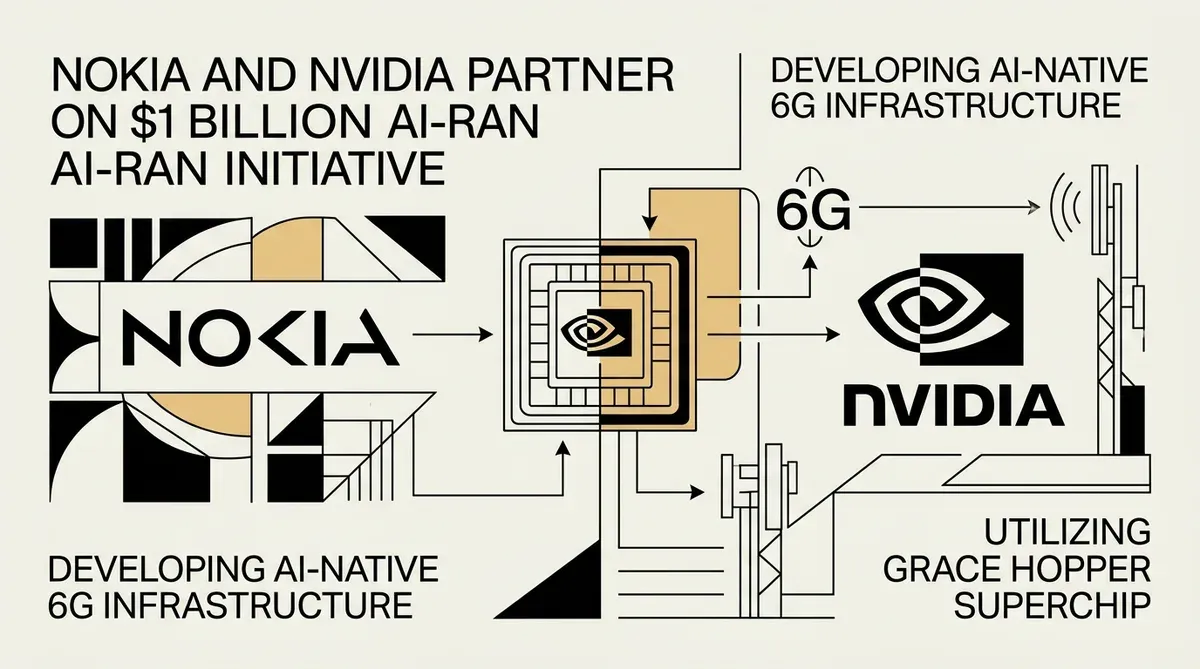
Nokia and NVIDIA have entered a strategic partnership to accelerate the development of AI-RAN technology, with NVIDIA committing a $1 billion investment to the initiative. The collaboration, announced this week, focuses on building a unified AI-native infrastructure designed to bridge the gap between current 5G-Advanced services and the future 6G standard. By integrating high-performance computing with telecommunications software, the two companies aim to transform how mobile networks process data and manage radio resources.
The technical foundation of this partnership relies on the NVIDIA Grace Hopper Superchip, which will be paired with Nokia's specialized RAN software. This hardware-software integration allows for high-performance network processing that can handle both traditional telecommunications tasks and intensive AI workloads on the same platform. As mobile operators look for ways to monetize their infrastructure beyond basic connectivity, this AI-native design provides the computational power necessary for advanced services like real-time edge analytics and autonomous network optimization.
Strategic Implications for the 6G Evolution
This $1 billion deal is a significant shift in the telecommunications industry's approach to infrastructure. Traditionally, radio access networks and AI processing have operated on separate silos. The AI-RAN initiative seeks to merge these domains, creating a more flexible and efficient architecture. For Nokia, the partnership provides a massive capital injection and access to world-class silicon, while NVIDIA gains a deeper foothold in the global telecommunications market as it seeks to expand the use cases for its data center chips.
A central component of the agreement is the establishment of a global AI-RAN research laboratory. This facility will serve as a testing ground for AI-native 5G-Advanced services and the early development of 6G protocols. By centralizing research efforts, Nokia and NVIDIA intend to set the technical benchmarks for the next decade of wireless communication. The lab will focus on optimizing the NVIDIA Grace Hopper Superchip for specific telco requirements, ensuring that the power efficiency and throughput meet the rigorous demands of carrier-grade networks.
Market Impact and Decision-Maker Takeaways
For enterprise leaders and network strategists, this partnership signals that the path to 6G will be defined by AI integration rather than just incremental speed increases. The shift toward AI-native designs suggests that future network investments should prioritize platforms capable of running heterogeneous workloads. Companies currently deploying 5G-Advanced should evaluate how their hardware choices match the emerging AI-RAN ecosystem to avoid premature obsolescence.
The move also highlights the growing influence of chipmakers in the telecommunications stack. As software-defined networking becomes the norm, the underlying silicon becomes the primary differentiator for performance and capability. Nokia's decision to work closely with NVIDIA may force competitors to seek similar high-scale silicon partnerships to remain competitive in the race toward 6G. As of 2026-05-12, this collaboration is one of the largest financial commitments to AI-driven telecommunications infrastructure to date.
While we strive for accuracy, bytevyte can make mistakes. Users are advised to verify all information independently. We accept no liability for errors or omissions.
AI-generated image.
Related Articles
- Nscale Secures $790 Million for Sovereign AI Infrastructure in Norway
- NVIDIA and SKT Partner on Industrial Digital Twins
- NVIDIA GPU Design Automation Replaces Months of Manual Work
✔Human Verified