
OpenAI Atlassian partnership deepens as GPT-6 agents move into Jira and Rovo
The OpenAI Atlassian partnership puts GPT-6 models inside Jira, Confluence and Rovo, testing whether enterprise distribution beats model benchmarks.
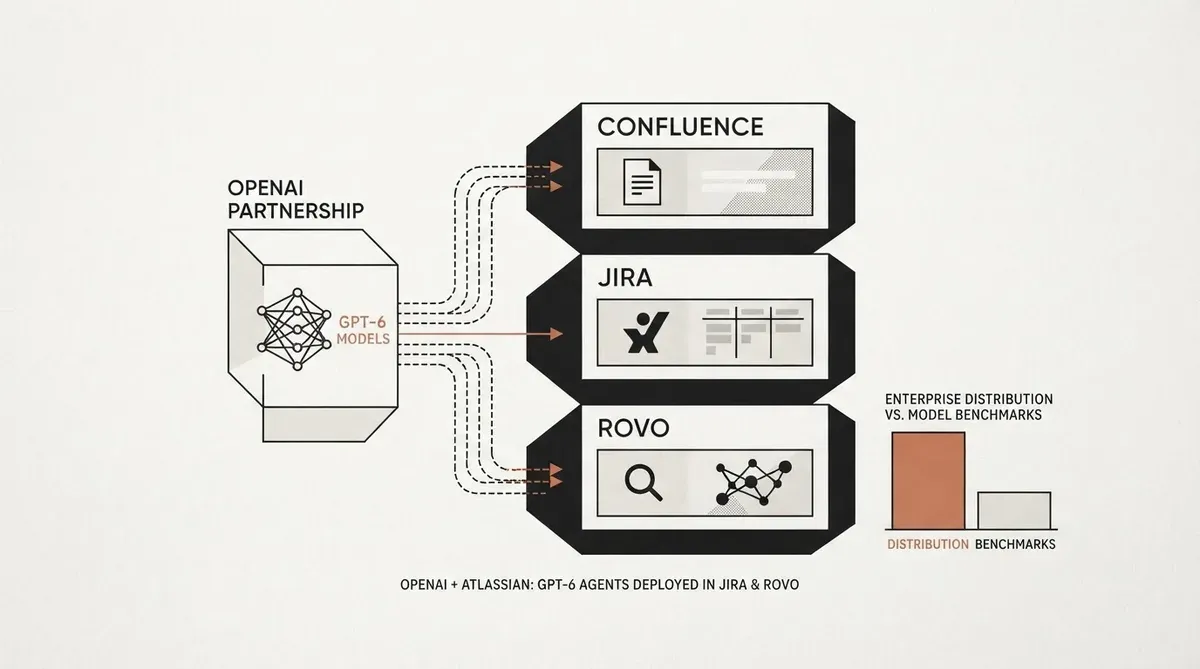
OpenAI's newest enterprise push runs through software that millions of knowledge workers open every morning. The company expanded its OpenAI Atlassian partnership on October 6, 2026, putting frontier models from the GPT-6 family inside Atlassian's platform and its Rovo AI product. The deal spans Jira, Confluence and Bitbucket, the systems enterprise teams use to track projects, documents and code.
The two companies have worked together since 2023. This agreement moves that relationship from a set of features toward infrastructure. OpenAI models now handle reasoning across Rovo and the wider Atlassian platform, while Atlassian's Teamwork Graph supplies the enterprise context those models reason over. Teamwork Graph maps the relationships among people, projects, tickets and documents, so an agent answering a question in Jira can ground its answer in actual work items and technical documentation rather than general web knowledge.
What ships immediately is narrower than the framing suggests, and worth separating from what remains exploratory. New command-line plugins connect ChatGPT and Codex to Jira, Confluence and Bitbucket, which lets Codex users pull relevant work items and technical docs while writing, testing and shipping software. Assigning Jira work to AI agents and measuring AI's effect on engineering output through Atlassian's DX platform are under exploration, not generally available.
What the OpenAI Atlassian Partnership Actually Ships
| Capability | Status | Where it runs |
|---|---|---|
| OpenAI models power reasoning | Available now | Rovo, Jira, Confluence, Bitbucket |
| CLI plugins linking ChatGPT and Codex to work context | Available now | ChatGPT, Codex, Jira, Confluence, Bitbucket |
| Assigning Jira work to AI agents | Under exploration | Jira |
| Measuring AI impact on engineering output | Under exploration | Atlassian DX |
Both companies published the news on the same day, and Atlassian framed the work as grounding frontier intelligence in enterprise context. Atlassian has also attached a spending commitment to the deeper tie-up, as stated in its own announcement of the deal.
Atlassian's platform stays multi-model, and the company has said as much. That detail matters more than the GPT-6 branding: Atlassian is buying optionality rather than exclusivity, and OpenAI is buying reach rather than a lock on Atlassian's customer base.
The commercial mechanics cut differently for each side. Atlassian sells seats and platform subscriptions, so its return on the deal arrives as renewal and expansion of existing contracts. OpenAI sells consumption, so its return arrives as inference volume running through Atlassian's products. A customer that enables Rovo does not necessarily generate more OpenAI revenue than one that leaves it off, which means the two companies measure success against different clocks and different numbers.
Why Distribution Settles This Fight
Model benchmarks have converged faster than distribution channels have. Frontier systems from OpenAI, Anthropic and Google now trade small leads on reasoning and coding evaluations, and buyers at large enterprises rarely switch vendors on the strength of a benchmark delta. What they do switch on is whether an assistant already sits inside the tools their employees use.
That is the ground OpenAI is competing on against Anthropic and Google in enterprise deployments. Atlassian's install base gives OpenAI an entry point into engineering and operations workflows that does not require convincing a CIO to adopt a new application. Anthropic has pursued the same logic through coding tools and cloud partnerships; Google has it through Workspace. The OpenAI Atlassian partnership adds another front: the project and issue tracking layer where engineering work is planned, assigned and measured.
The 2023 starting point makes the shift in ambition visible. That earlier phase put OpenAI models behind assistive features inside Atlassian products. The current agreement places them in the reasoning path for agents that read work items, propose changes and, on the roadmap, take on assigned tasks. Assistance and delegation carry different failure costs, and the second is harder to reverse once teams build habits around it.
The read-through to Microsoft is direct. Enterprise knowledge and workflow sit on the installed base of the large suite vendors, and Atlassian occupies a substantial share of that territory in software organisations. Every agent that answers a Jira question with an OpenAI model is a workflow Microsoft's Copilot stack does not touch.
The Trade-Offs Both Sides Are Managing
OpenAI accepts a dependency it cannot control. Atlassian keeps the customer relationship, the data graph and the decision about which models to route work to. If a future Anthropic or Gemini model performs better on a given task, Atlassian can shift traffic without asking OpenAI's permission. OpenAI's models become one option in a routing layer, not the default.
Atlassian takes on a different risk. Wiring a third-party frontier model into Jira and Confluence means enterprise data flows through OpenAI's systems under terms Atlassian negotiates but does not set. Atlassian's customers are unusually sensitive to where their code, incident reports and internal documentation travel, and the governance language around the deal reflects that pressure.
Compliance questions follow the data. Enterprise buyers ask where prompts and retrieved documents are stored, how long they are retained and which jurisdiction processes them. Atlassian's ability to answer those questions for regulated customers in finance, healthcare and government will shape how far the integration spreads beyond software teams that adopt tools quickly.
Cost is the third variable. A spend commitment converts a partnership announcement into a revenue line for OpenAI, but it also fixes Atlassian's exposure at a moment when inference prices are falling and open-weight models are improving. Committing volume early is cheaper than paying spot rates later only if the models stay ahead.
What Would Prove It Worked
Announcements in this category have a poor record of moving enterprise software valuations on their own. The evidence that separates a durable shift from a headline reaction appears later, in attach rates, seat expansion and usage revenue reported in subsequent quarters. For Atlassian, that means DX adoption and Rovo usage figures; for OpenAI, it means enterprise revenue attributable to embedded distribution rather than direct API sales.
Measurement changes the terms of the contest again. Atlassian's DX platform already tracks engineering output, and extending it to AI's effect turns model choice into a procurement decision with a number attached. If a rival model scores better on the same measured tasks, Atlassian has both the evidence and the architecture to switch. Vendors then compete on measured task performance inside a specific customer's workflow, which is a harder test than a public benchmark.
The deal arrived in a crowded week for OpenAI's newsroom. The same October 6, 2026 batch included an October 2026 update to the GPT-6 family covering GPT-6 Sol and GPT-6 Luna, a mathematics result touching on Millennium Prize problems, and the appointment of Paul Christiano to the company's Foundation Board and Safety Committee. Governance, research and distribution announcements sharing one publication date is itself a signal about how OpenAI wants to be read: as a company selling capability and credibility to the same enterprise buyers.
For engineering leaders evaluating the integration, the near-term question is narrow. The CLI plugins work today, and the Jira agent assignment and DX measurement features do not. Teams that need grounded answers inside Jira and Confluence can pilot now; teams waiting on agent-driven ticket assignment should treat the roadmap as uncommitted.
Why this matters
The OpenAI Atlassian partnership shows that the enterprise AI contest is being decided by who occupies the tools teams already use, not by which model tops a leaderboard. For buyers, that means more capable assistants arriving inside existing subscriptions and less reason to procure a separate AI product. For OpenAI, Anthropic and Google, the next phase of competition runs through partnerships with incumbent software vendors, where the advantage goes to whoever gets embedded deepest before the routing decisions harden.
Sources
OpenAI News — Atlassian and OpenAI expand their partnership
Atlassian and OpenAI expand partnership to turn enterprise knowledge into action | OpenAI
AI-generated image.
Related Articles
- GPT-6 Astra Pricing: OpenAI Opens Flagship Model to Enterprises
- GitHub Copilot Puts GPT-6 Astra Behind Premium Tiers
- GPT-6 Astra on Amazon Bedrock hits general availability for enterprises
✔Human Verified
Researched and cross-referenced against primary sources by the Bytevyte editorial team. This article was generated with the assistance of artificial intelligence and reviewed by the Bytevyte editorial team.