
Oracle Point Beach Nuclear Deal: Absorbing $300M to Shield Wisconsin Ratepayers
The Oracle Point Beach nuclear deal would absorb $300M in fuel costs for 1M+ Wisconsin ratepayers, but PSC approval and a delivery delay loom.
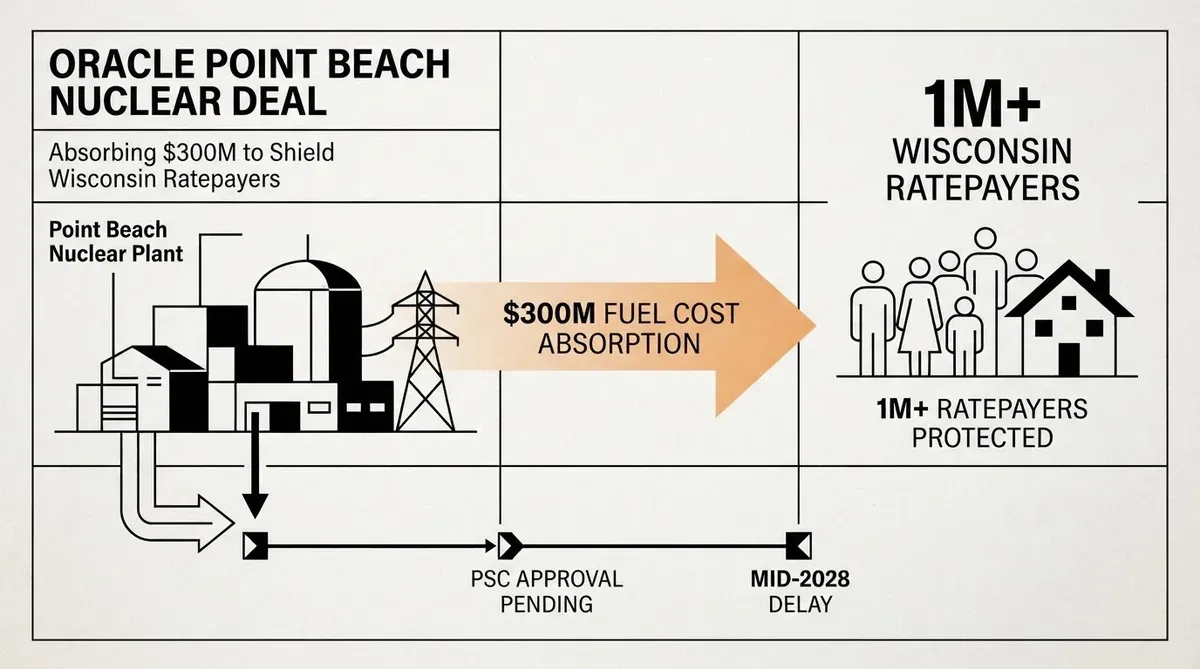
Oracle will buy a share of the electricity generated by the Point Beach Nuclear Plant in Manitowoc County, Wisconsin, and pay for it from its own balance sheet rather than letting the cost reach household bills. The company values that commitment at roughly $300 million in avoided fuel costs for more than 1 million Wisconsin utility customers, with the savings window running from 2027 to 2033. The Oracle Point Beach nuclear deal supports Project Lighthouse, Oracle's data center campus in Port Washington. The subscription agreement still needs approval from the Public Service Commission of Wisconsin.
The direction of the money sets this apart. Data center operators normally sign long-term power contracts and leave generation and transmission upgrades to utilities, which recover the expense from ratepayers across decades. Oracle proposes the inverse: it funds the energy for its own campus and lets a nuclear subscription offset fuel costs for everyone else on the We Energies system.
Oracle's projections for Project Lighthouse are large and specific. The company expects the campus to deliver about $11 billion in economic impact, support 4,000 construction jobs, and leave 1,000 permanent operational positions once it is running.
What the Oracle Point Beach Nuclear Deal Covers
Point Beach is an existing plant, not a new build. Oracle is contracting for output the plant already produces rather than financing a reactor. The plant's fuel costs have landed on We Energies customers for several years, adding to bills rather than reducing them. Subscribing to a portion of the generation gives the plant a committed buyer and pulls the matching fuel-cost burden out of the rate base.
Mahesh Thiagarajan, executive vice president of Oracle Cloud Infrastructure, has described the commitment as a way to protect Wisconsin ratepayers while keeping reliable, carbon-free power available to the state. That claim holds only if the subscription price sits at or below what the utility would otherwise pay for the same electricity.
| Item | Detail |
|---|---|
| Announced savings | About $300 million in fuel costs |
| Customers affected | More than 1 million Wisconsin utility customers |
| Savings window | 2027 to 2033 |
| Plant | Point Beach Nuclear Plant, Manitowoc County |
| Data center | Project Lighthouse, Port Washington |
| Economic impact | About $11 billion |
| Employment | 4,000 construction, 1,000 operational roles |
| Approval required | Public Service Commission of Wisconsin |
| Independent analysis of delivery | Mid-2028 at the earliest, against Oracle's 2027 guidance |
Divide the headline number by the customers it covers and the scale becomes clearer. Three hundred million dollars spread across more than a million customers works out to roughly $300 per customer over seven years, or about $43 a year. That is real money in a household budget, and a rounding error against a campus Oracle expects to generate $11 billion in economic activity.
A hyperscaler has a reason to pay above market for firm nuclear output. Wholesale electricity prices move with gas, and a campus drawing hundreds of megawatts needs supply that does not reprice every season. Nuclear generation offers Oracle a fixed, low-carbon source and a public-interest argument that regulators elsewhere will read closely.
The economics cut both ways. If Oracle pays a premium for the power, the customer savings are real but funded from Oracle's margin, and the company can revisit the arrangement when the contract comes up for renewal. If Oracle pays below market, ratepayers are underwriting a data center's electricity. The Public Service Commission has to determine which version it is reviewing before it approves anything.
We Energies has its own stake in the outcome. A committed subscriber reduces the plant's exposure to wholesale price swings, and that benefit accrues to the utility and its shareholders first. Whether customers see the savings depends on how the commission orders the fuel-cost allocation in the final agreement.
One structural point matters. The agreement adds no new generation to the Wisconsin grid. Oracle is buying from an existing plant, so as more data center load arrives in the state, the supply side stays where it is. The ratepayer benefit survives, but the subscription reallocates existing costs rather than expanding the supply base.
The size of the commitment moves with the size of the campus. Oracle's figures describe 1,000 permanent operational roles and $11 billion in economic activity, which implies a facility drawing power at industrial scale rather than a single warehouse. The subscription is sized to that footprint, so the savings and the obligation rise and fall with Oracle's build-out plans.
The Counterargument That Holds Up
The strongest objection concerns timing. Independent analysis of the Port Washington campus concludes that meaningful power at the Vantage Data Centers facility being built for Oracle is unlikely to be delivered before mid-2028, roughly a year beyond the 2027 start Oracle has guided to.
Take the delay seriously and the $300 million changes character. The savings are projected across 2027 to 2033, so a later start pushes the benefit toward the back of that window. Ratepayers do not lose the money; they wait longer for it, and the further out a projection sits, the more assumptions it carries about load, fuel prices, and whether the campus ever reaches the utilization Oracle has planned.
Regulatory review cuts the same way. A subscription agreement of this size takes months for the Public Service Commission to work through, and the savings clock is already set to start in 2027. Any condition that shifts costs back toward Oracle's side of the ledger narrows the benefit the announcement has already been credited with.
Enforceability is the second objection. Nothing binds until the commission signs off, and it can attach conditions, restructure how costs are allocated, or reject the agreement outright. Oracle's commitment is also only as durable as its Wisconsin footprint. A campus that never reaches full load leaves behind a commitment sized for a campus that did.
The objections are about schedule and enforcement, not about whether the model can work. The alternative is the arrangement that has already strained utility commissions across the country: data centers drawing gigawatts while residential rates climb to pay for the infrastructure behind them. Writing the fuel-cost check is a cheaper way for Oracle to buy social license than fighting that argument state by state, and Wisconsin is where the argument gets its first hearing.
The Public Service Commission docket is where the real decision happens. If the commission approves a structure in which the operator funds the power and ratepayers capture the fuel savings, other hyperscalers building in regulated markets will face pressure to offer comparable terms. If it rejects the agreement or narrows the cost allocation, the Oracle Point Beach nuclear deal loses its mechanism and becomes a statement of intent with a price tag attached.
Why this matters
Oracle has turned a cost problem into a negotiating position. The $300 million figure matters less than the template it creates: a hyperscaler volunteering to absorb power costs in exchange for regulatory goodwill in a state that will decide whether its campus can run at full load at all, and at what price to every other customer on the same grid.
For Wisconsin ratepayers, the benefit depends on a commission ruling and on a construction schedule that independent analysis disputes. For everyone else watching data center power politics across the Midwest, the test is whether funding the power becomes the price of entry in regulated markets or stays a one-off gesture.
AI-generated image.
Related Articles
- Ratepayer Protection Act Clears the House 417-3, but Its Weakest Point Is Enforceability
- Washington's $1.9B bet on the Duane Arnold nuclear restart
- Oracle's Project Jupiter Force Majeure Notice Tests AI Data Center Financing
✔Human Verified
Researched and cross-referenced against primary sources by the Bytevyte editorial team. This article was generated with the assistance of artificial intelligence and reviewed by the Bytevyte editorial team.