
PC Shipments Plunge 20.1% in Q3 2026 as AI Buildout Lifts Holiday Prices
PC shipments plunge 20.1% in Q3 2026 as AI data-center memory demand lifts component costs. Why holiday PC prices will stay high and what buyers should do.
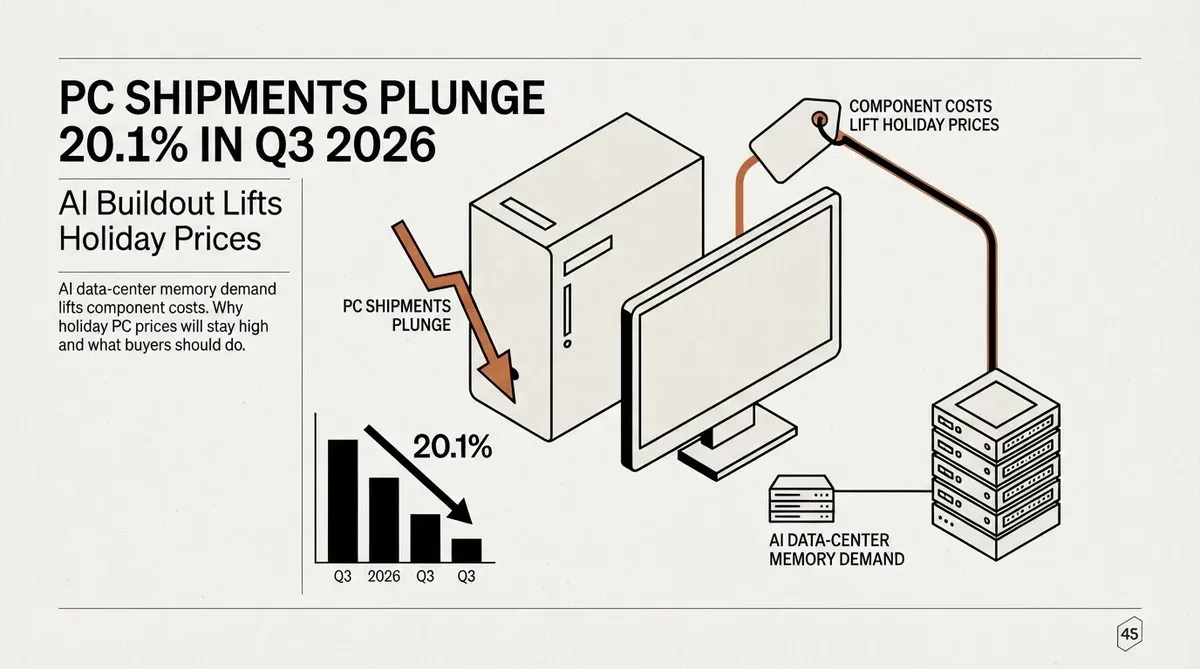
Global PC shipments plunge 20.1% year over year in the third quarter of 2026, landing at 62.7 million units against 78.5 million in the same period of 2025, according to preliminary figures from IDC. The gap is 15.8 million machines, and the deepest third-quarter year-over-year fall the research firm has recorded. It is also the second consecutive decline, after a 3.8% drop between April and June ended a nine-quarter run of growth.
The sequential number is just as striking. Shipments slipped 9.1% from the second quarter, reversing the pattern in which Q3 outpaces Q2 as vendors and retailers stock up for back-to-school and holiday demand. That seasonal lift failed to appear.
Why PC Shipments Plunge 20.1% in Q3 2026
IDC attributes the downturn to supply constraints, high price points and logistical disruption arriving together. The heaviest factor is a demand pull-in: vendors and channel partners loaded up on inventory early in 2026 to get ahead of expected memory price increases, then spent Q3 clearing stock already in warehouses instead of ordering new machines.
The AI buildout is the root cause. Memory production is being pulled toward data-center customers, and the components that go into servers overlap with those needed for ordinary laptops and desktops. When chipmakers can sell the same silicon at data-center prices, PC makers compete for a smaller allocation and pay more for what they receive.
IDC flagged the turn in July 2026, when it logged its first year-over-year decline in nine quarters and cut its full-year forecast. Q3 turned that dip into a slide, roughly five times steeper than the previous quarter's contraction.
The Vendors That Absorbed the Damage
Losses were not spread evenly. The three biggest vendors by volume fell harder than the market as a whole, while Apple shrank less and gained share as a result.
| Vendor | Q3 2026 YoY shipment change | Context |
|---|---|---|
| HP | -30.9% | Sharpest fall in the group |
| Dell | -25.0% | Decline steeper than the market |
| Lenovo | -22.6% | Volume leader, still down more than the market |
| Apple | -11.3% | Market share rose from 8.5% to 9.5% |
| ASUS | -8.6% | Smallest decline among the top five |
Apple's quarter shows how share moves inside a shrinking market. Mac shipments declined, yet Apple's slice of the total climbed because competitors contracted faster. HP recorded the sharpest single figure of the quarter, giving up close to a third of its year-earlier volume. Taken together, the top three vendors shipped 11.6 million fewer units than a year before, which accounts for most of the market's 15.8 million unit shortfall.
What Buyers Should Expect Through the Holidays
Price is the deciding factor for anyone shopping for a laptop or desktop now. IDC projects global PC shipments will fall 11.3% across 2026, with average selling prices climbing sharply; its published estimates for the price increase range from 17% to 18.3% depending on the document. The firm does not see meaningful relief before the end of 2027, and Intel's chief executive has said supply will not loosen until 2028.
That rewrites the usual holiday script. Instead of the seasonal discounts buyers have learned to wait for, the market is settling around elevated list prices punctuated by short-lived promotions. Vendors are also pushing a richer mix: fewer units, but more expensive configurations built around AI-capable processors and larger memory tiers.
The mix shift has a second edge. IDC's June outlook warned that the final quarter of 2026 could bring a year-over-year fall of as much as 20%, which would leave the full-year decline close to its 11.3% projection without a late recovery. Availability is also becoming less predictable, so a configuration in stock this month may not be next month at the same price.
Vendor economics look different from what the PC shipments plunge 20.1% headline suggests. Falling unit volumes do not automatically mean falling sales value, because the machines still selling carry higher price tags. That rewards premium positioning over volume, and it explains why manufacturers can report steady revenue while shipping far fewer machines.
New fabrication capacity is due in 2027 and 2028. Even when it arrives, IDC expects PC pricing to settle above 2025 levels rather than return to them.
The Buy-Now-or-Wait Calculation
For a buyer with a working machine, the case for waiting is weaker than it looks. Holding off has historically paid because prices drift down and specifications improve. The current setup points the other way: memory costs are still rising, the pull-in hangover will keep channel inventory thin into early 2027, and IDC's own forecast has prices climbing rather than easing.
Against that, a 20% shipment drop forces vendors to compete harder for the customers who are still buying. Short-term promotions around the holidays are plausible, particularly on configurations that channels over-ordered earlier in the year. Those discounts are tactical and do not change the direction of component costs.
Two routes sit between paying full price for new hardware and waiting indefinitely. Refurbished and previous-generation machines avoid the newest memory-heavy configurations, and buyers willing to add RAM themselves can sometimes spend less than they would at purchase. Both carry trade-offs in warranty coverage and useful lifespan that the price gap has to justify.
Two caveats belong on the record. These are preliminary IDC figures, and the firm routinely revises its tracker once full-quarter data is complete. Shipment counts also measure what vendors and channels take in, not what consumers carry out of stores.
Why This Matters
The AI buildout was framed as an infrastructure story, and Q3 shows its costs reaching the consumer checkout. Demand for memory from data centers now sets the floor under laptop and desktop pricing, which is why a historically weak shipment quarter is arriving alongside rising average selling prices instead of discounts. The share shifts inside the decline, with Apple gaining ground while HP loses close to a third of its volume, will shape which vendors can afford to compete on price once supply eases. For buyers, the near-term read is straightforward: plan around higher prices through 2027 rather than waiting for a correction that IDC does not forecast.
AI-generated image.
Related Articles
- Acer Chief Sees PC Price Increases in Q4 2026 Peaking Near Mid-2027
- Samsung Strike Threat Drives 20% Surge in Memory Spot Prices
- Graphics Card Prices Hit Record Highs as the AI Memory Crunch Reshapes Upgrades
✔Human Verified
Researched and cross-referenced against primary sources by the Bytevyte editorial team. This article was generated with the assistance of artificial intelligence and reviewed by the Bytevyte editorial team.