
Pixel Modem Zero-Day: Google's Patch Lands, CISA Escalates Within a Day
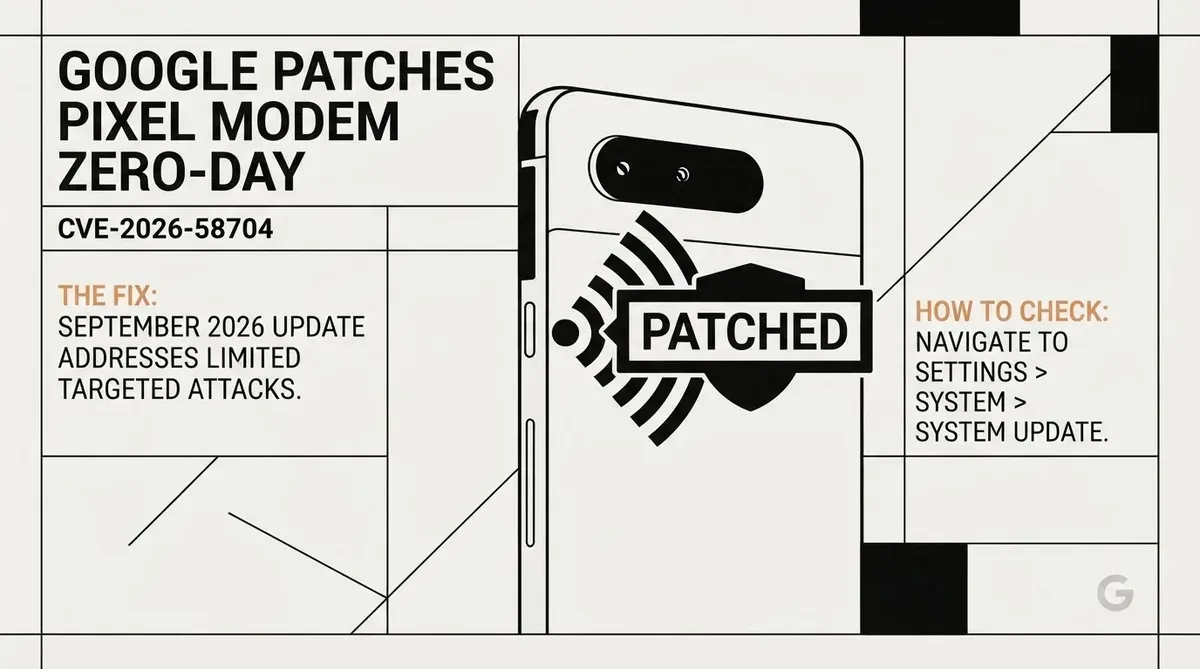
Google has fixed a Pixel modem zero-day that attackers had already used against a small number of handsets, and US federal agencies were placed on a remediation deadline one day later. The flaw is tracked as CVE-2026-58704. It let a radio signal from a nearby position bypass permission checks on the phone without the owner doing anything. Google published the September 2026 Pixel Update Bulletin on 15 September. CISA added the vulnerability to its Known Exploited Vulnerabilities catalog on 16 September.
The sequence matters more than the score. Once a vendor confirms an attack in the wild, the flaw moves onto a binding federal patch clock within a day, which turns a Pixel firmware update into a compliance item for any organisation that tracks the KEV list. The vulnerability itself is narrow: one logic error in baseband code, one permission bypass, one fix. The consequences are not, because that code sits below every control a phone owner or an administrator normally holds.
| Attribute | Detail |
|---|---|
| CVE | CVE-2026-58704 (Android bug A-484011314) |
| Component | Cellular Modem, baseband firmware |
| Type | Elevation of privilege through a permission bypass |
| Severity | High, CVSS 8.0 |
| Attack vector | Remote and proximal or adjacent, no user interaction |
| Fixed in | September 2026 Pixel Update, patch level 2026-09-05 or later |
What Google Fixed, in Technical Terms
Google classifies the issue as an elevation-of-privilege bug in the modem subcomponent. It is rated High at CVSS 8.0 and filed internally as Android bug A-484011314. The CVE record traces the fault to a mistake in the cellular modem's logic that lets an attacker skip permission checks and escalate privilege remotely from an adjacent position. No additional execution privileges are required on the device, and nothing prompts the owner to tap, open or approve anything. That absence of user action is what puts it in the zero-click class.
The bulletin covers 110 vulnerabilities in total. Critical-rated fixes run across the Bootloader, Modem and Trusted Execution Environment, alongside remote code execution issues in subcomponents that include the IP Multimedia Subsystem and Telephony. The spread of those fixes shows how much of the radio stack accepts input from outside the handset. The EPSS score for CVE-2026-58704, which estimates the likelihood of exploitation over the next 30 days, sits near 0.21%.
Why the Modem Is the Hard Case
This bug is difficult to defend because of where it lives: baseband firmware rather than application code. The app sandbox, the runtime permission prompts and Play Protect scanning all operate above the modem, so none of them can inspect traffic that arrives over the air. The baseband keeps its own software stack, negotiates with cell towers and manages network handoffs on its own terms.
Elevation of privilege is the class of flaw that converts a foothold into control. The layers that normally separate a compromised radio stack from the rest of the handset, the Bootloader and the Trusted Execution Environment, also needed critical patches in the same bulletin. Google has not named the attackers or described their tools, which leaves owners unable to judge whether they were among the targets.
The Trade-off: A Fast Clock and Hardware Left Behind
The attack window is narrow by design. Google places the attacker in a proximal or adjacent position, meaning physical radio range rather than the open internet. Mass campaigns spread through links and attachments do not fit that profile. Tooling aimed at named targets does. Google has not said who carried out the attacks or how many devices were affected. Its wording on scope, describing exploitation as limited and targeted, is the phrasing it reserves for narrow, directed campaigns rather than mass malware.
Standard mobile security advice does not apply. Avoiding suspicious links, sticking to official app stores and ignoring unexpected messages all defend against threats that need some form of user action. A zero-click modem bug bypasses those habits. Installing the firmware fix is the only user-side control that changes the outcome.
Risk then splits by profile. A typical owner faces a low probability of being singled out. Anyone working in journalism, activism, litigation or executive roles has reason to install the update now rather than wait for the next automatic cycle. Owners of Pixels that have fallen outside Google's security support window cannot reach the required patch level, and this bulletin leaves them without a fix. That is the limit of the fast federal timeline: it pushes supported devices to patch and does nothing for the ones the vendor has stopped updating.
How to Check a Pixel and Install the Fix
Supported Pixel and Google devices reach the 2026-09-05 patch level or later with this update. On a Pixel, the relevant line appears under Settings, then About phone, then Android version. A date earlier than 2026-09-05 means the handset is still exposed. The install path runs through Settings, then System, then Software update.
Administrators have limited options after the fact. Mobile device management tools can confirm whether a device reports the right patch level. A compromise leaves no obvious app-level trace for users to find, so prevention is the only control that matters.
Why This Matters
The Pixel modem zero-day lands where consumer attention rarely goes. Updates that change what appears on screen get noticed; fixes that decide whether a handset can be reached by a nearby radio sit in firmware almost nobody examines. For Pixel owners the decision is simple, because the patch is available now and takes minutes. For the wider Android ecosystem, the reminder is that baseband code remains among the least auditable parts of a modern phone, and one logic error there can undo the layers built above it.
Sources
Google Pixel owners urged to patch actively exploited modem flaw
AI-generated image.
Related Articles
- Chrome 153 Zero-Day Patch Bundles 230 Fixes in Google's First Two-Week Release
- Record September 2026 Patch Tuesday: 974 Fixes, Two Live Zero-Days, and an Overloaded Triage Pipeline
- Apple's iOS 26.5.2 Security Update Patches 29 Vulnerabilities as AI Threats Accelerate
✔Human Verified
Researched and cross-referenced against primary sources by the Bytevyte editorial team. This article was generated with the assistance of artificial intelligence and reviewed by the Bytevyte editorial team.