
PJM Grid Data Center Incident Exposes the Hidden Fragility Behind America's AI Infrastructure Boom
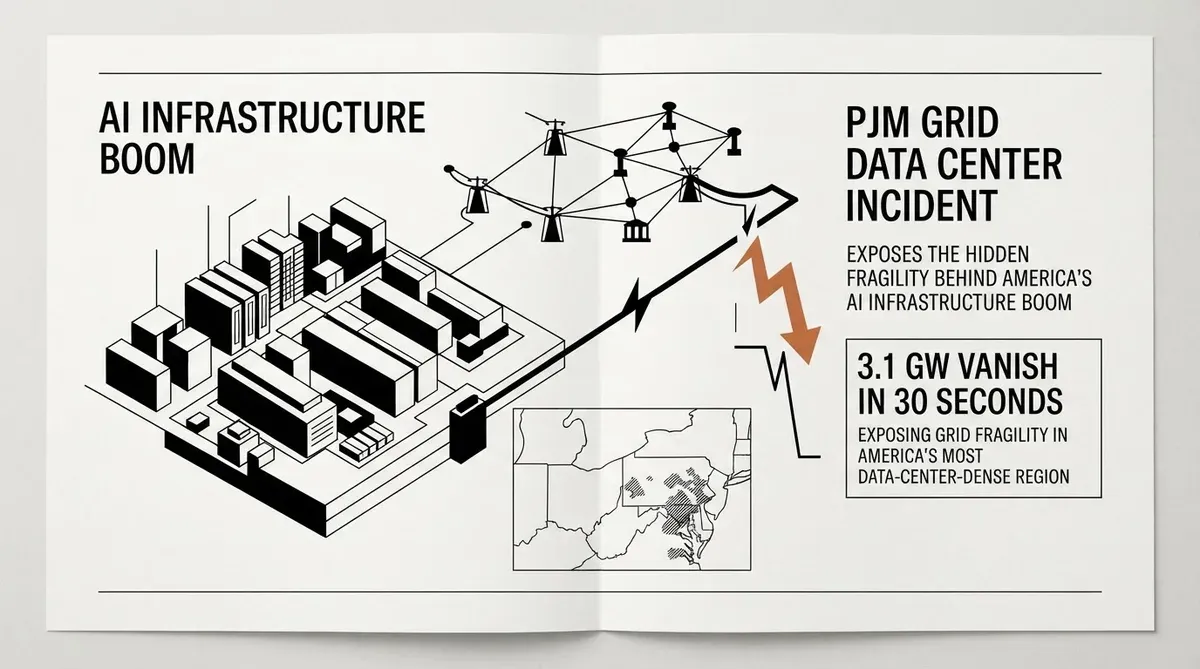
The PJM grid data center incident began with a fallen power line outside Washington, D.C., but the disruption did not stay local. Within seconds, data centers across Northern Virginia, the most concentrated cluster of computing infrastructure in the world, stopped drawing power from the grid almost simultaneously as they switched to backup systems. Roughly 3.1 gigawatts of demand vanished from the PJM Interconnection in about 30 seconds, according to grid operator data. The sudden load loss sent voltage spiking from the D.C. suburbs to Chicago, causing lights to flicker across multiple states.
The disconnected data centers accounted for approximately 3 percent of total demand on the PJM grid at the time. At the peak of the event, an extra 3.49 gigawatts of electricity sat on the system, the rough equivalent of three large nuclear reactors running with nowhere to send their output. PJM operators needed 11 minutes to bring the grid back to stable conditions, voltage data collected by Ting Labs showed. The event did not trigger a blackout, but it came far closer than a minor flicker suggests.
What the PJM Grid Data Center Incident Reveals
The incident exposes a structural vulnerability that has been building as AI computing expands. Northern Virginia's Loudoun County and surrounding areas host the densest concentration of hyperscale data centers globally, driven by demand from cloud providers and companies training and deploying large AI models. PJM, the regional transmission organization covering 13 states and the District of Columbia, has seen data center load grow faster than any other demand category in recent years.
What made the July event dangerous was the behavioral synchronization of the load. When the transmission line failed, dozens of data centers reacted identically within seconds, switching to on-site batteries or diesel generators and drawing negligible power from the grid. That coordinated drop created a ramp rate PJM's automatic generation control systems were not designed to handle smoothly. The grid appeared to recover initially, but shortly afterward additional loads dropped off, indicating control systems struggling to find equilibrium.
A 3.49 gigawatt oversupply is a severe voltage regulation challenge. Such surges stress transformer windings, excite saturation in reactor banks, and can trip protection relays on adjacent transmission lines, any of which can escalate a single line failure into a wider blackout. PJM's ability to stabilize within 11 minutes reflects significant engineering capability, but the margin for error was narrower than the flickering lights indicated.
AI Load Growth Outpacing Grid Investment
The PJM grid data center incident is not an isolated data point. AI training clusters routinely draw 100 megawatts or more per facility, and inference workloads add a spiky, unpredictable demand pattern that is fundamentally different from the steady loads traditional data centers presented. The pace of new data center construction in Northern Virginia has outstripped the buildout of new transmission capacity and generation resources by a wide margin.
PJM's interconnection queue is crowded with requests for new data center connections, but the timeline for building new transmission lines stretches seven to 10 years from planning to operation. AI companies lease and build facilities on timelines measured in months. The mismatch means that more load is connecting to a grid infrastructure that was designed for a different era of electricity consumption, with transmission and voltage support equipment sized for yesterday's demands.
The same dynamics that caused 3.1 gigawatts to vanish in half a minute will recur as more data centers come online in the same region, connected to the same transmission paths, with the same backup power protocols. The July 25 event validated warnings that have been circulating for months about the fragility created by rapid AI data center deployment.
What Must Change
Solutions to this class of instability fall into several categories. Grid-scale battery storage can absorb sudden drops in demand by charging rapidly, creating a buffer that gives operators seconds to minutes for generation redispatch. Synchronous condensers and STATCOM devices can inject or absorb reactive power to manage voltage fluctuations faster than traditional generation can respond. Better coordination between data center operators and PJM, including real-time telemetry on backup power status and staggered transition protocols, could prevent simultaneous load drops from occurring in the first place.
Some hyperscale operators have begun investing in on-site generation and microgrid architectures that allow facilities to island themselves from the grid without all transitioning at the same moment. But the financial incentives for coordination are weak under current PJM market rules. Backup power transitions are driven by facility-level reliability requirements, not system-level stability, and individual operators have limited reason to stagger their switchovers absent regulatory mandates.
PJM has proposed tariff changes and new interconnection requirements for large loads, but these processes move at regulatory speed while AI compute deployment moves at Silicon Valley speed. The gap between the two timelines is where the risk lives.
The Regional Economic Stakes
Northern Virginia's data center cluster supports a multi-billion-dollar cloud and AI economy that has become central to the region's tax base and employment. Loudoun County alone has seen data center property taxes become a major revenue source for schools and infrastructure. A significant grid reliability incident, one that causes a blackout affecting not just data centers but residential and commercial customers, could threaten the regulatory and political support that has enabled the cluster's growth.
For the companies building next-generation AI infrastructure, the July grid event carries a clear message. The transmission and generation assets that power their facilities were designed for load profiles very different from what AI workloads present. Without coordinated investment in new transmission, battery storage, and intelligent load management, the risk of a more severe event, a blackout rather than flickering lights, will continue to rise alongside compute demand.
Why this matters
The PJM grid data center incident signals that AI infrastructure growth has crossed a threshold where individual facility designs can no longer be considered in isolation from grid-level stability. For technology executives and investors, the event makes clear that data center location strategy, power procurement, and backup system design now carry a systemic risk dimension that did not exist a few years ago. The reliability of the cloud and AI services that enterprises rely on depends not just on redundant power within each facility, but on the coordinated behavior of dozens of facilities sharing a single transmission grid. Closing that coordination gap is the infrastructure challenge that AI scaling has created.
AI-generated image.
Related Articles
- National Grid's $1.75B Bet on Dedicated AI Power
- Data Center Power Coalition Launches to Tackle AI Grid Delays
- Anti-Data-Center Protests Go National With 142 Demonstrations Across 42 States
✔Human Verified
Researched and cross-referenced against primary sources by the Bytevyte editorial team.