
Red Hat AI 3.4 Introduces Isolated Sandboxing to Secure Autonomous Enterprise Agents
Red Hat AI 3.4 debuts with isolated agent sandboxing and AgentOps to secure autonomous AI agents for enterprise deployment at Red Hat Summit 2026.
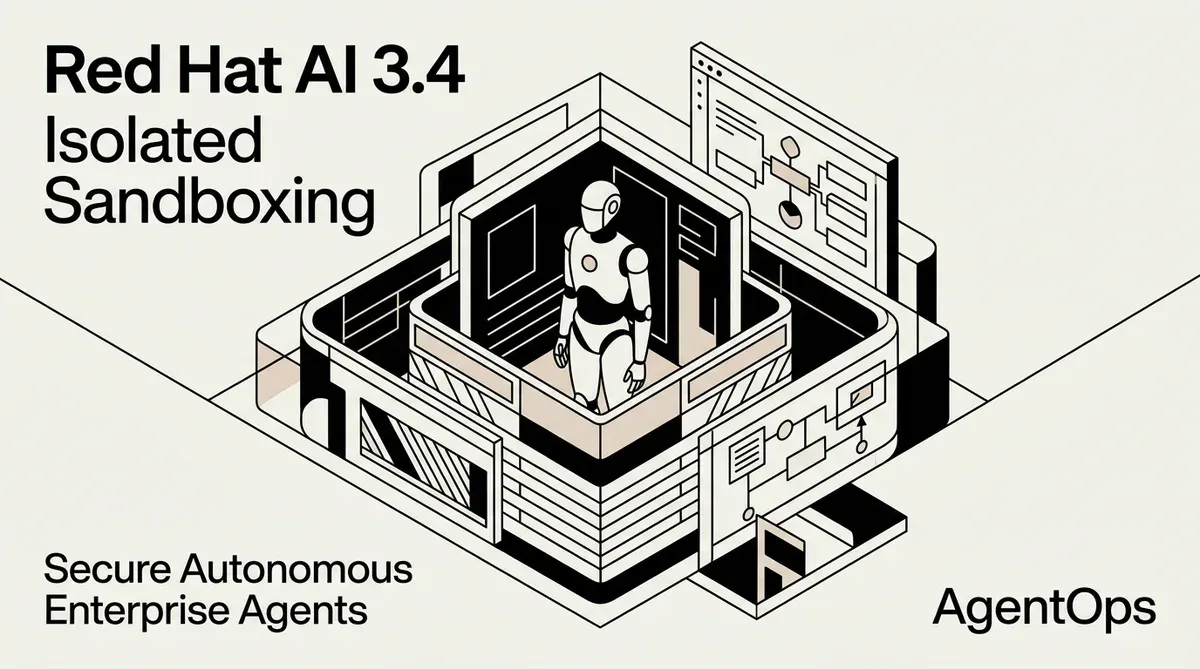
Red Hat has launched Red Hat AI 3.4, a major update to its developer portfolio designed to secure the deployment of autonomous agents within enterprise environments. Announced during the Red Hat Summit 2026 on May 13, the release introduces a specialized environment for isolated agent sandboxing, addressing growing corporate concerns regarding the safety and predictability of agentic AI systems.
The update focuses on transforming autonomous agents into governable enterprise workloads. By providing a protected execution space within Red Hat Desktop, developers can now test agent behaviors without risking unverified actions on production systems. This move directly targets the technical barriers that have prevented many organizations from moving beyond simple chatbots to more complex, autonomous workflows.
Securing the Agentic AI Lifecycle
At the center of this release is the AgentOps Toolkit, which provides the necessary infrastructure for monitoring and managing agent operations. The toolkit includes integrated tracing for Large Language Model (LLM) and tool calls, alongside analysis of reasoning steps. These features allow technical leaders to audit the decision-making process of an agent, ensuring that its logic aligns with business requirements and safety protocols.
Security is further strengthened through the integration of SPIFFE/SPIRE for cryptographic identity management. This replaces the traditional use of static keys, which are often a point of vulnerability in automated systems. By assigning unique, verifiable identities to each agent, Red Hat ensures that autonomous entities can only access authorized resources and external systems. This identity-first approach is a critical component of Red Hat AI 3.4, as it prevents unauthorized agents from interacting with sensitive internal databases.
Expanding Connectivity with MCP Support
To facilitate broader utility, Red Hat AI 3.4 includes full support for the Model Context Protocol (MCP). This implementation features a dedicated server catalog and gateway, allowing agents to interact with a wide range of external tools and data sources at runtime. The standardized approach provided by MCP reduces the friction of integrating diverse AI models with existing enterprise software stacks, making it easier for teams to swap models as new versions become available.
The introduction of these governance tools reflects a shift in the industry toward "agentic AI" that prioritizes control over raw capability. For decision-makers, the ability to sandbox and trace agent actions is a prerequisite for deploying AI in high-stakes environments like finance or healthcare. Red Hat is positioning its platform as the bridge between experimental AI development and stable, secure enterprise operations. This strategy aligns with the broader enterprise need for "guardrails" that prevent autonomous systems from making unapproved financial commitments or data disclosures.
This release follows a series of industry-wide efforts to standardize how autonomous agents communicate and operate. As organizations look to scale their AI initiatives, the focus is increasingly on the infrastructure of AI—the security, identity, and connectivity layers that make automation reliable. Red Hat plans to continue expanding the AgentOps ecosystem throughout the remainder of 2026, with additional features for multi-agent coordination expected in future updates. The company is also working with partners to populate the MCP server catalog with industry-specific tools for manufacturing and logistics.
By focusing on the governance layer, Red Hat is addressing the "trust gap" that has slowed the adoption of autonomous agents in regulated industries. The combination of isolated agent sandboxing and cryptographic identity provides a framework where agents can be treated as first-class citizens in the enterprise IT environment, subject to the same rigorous security standards as any other application. This release is a transition from AI as a standalone experiment to AI as a core component of the enterprise software stack.
While we strive for accuracy, bytevyte can make mistakes. Users are advised to verify all information independently. We accept no liability for errors or omissions.
AI-generated image.
Related Articles
- Nutanix Unveils Full-Stack Platform to Accelerate Autonomous AI Agents
- SUSE and NVIDIA Partner to Deliver Sovereign AI Infrastructure for High-Security Enterprises
- Aviatrix Debuts Security Framework to Manage Autonomous AI Agent Risks
✔Human Verified