
Reflex Aerospace Wins Exclusive Orbital Satellite Platform Contract for Orbital-1
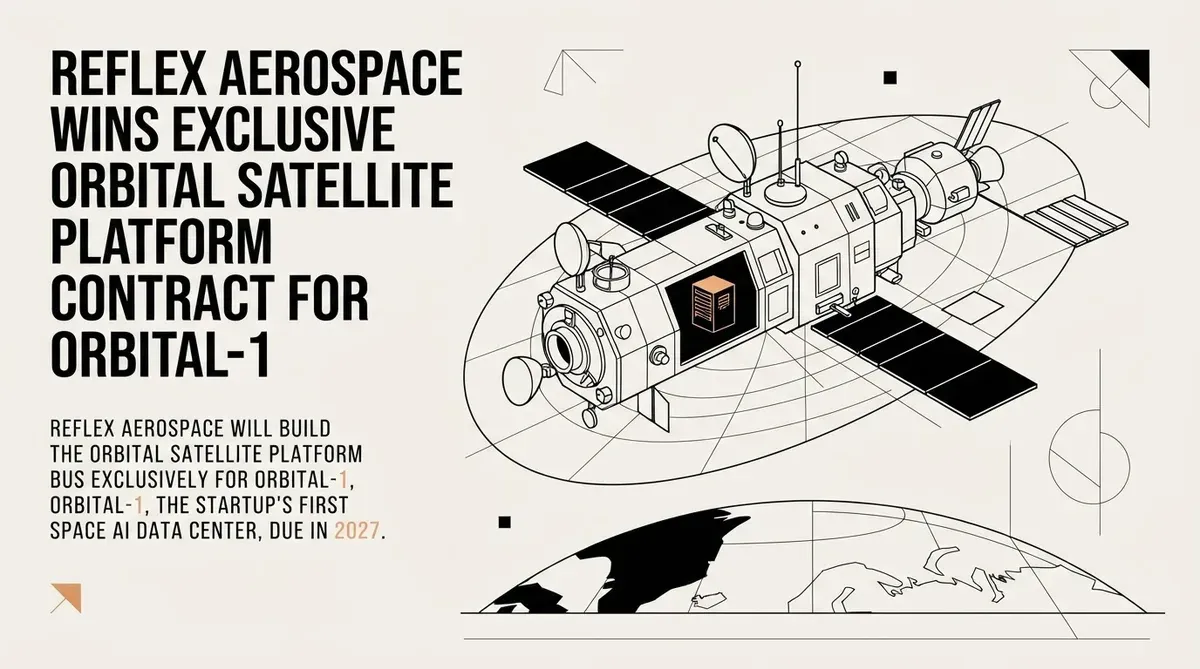
Orbital Compute has selected Germany's Reflex Aerospace as the exclusive supplier of the Orbital satellite platform that will carry its first AI inference data center into orbit. The agreement, announced on September 10, 2026, puts Reflex in charge of designing the spacecraft bus for Orbital-1 and for the constellation that follows, with exclusivity applying to Orbital's orbital compute applications. Orbital-1 is slated to launch on a SpaceX Falcon 9 in April 2027.
Orbital is a Los Angeles startup founded by Euwyn Poon, a former e-scooter entrepreneur. It raised a $5 million seed round led by Andreessen Horowitz's Speedrun accelerator earlier in 2026 and has asked the Federal Communications Commission for permission to deploy up to 100,000 data center satellites, with 10 gigawatts of computing capacity as the target.
What the Orbital Satellite Platform Deal Covers
Reflex takes responsibility for the bus: the structure, power, thermal and pointing subsystems that hold the payload and keep it working. Orbital keeps the compute layer, the GPUs and the software that turns them into an inference service. Under the terms described by both companies, Reflex supplies the bus on an exclusive basis for Orbital's orbital compute use, which closes off that same platform to rival space data center operators.
The arrangement carries a clear logic for each side. Reflex, which raised €50 million to expand production of next-generation satellite platforms, gains a US anchor customer for a bus aimed at compute-heavy payloads. Its existing business leans on payload-centric designs that can be built quickly without the capital burden of a mega factory, a model pitched at intelligence, surveillance and reconnaissance demand across Germany and allied markets. Human Element managing partner Christian Sullivan has framed that approach as trading facility scale for speed and flexibility.
For Orbital, outsourcing the Orbital satellite platform keeps engineering spending on the parts that differentiate the company: the compute stack and the operational software. Building a bus in-house would consume years and capital that a startup with $5 million in seed funding has allocated to inference hardware and flight software instead.
The pace of announcements has been quick. The seed round closed in the spring, the FCC application followed in the summer, and the platform partner was named in September, less than a year after the company was founded. Reflex is not waiting on Orbital for its own pipeline: a propulsion agreement with Spanish startup Arkadia Space covers a 2027 mission.
Why the Bus Decides Whether Orbital Works
Space-based data centers answer one constraint neatly. Radiating heat into the vacuum removes the cooling towers and water rights that limit terrestrial AI campuses. The same vacuum provides no convection, so every watt a GPU produces has to leave through surfaces the bus supplies. Radiation is the second problem, since energetic particles degrade and disrupt processors that were never designed for orbit.
A compute bus differs from a communications or imaging bus in ways that push against standard designs. Power generation scales with solar array area, heat rejection scales with radiator area, and both compete for the same structural mass and launch volume. Every kilogram given to radiators is a kilogram that cannot be spent on GPUs, so platform efficiency shows up directly in the cost per unit of compute delivered. That is the argument for treating the bus as a first-class part of the business case rather than a commodity purchase.
Orbital-1's first mission reflects the physical risks. Its stated objectives include measuring sustained GPU performance in orbit and characterizing the radiation environment before commercial AI workloads are run. Data from that flight determines whether the follow-on constellation proceeds on the timeline Orbital has described.
Orbital has also narrowed its workload to inference rather than training. Training large language models depends on thousands of tightly coupled accelerators exchanging gradients over high-bandwidth interconnects at very low latency, a pattern that is hard to reproduce across a constellation. Inference tolerates distribution: requests can be batched and routed to whichever satellite has spare capacity and a downlink window.
Orbit geometry matters as much as the chips. Concepts for orbital AI infrastructure generally assume sun-synchronous orbits that keep spacecraft near the dawn-dusk terminator, where sunlight is nearly continuous for power and the thermal cycle stays comparatively stable. Reflex's bus has to hold that geometry while carrying payloads that draw far more power than a typical imaging or communications satellite.
Where the Public Numbers Stand
Orbital's own figures span a wide range, and the spread is the clearest available measure of how much of the program remains unbuilt.
| Item | Stated figure |
|---|---|
| Satellites requested from the FCC | Up to 100,000 |
| Long-term constellation scale cited for the platform | About 10,000 low-Earth-orbit satellites |
| Units the founder has said are needed | More than 100,000 |
| Target compute capacity | 10 gigawatts |
| Seed funding | $5 million, led by a16z Speedrun |
| First spacecraft | Orbital-1, SpaceX Falcon 9, April 2027 |
Ten gigawatts is the headline figure and the hardest to check. It describes capacity the company intends to operate rather than capacity under contract, and no schedule for reaching it has been disclosed. The FCC application is a first regulatory step, not an authorization, and deployment would also depend on launch cadence from providers such as SpaceX, which Orbital has already lined up for its first flight.
A $5 million seed round does not fund a constellation, and neither company has described how the manufacturing ramp would be financed. That gap is the real trade-off in the deal. Bus design is an engineering problem with a defined solution path. Producing tens of thousands of compute satellites at a workable unit cost is a capital problem that no design choice solves on its own.
Exclusivity cuts both ways for Reflex. It secures a customer in a market that has no operating revenue yet, and it limits how many other orbital compute operators can buy the same configuration. If Orbital's schedule slips, Reflex has forgone other buyers for that platform.
The supplier choice also says something about how Orbital views its supply chain. Pairing a US-flagged constellation with a German manufacturer spreads manufacturing risk across two jurisdictions and gives Reflex a reference customer beyond its defence and ISR base in Europe, a segment where allied-market demand has been rising.
What to Watch
Orbital-1 is the gate. Radiation tolerance data, sustained GPU throughput and thermal performance under real orbital conditions will decide whether the follow-on constellation advances as planned. Reflex has a second 2027 test case of its own, a mission that will carry a propulsion system from Spanish startup Arkadia Space.
The inference-only scope is a deliberate narrowing. Inference traffic grows as deployed models serve more requests, and it is the segment where an operator can sell capacity without promising tight coupling between chips. The trade-off is distance: a request that travels to a satellite and back crosses more ground than one served from a facility on Earth, which leaves batch jobs, model evaluation and data that originates in orbit as the natural workloads.
For buyers of AI compute, the question is price and availability rather than novelty. If orbital inference can be sold at a competitive cost per token, it can absorb workloads that tolerate latency, including batch inference and data already collected in orbit. If it cannot, the FCC filing stays a filing.
Why This Matters
The Orbital satellite platform decision shows where a space data center startup believes its risk sits: in the spacecraft rather than the silicon. Orbital is buying the bus and keeping the compute, which places its near-term credibility in a partner's ability to mass-produce platforms for power-hungry, radiation-exposed payloads. Reflex gains a US anchor customer for a bus designed around payloads instead of launch slots. Both companies have tied their public positions to data from a single spacecraft scheduled to fly in 2027.
AI-generated image.
Related Articles
- SpaceX and Nvidia Set a Q4 2027 Launch Date for the Starmind AI1 Orbital Data Center
- Orbital Industries Raises $50M to Scale Modular AI Data Centers
- SpaceX Orbital Compute: Selling Capacity Before the Satellites Fly
✔Human Verified
Researched and cross-referenced against primary sources by the Bytevyte editorial team. This article was generated with the assistance of artificial intelligence and reviewed by the Bytevyte editorial team.