
Rocket Lab Space Force Contract: $266M for 18 Launches
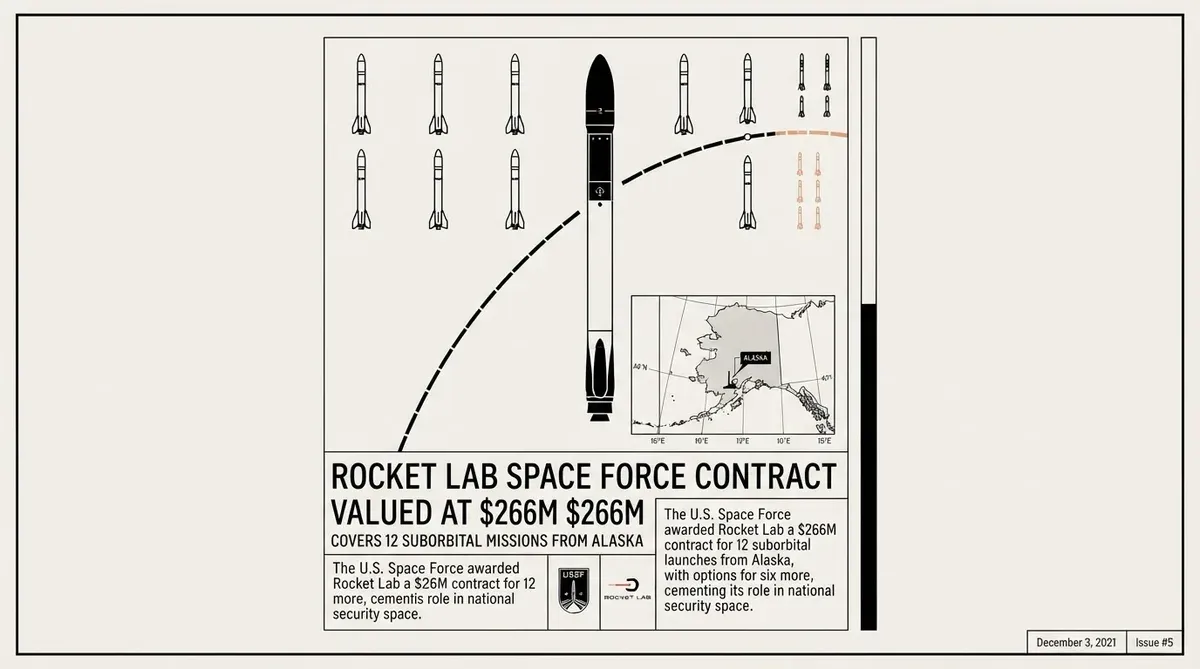
The U.S. Space Force has awarded Rocket Lab a $266 million firm-fixed-price contract for suborbital launch services from Alaska, one of the largest government orders in the company's history. The Rocket Lab Space Force contract guarantees 12 launches with options for six more, extending the company's defense pipeline through 2028. The award underscores the Pentagon's growing reliance on commercial launch providers for national security missions.
The Space Systems Command contracting office at Kirtland Air Force Base in New Mexico managed the competitive acquisition. Three companies submitted bids. At the time of the award, $112 million in fiscal 2025 research, development, test and evaluation funds were obligated. The missions will be conducted from the Pacific Spaceport Complex in Alaska, a site Rocket Lab has already established as a key operations hub for suborbital testing.
HASTE Vehicle at the Center of the Program
Rocket Lab will perform the missions using its Hypersonic Accelerator Suborbital Test Electron vehicle, known as HASTE. Derived from the company's Electron small rocket, HASTE is a purpose-built testbed for hypersonic and suborbital experimentation. The vehicle is central to Rocket Lab's growing suborbital testing business, which serves defense and national security customers who need reliable, cost-effective access to flight regimes that are difficult to replicate in ground-based facilities.
The HASTE platform provides the military a dedicated path for testing hypersonic technologies, missile defense sensors, and reentry systems without tying up larger, more expensive launch vehicles. Each HASTE flight carries experimental payloads to specific altitudes and velocities that match real-world operational conditions. The vehicle's heritage from the Electron rocket means it shares the same manufacturing processes, supply chain, and flight-proven components that have made the company's orbital launches a reliable workhorse for small satellite operators.
What the Contract Covers
The contract is a firm-fixed-price completion deal, meaning Rocket Lab bears the cost risk for executing the work within a set budget. The 12 guaranteed launches provide a multiyear revenue stream. The six optional launches, if exercised, would increase the total value. Under the contract, the per-launch cost is roughly $22 million for the guaranteed 12 missions, in line with the company's competitive pricing for suborbital services.
Rocket Lab's stock responded to the news. Shares climbed more than 5 percent during the regular trading session and rose an additional 9 percent in after-hours trading, reflecting investor confidence that the defense sector will remain a reliable growth engine for the company, especially as governments worldwide increase spending on hypersonic and missile defense programs.
Strategic Significance for Rocket Lab
This award is the third defense-related contract for Rocket Lab in two weeks, signaling an accelerated push into national security markets. The company has been steadily expanding its federal portfolio, complementing existing NASA missions and strategic acquisitions with a heavier focus on defense work. The Alaska launch site gives the military a high-latitude launch capability that is strategically important for polar and near-polar orbital insertion profiles, as well as for certain hypersonic test corridors that require access to northern airspace.
For the Space Force, the contract provides dedicated suborbital launch capacity at a time when demand for hypersonic testing is rising. The Pentagon has prioritized hypersonic weapons development as a key capability gap, and suborbital test flights are essential for validating thermal protection systems, guidance algorithms, and sensor packages. By contracting with a commercial provider like Rocket Lab, the Space Force avoids the higher costs and longer lead times associated with traditional government-run test ranges.
Market Position and Competitive Dynamics
This contract cements Rocket Lab's role as a core supplier within the national security space ecosystem, a status that brings recurring revenue and credibility benefits for future contracts. In the suborbital launch market, Rocket Lab competes with a handful of specialized providers, but the HASTE vehicle's flight heritage, the Alaska launch infrastructure, and the company's vertically integrated manufacturing model give it a cost and scheduling advantage that is difficult to replicate.
The contract's structure, with a significant upfront obligation of FY2025 funds, suggests the Space Force views these launches as a high-priority program. The $112 million in immediately obligated funds covers nearly half the contract value upfront, indicating that work will begin promptly. Work must be completed by December 31, 2028, implying an average launch tempo of three to four missions per year over the contract period, though the actual cadence may vary based on customer requirements and vehicle readiness. If the six optional launches are exercised, the pace would increase to roughly five missions per year. The guaranteed minimum launch rate provides Rocket Lab with a predictable production schedule that allows the company to optimize its HASTE manufacturing line and maintain a steady workforce at the Alaska facility.
Broader Implications for the Defense Space Sector
Rocket Lab's win fits a larger pattern of the Pentagon leaning on commercial space companies for mission-critical services rather than relying exclusively on government-owned infrastructure. The Space Force's Commercial Space Office has actively sought to integrate commercial solutions into national security programs, and this contract is a concrete example of that strategy. By awarding a firm-fixed-price contract to a publicly traded company, the government shifts execution risk to the contractor while gaining the cost discipline that competitive commercial pricing provides.
The Alaska launch site has geopolitical significance. The Pacific Spaceport Complex on Kodiak Island gives the military a launch capability in the Pacific theater that is independent of the Western Test Range at Vandenberg. This geographic diversification is important for assured access to space, particularly as the Indo-Pacific region becomes a focal point of U.S. defense strategy.
Why This Matters
For Rocket Lab, the $266 million contract transforms the company from a niche small-launch provider into a strategic defense asset with a funded multiyear pipeline. For the Space Force and the broader defense community, the deal demonstrates that commercial suborbital launch services can meet national security requirements at competitive prices. This Rocket Lab Space Force contract also ties the commercial space industry more closely to Pentagon spending priorities, a relationship that will shape how both sectors evolve through the remainder of the decade.
AI-generated image.
Related Articles
- SpaceX Prepares Midnight Falcon 9 Launch for South Korean Imaging Mission
- SpaceX Terrestrial AI Compute Business Generates $28B from Colossus Deals
- SpaceX Pentagon AI Compute Deal Could Reshape Defense Cloud Market
✔Human Verified
Researched and cross-referenced against primary sources by the Bytevyte editorial team.