
Salesforce AI Strategy Triggers Major Revenue Model Overhaul for FY27
Salesforce resets its revenue model for FY27 to focus on its Salesforce AI strategy and the Agentic Enterprise, including a 1,000-person hiring surge.
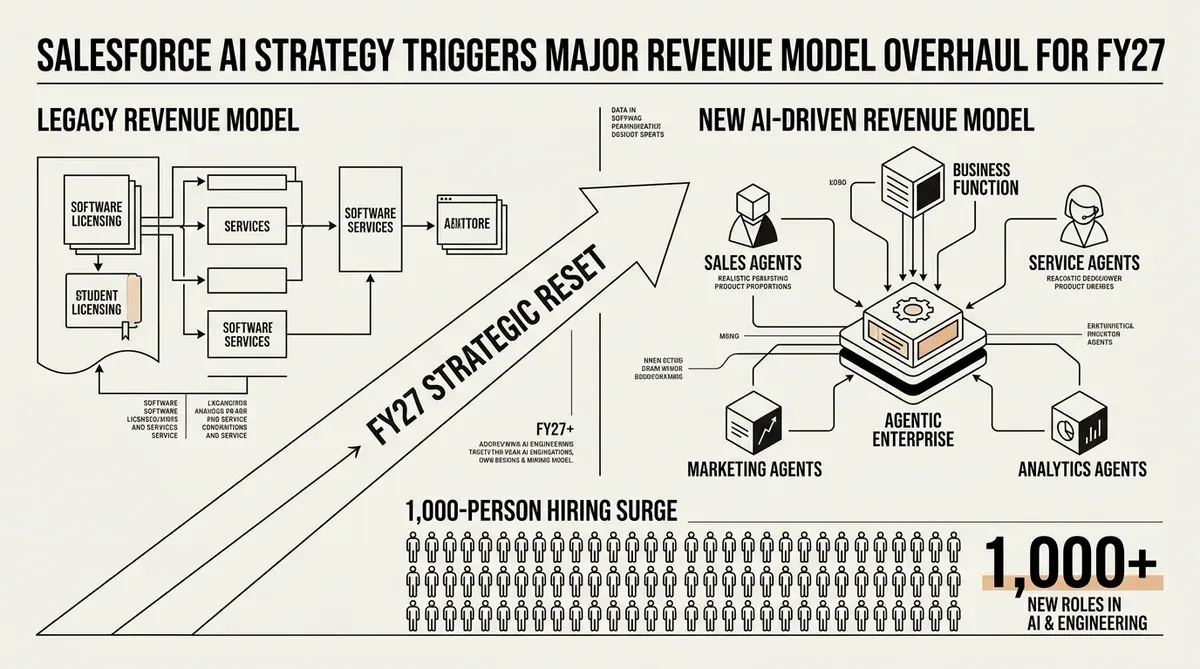
Salesforce has initiated a comprehensive restructuring of its financial reporting and product strategy to prioritize autonomous artificial intelligence, signaling a shift toward what the company calls the Agentic Enterprise. This transition, announced this week, involves a fundamental reset of revenue segments starting in fiscal year 2027 to better match its Salesforce AI strategy and the growing demand for independent digital agents.
The new reporting structure divides the company's operations into two primary categories: Agentforce Apps and Data 360 & Platform. Recast financial data for fiscal year 2026 indicates that the Agentforce Apps segment, which includes core products like Sales, Slack, and MuleSoft, generated approximately $26.7 billion in revenue. Meanwhile, the Data 360 segment, encompassing Data Cloud, reached $12.7 billion, reflecting a 15% growth rate that outpaces the 7% growth seen in the applications division.
Infrastructure for the Salesforce AI Strategy
To support this Salesforce AI strategy, the company is launching the Agentforce platform as part of its Summer '26 release. This update introduces technical tools such as the Agentforce DX MCP Server and the Vibe IDE, designed to help developers build and manage autonomous agents. These agents are intended to operate with a high degree of independence, moving beyond simple chatbots to handle complex workflows across an organization's data ecosystem.
A key component of this technical shift is the Headless 360 architecture. This approach provides autonomous agents with direct data access, ensuring they can retrieve and process information across the entire CRM suite without manual intervention. Salesforce is also moving toward an API-first model, ensuring that all customer relationship management functions are compatible with agent-driven automation.
Strategic Workforce Expansion
The pivot toward autonomous agents includes a significant investment in human capital. Salesforce plans to hire 1,000 new specialists and recent graduates specifically to accelerate the creation and deployment of these AI systems. This recruitment drive is aimed at providing enterprise customers with the expertise needed to integrate autonomous agents into their existing business processes.
By reorganizing its revenue model and technical architecture around Agentforce, Salesforce is positioning itself to capture the next wave of enterprise automation. The focus on Data Cloud as a high-growth engine suggests that the ability to unify and activate corporate data is now the primary prerequisite for successful AI implementation. As of May 8, 2026, sandbox environments have begun receiving these upgrades, marking the start of a broader rollout for the agent-compatible architecture.
While we strive for accuracy, bytevyte can make mistakes. Users are advised to verify all information independently. We accept no liability for errors or omissions.
AI-generated image.
Related Articles
- Salesforce Headless 360 Launches to Power Autonomous AI Agents
- SAP SuccessFactors 1H 2026 Release Adds Agentic AI
- Google Cloud Launches $750M Agentic AI Partner Fund
✔Human Verified