
Salesforce's Koa CRM Reasoning Model Is Really a Play for AI Margins
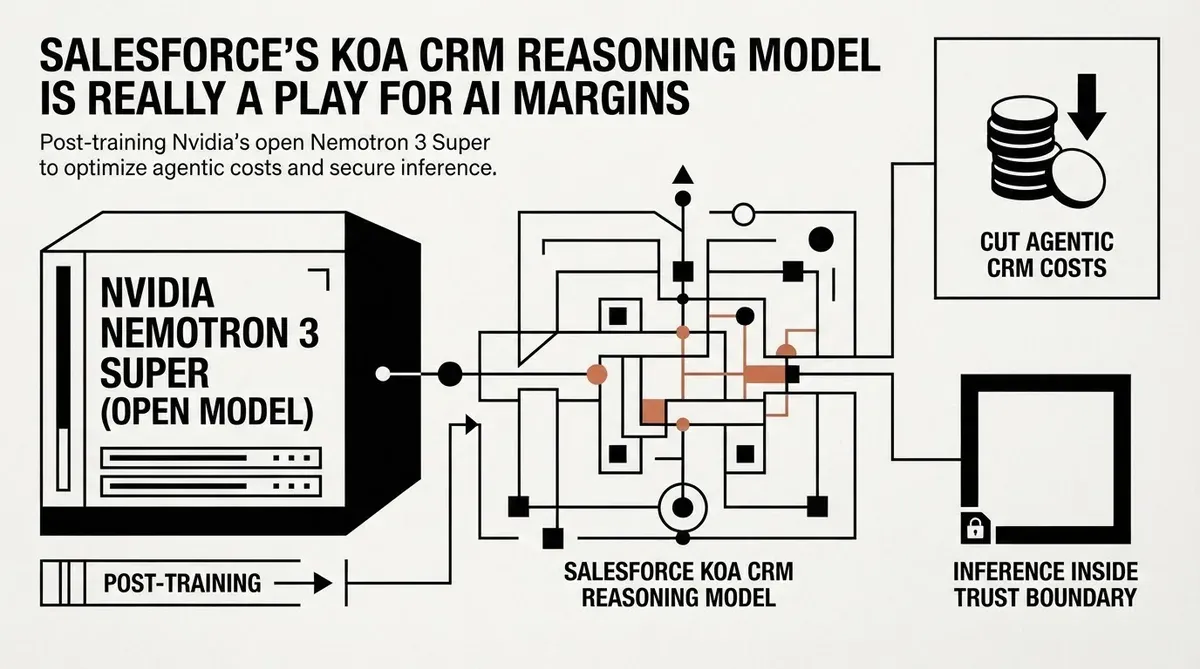
Salesforce's first in-house reasoning model for customer data has arrived, and its significance lies in where it runs rather than what it scores. The Koa CRM reasoning model, unveiled at Dreamforce in San Francisco this week, is a post-trained version of NVIDIA's open-weight Nemotron 3 Super, and it executes entirely inside Salesforce's own infrastructure instead of through a third-party frontier API.
The strategic weight of that decision is easy to miss. Agentforce agents work through multi-step CRM processes, and every step routed to an external model carries a per-token charge plus a data-boundary question. Salesforce now owns both halves of that equation: the weights, and the machines they run on.
The Margin Story Behind the Model
Enterprise software economics have always been set by whoever controls the marginal cost of the work being sold. Agentic features break that pattern when each action is metered by an outside provider. A support agent that resolves a case in twelve steps burns tokens on someone else's price list, which turns the gross margin on that feature into a number Salesforce cannot set.
The Koa CRM reasoning model converts that variable cost into fixed training spend plus inference on infrastructure the company already operates. The gap widens with volume: the more agentic work Salesforce's customers run, the larger the difference between owning inference and renting it.
NVIDIA chief executive Jensen Huang, who joined Marc Benioff on stage at Dreamforce, put the supply-side shift at the center of the argument. Open-source models have moved from roughly 30% of the market to about 70% over the past year. That is the condition which makes internalization practical for a vendor of Salesforce's size. A year ago, matching a frontier model on narrow reasoning work with an open base was a research project. Now it is a training run with a published toolchain.
Inside the Koa CRM Reasoning Model
The Koa CRM reasoning model was post-trained on Nemotron 3 Super using a proprietary synthetic dataset modeled on 27 years of Salesforce CRM deployments across more than 14 industries. Salesforce states that no customer data was used in training, a point that carries weight with regulated buyers.
The training pipeline drew on NVIDIA's NeMo RL, NeMo Gym and NeMo AutoModel, combining supervised fine-tuning with reinforcement learning through GRPO. Salesforce says the resulting model matches or exceeds leading models on CRM benchmarks and produces three times fewer errors on CRM-specific tasks.
| Koa at a glance | Detail |
|---|---|
| Base model | NVIDIA Nemotron 3 Super, open weights |
| Post-training method | Supervised fine-tuning plus GRPO reinforcement learning via NVIDIA NeMo RL, NeMo Gym and NeMo AutoModel |
| Training data | Proprietary synthetic dataset modeled on 27 years of CRM deployments across 14+ industries; no customer data used |
| Performance claim | Matches or exceeds leading models on CRM benchmarks; three times fewer errors on CRM-specific tasks |
| Deployment | Runs inside Salesforce's own trust boundary and infrastructure |
| Availability | Select customers now, including 1-800Accountant, Formula 1 and UChicago Medicine; US general availability in Winter 2026 |
Agentforce has drawn on external model providers for its reasoning steps. Koa is the first reasoning model Salesforce has built in house, so the launch changes where the work is sourced rather than what the platform does. Salesforce continues to work with other providers while moving the highest-volume, most predictable share of its traffic onto a model it controls.
The same option is open to every large enterprise software vendor. Microsoft, ServiceNow and SAP each sit on comparable volumes of domain-specific workflow data, and the shift toward post-training narrow open-weight models for well-defined tasks is already visible across the sector. Salesforce moved first among the CRM incumbents, which buys it a head start on cost structure rather than on capability.
Commercial availability is staged. Koa is in the hands of a small set of customers, among them 1-800Accountant, Formula 1 and UChicago Medicine, with general availability across US regions scheduled for Winter 2026. A parallel track brings NVIDIA models and accelerated computing into Missionforce for government and regulated organizations that need AI running in private clouds or air-gapped networks. Missionforce Operations is generally available now, and post-trained NVIDIA models reach select customers in October 2026.
The Trade-Offs Salesforce Is Accepting
Owning a model means owning its upkeep. Fine-tunes drift, evaluation suites age, and every base-model refresh from NVIDIA restarts part of the pipeline. Vendors that rent frontier tokens outsource that work along with the cost, and they buy from a supplier whose entire business is keeping the model current.
Dependency shifts rather than disappears. Salesforce controls its weights but inherits the release cadence and the capability ceiling of the Nemotron family and the NeMo toolchain. If NVIDIA ships a materially stronger base in eighteen months, Salesforce faces a retraining cycle it cannot schedule for itself.
The performance claims behind the Koa CRM reasoning model are self-reported and narrow. Three times fewer errors is measured on CRM-specific tasks defined by Salesforce, and the launch did not include independent benchmark numbers. Three named design partners show the model works in production for a handful of deployments. They do not show that it holds across an installed base of hundreds of thousands of organizations.
Synthetic training data cuts both ways. Building the dataset from modeled CRM knowledge instead of live customer records removes a serious privacy exposure and a contractual obstacle, since customer data was never in the loop. It also caps how closely the model can mirror the irregular, non-standard processes that appear in unusual deployments.
The base model is open to everyone. Any competing CRM or service-desk vendor can post-train Nemotron 3 Super, so Koa's differentiation rests on Salesforce's data-modeling pipeline, its evaluation harness and its integration into Agentforce, not on privileged access to the base weights.
Why NVIDIA Can Afford to Give Away the Model Layer
Every enterprise that trains and serves its own model buys compute to do it. NVIDIA's incentive runs opposite to a frontier lab's. Commoditizing the model layer increases demand for the accelerators underneath, and NeMo gives customers a supported path to do the work. Salesforce's post-training run is a hardware purchase, and its inference traffic is a recurring one.
That asymmetry explains the tone of the Dreamforce appearance. Huang's argument that AI is becoming a global infrastructure layer, and that safety is an engineering problem rather than a brake, suits a supplier whose model releases are designed to pull hardware. The open-weight share figure he cites works as a market description and a sales argument at once.
Where the Frontier Labs Lose Ground
Frontier labs earn enterprise revenue disproportionately from high-volume, repetitive, well-specified work, which is exactly the traffic a domain post-train absorbs first. When the largest software vendors internalize the top of their own task distribution, what remains for outside providers is the long tail of novel reasoning, plus consumer subscriptions.
The NVIDIA relationship makes the loop explicit. NVIDIA runs its own sales and marketing on Salesforce and is piloting Agentforce for support, while supplying the compute and the open weights that let Salesforce reduce its spend with model providers.
For regulated buyers, the trust-boundary argument is the practical one. Air-gapped and private-cloud deployments cannot route data to an external API at all, which is why the Missionforce track matters more than the benchmark table for government and healthcare accounts.
Why this matters
For buyers, the question is shifting from which model scores highest to where inference runs and who collects the per-token fee. The Koa CRM reasoning model shows that a large SaaS vendor can take the model layer in house, and the same arithmetic applies to every platform with enough proprietary domain data to build a synthetic training set. The frontier labs keep the hardest reasoning work and the consumer market. The high-volume work that used to fund them is moving inside their customers' walls.
Sources
'Now We Can Know Everything and Do Anything,' Jensen Huang Says at Dreamforce
AI-generated image.
Related Articles
- NVIDIA Brings Nemotron 3 Ultra to AWS to Power High-Efficiency Autonomous Agents
- NemoClaw Deep Agents Blueprint Cuts AI Agent Costs by 90 Percent
- Nvidia Nemotron 4 open-weights model reshapes AI race
✔Human Verified
Researched and cross-referenced against primary sources by the Bytevyte editorial team. This article was generated with the assistance of artificial intelligence and reviewed by the Bytevyte editorial team.