
Samsung's Galaxy S26 Price Hike Puts a $1,000 Floor Under Its Flagship
The Galaxy S26 price hike adds $100 to most Samsung models and $200 to the 1TB Ultra as AI data-center memory demand drives phone costs up.
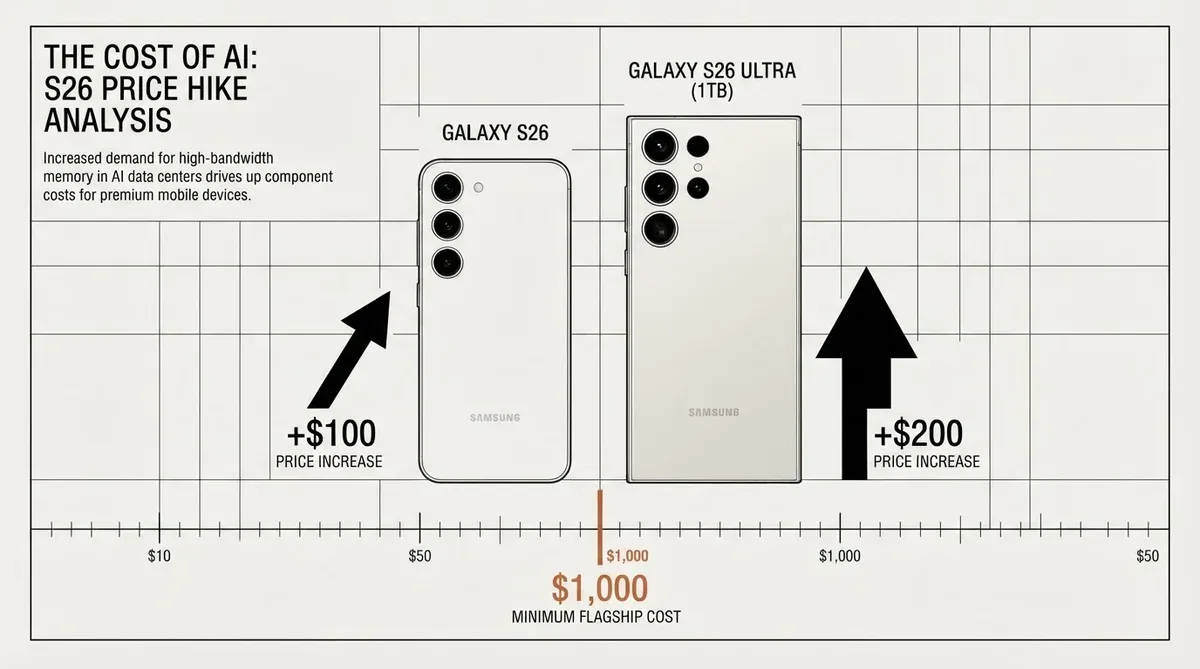
Samsung has raised prices on nearly every Galaxy S26 model in the United States, adding $100 to the base Galaxy S26, the S26 Plus and the S26 Ultra, and $200 to the 1TB Ultra. The Galaxy S26 price hike is a second increase for the S26 and S26 Plus since they launched in March, and it lifts Samsung's entry flagship to $999.99.
The new figures appeared on Samsung's US online store on October 1 with no press release and no public explanation from the company. Samsung has previously tied earlier price moves to DRAM and NAND cost inflation, and it has not offered a different reason this time.
The shift is clearest in the base configurations:
| Model | Launch price (March 2026) | Price from Oct 1 | Change |
|---|---|---|---|
| Galaxy S26 (256GB) | $899.99 | $999.99 | +$100 |
| Galaxy S26 Plus (256GB) | $1,099.99 | $1,199.99 | +$100 |
| Galaxy S26 Ultra (256GB) | $1,299.99 | $1,399.99 | +$100 |
| Galaxy S26 Ultra (1TB) | $1,799 | $1,999 | +$200 |
| Galaxy S26 FE | $699 | $699 | No change |
The increases cover the 256GB and 512GB configurations of all three core models plus the 1TB Ultra. The 512GB tiers rose in step with the 256GB versions, taking the S26 to $1,199, the S26 Plus to $1,399 and the S26 Ultra to $1,599. Samsung left the Galaxy S26 FE and its foldable range untouched, which makes the $699 FE the only current Galaxy phone still selling at its March launch price.
The Memory Math Behind the Hike
Samsung has pointed to memory costs in previous pricing decisions, and the pressure behind them has not eased. AI data-center construction consumes huge volumes of DRAM and NAND, with high-bandwidth memory taking priority for manufacturing capacity. Micron has said the shortage will run into its fiscal 2028, so supply is unlikely to loosen quickly.
Memory has moved from a commodity input to a bottleneck across consumer hardware. Data-center operators are buying DRAM in volumes that fabs cannot match quickly, and the HBM stacks used in AI accelerators consume wafer capacity that would otherwise serve standard chips. Laptops, consoles and phones have all seen tags rise as a result, which places the S26 increase inside a broader repricing of consumer electronics rather than an isolated Samsung decision.
Protecting handset profitability is the stated logic behind the move. The surge in memory chip prices has eroded margins in Samsung's phone business, and higher list prices shift part of that gap to buyers instead of onto the division's earnings.
Samsung sits on both sides of that trade. It is among the largest memory producers in the world, so higher chip prices lift its semiconductor revenue at the same time as they raise the bill of materials for its own phones. The company has said it will lean on premium devices that carry lighter cost burdens, naming the Galaxy Z8 foldable and next year's Galaxy S27.
That context separates this from a routine mid-cycle adjustment. The March launch already priced the S26 and S26 Plus $100 above their S25 equivalents, while the Ultra held its predecessor's price until now. Combined, the base S26 costs roughly $200 more than the base S25 did at launch, and buyers who waited for the phone to age into a discount have watched it move the other way.
Who Absorbs the Cost
The increase is not limited to the US. Samsung applied comparable moves in South Korea, Canada, the UK, mainland Europe and India. In South Korea, the 256GB and 512GB models rose by 149,600 won and the 1TB Ultra by 276,100 won, the largest single jump in the rollout.
The rollout moved in stages rather than at once. South Korea and the US changed on the same day, with Canada, the UK, mainland Europe and India following through October at increases between $100 and $200 depending on model and storage tier.
Storage capacity is the clearest driver of the difference. The 1TB Ultra absorbs twice the increase applied to the 256GB model, a pattern that tracks the amount of NAND each device carries. Buyers who need maximum storage are the ones most exposed to the memory market.
The change is live on Samsung's own store, where the company controls pricing directly. Retail partners and carriers set their own shelf prices, so promotional pricing on the S26 can lag the list change or absorb part of it, a gap that matters most for buyers on installment plans tied to retail price.
For Samsung, the trade-off runs the other way. Higher list prices protect handset margins that memory inflation has compressed, but they also push price-sensitive buyers toward the FE, toward older stock, or toward promotions that give the increase back. The timing is awkward: the change lands days before Amazon's Prime Big Deal Days and weeks ahead of Black Friday, two events where Galaxy phones typically sell below list.
What Buyers Should Watch
Discounts are the immediate counterweight. A $100 list increase on a phone that routinely sees steeper holiday cuts is a paper change for anyone shopping in the next two months, though it raises the ceiling for trade-in valuations and financing plans built on retail price.
Two increases in seven months is an unusual cadence for a flagship still inside its first year. Samsung's own semiconductor business benefits from the same memory tightness that is raising the phone's cost, so the company can absorb part of the squeeze internally in a way that handset makers without memory fabs cannot.
The longer signal sits in the memory market. If Micron's timeline holds, Samsung's next flagship cycle starts from a higher cost base instead of recovering toward 2025 levels, which makes the Galaxy S27 and the Z8 foldable the next test of how much of the memory bill reaches the shelf.
Why This Matters
The Galaxy S26 price hike shows how quickly a data-center supply crunch becomes a consumer bill. Memory capacity that AI builders are absorbing is capacity that phones, laptops and consoles no longer get cheaply, and Samsung's decision to raise prices twice in seven months rather than absorb the cost sets a marker other handset makers will be measured against. For anyone planning a flagship purchase, the practical question has shifted from which model to buy to how long the memory shortage lasts.
AI-generated image.
Related Articles
- Galaxy S26 Price Hike Looms as Samsung Expands Certified Re-Newed Sales
- Samsung Q2 2026 results: Record revenue driven by AI memory
- Samsung Strike Threat Drives 20% Surge in Memory Spot Prices
✔Human Verified
Researched and cross-referenced against primary sources by the Bytevyte editorial team. This article was generated with the assistance of artificial intelligence and reviewed by the Bytevyte editorial team.