
SAP Joule Work Runs on 110,000 Employees as Agentic ERP Ships
SAP Joule Work is live for 110,000 SAP employees with a reported 20% productivity gain as the Autonomous Enterprise reaches general availability.
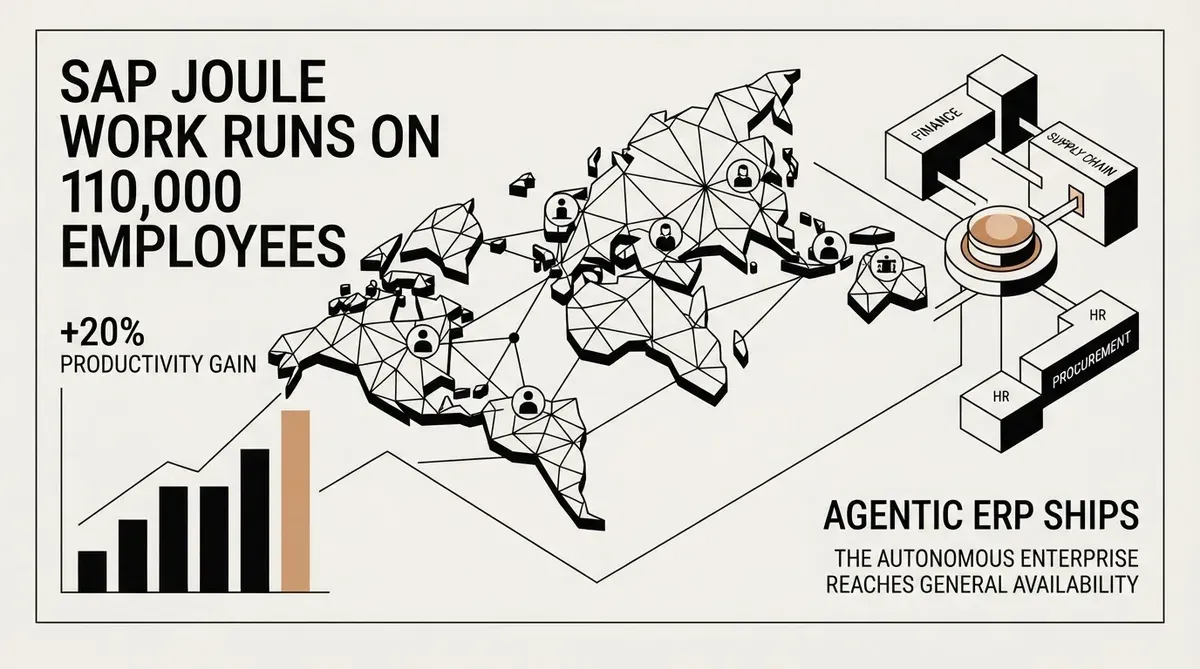
SAP has begun running its agentic enterprise software on its own workforce, and it wants customers to treat the results as proof. The company said SAP Joule Work is now live for 110,000 SAP employees, producing a 20% productivity gain across finance, human resources and procurement. SAP announced the figures at SAP Connect in Las Vegas this week, alongside general availability of the Autonomous Enterprise architecture it first previewed at Sapphire in May 2026.
Joule Work is the interface employees use; the architecture underneath decides what work gets done. Role-based Joule Assistants execute operational tasks inside existing workflows, including automated revenue recognition and trade compliance, while Joule Desktop gives the conversational layer a permanent surface outside the browser. SAP's stated aim is that employees work through the system instead of opening applications one at a time.
The grounding layer is the SAP Knowledge Graph, which maps more than 7 million data fields so that responses and actions stay attached to real business context and master data. SAP said the Business AI Platform behind the suite now runs more than 70 AI models, with Joule Studio available for customers and partners building their own agents.
| Metric | Figure |
|---|---|
| Internal deployment | 110,000 SAP employees |
| Reported productivity gain | 20% across finance, HR and procurement |
| Trade classification effort | Cut by up to 50% in early deployments |
| Knowledge Graph coverage | More than 7 million data fields |
| AI models on Business AI Platform | 70+ |
| Customer rollout | Started October 2026 |
SAP named Novartis, Morgan Foods, Nestle and PwC among the organisations connecting intelligence across functions with Joule and the Autonomous Suite. It also announced two partnerships aimed at defined problems: Moody's for supplier risk monitoring and ORO Labs for procurement orchestration.
Inside the SAP Joule Work rollout
The customer rollout of Joule Work began this month, which makes the internal deployment a reference case and not a finished product. SAP's own 110,000-employee footprint is a large test bed, and it is an unusually favourable one. Internal teams run standardised processes on the current release, with no legacy customisations, no third-party bolt-ons and no multi-year upgrade backlog to work through.
The trade compliance result shows the same pattern. SAP said early deployments of the International Trade Assistant cut trade classification effort by as much as 50%. Trade classification is a bounded, rules-heavy task with a clear input and a checkable output, which is the profile where an assistant can be measured cleanly. Finance close and procurement negotiation carry far more judgment per step.
At SAP Connect, the company also introduced a generation of role-based assistants built to pair with a person in a specific business role, routing each request to the agents suited to the job. That design concentrates value in the routing layer: the better SAP maps roles to agents, the less configuration a customer needs, and the harder the assistant becomes to reproduce outside SAP's own process model.
SAP has extended the same idea beyond the enterprise's own systems. Joule for Consultants is grounded in a curated body of SAP knowledge that includes non-public material such as SAP Notes, knowledge base articles, simplification lists and implementation guides, and SAP markets productivity gains in project delivery, code interpretation and redesign effort. That targets the partner channel, where the same assistants are expected to help implement the platform that hosts them.
The general availability tag applies to the Autonomous Enterprise architecture, not to every assistant inside it. Individual assistants ship on their own schedules, so customers adopting this month get the layer and the first set of role-based assistants, with the rest arriving as SAP publishes them. Buyers planning a rollout should map the assistants they need against what is actually released, not against the full catalogue SAP describes.
Reading the 20% number
Vendor-internal productivity figures rarely transfer intact. SAP's employees work in SAP's system, on SAP's data model, under SAP's process design, and the company controls rollout pace and the training around it. A customer running a heavily customised older ERP estate, or a hybrid system estate stitched together after an acquisition, faces a different starting point. The Knowledge Graph's 7 million mapped fields describe SAP's reference model; a customer's own data quality decides whether that mapping produces usable answers on day one.
The measurement method is a second open question. SAP describes the gain as productivity across three functions without publishing a baseline, a timeframe or the task mix behind it. Internal benchmarks built without a controlled comparison tend to capture time saved on the measured task while missing time added elsewhere, such as reviewing assistant output or correcting downstream records.
Joule Work is designed to reach third-party data as well as SAP's own, which widens what an assistant can answer and also widens the surface a customer has to govern. Permissions that were enforced application by application now have to hold at the layer where a natural-language query can pull records from several systems at once. For security and audit teams, that is a new control point.
Governance adds cost that internal rollouts do not carry at the same rate. SAP advises users to verify important information before acting on Joule responses, and production implementations are expected to include validation, business controls and human review where a process requires it. Those controls take time, and they take more of it in regulated finance and trade workflows than in internal ones. Part of the distance between a 20% internal gain and a customer's realised number is the price of that oversight.
Competitive pressure explains the timing. Agentic layers over ERP are the contested ground in enterprise software, with SAP, Oracle, Microsoft and Workday all arguing that the interface becomes the new switching cost. SAP's answer is to make Joule the default entry point and let the assistants accumulate workflow integrations. Moving the customer rollout to live in the same month as the architecture's general availability is an attempt to convert a demonstration into an installed base.
SAP Pay pushes the same logic into payments. An embedded payment solution for Cloud ERP keeps settlement inside SAP's own process instead of routing it through an external provider, which extends the footprint from records to money movement. The partnerships with Moody's and ORO Labs fill risk and procurement gaps without SAP building them in-house.
What enterprises should test
For buyers, the useful move is to treat the 20% as a hypothesis and not a benchmark. The useful unit of comparison is the specific task a team performs today: how long it takes, how many handoffs it involves and how often it needs correction, rather than a blended corporate average. Trade classification, where a 50% reduction is already on record, is a better template for scoping a pilot than finance close.
SAP runs a preview environment for Joule so customers can validate new capabilities before those updates reach production, which gives buyers a controlled way to test assistant behaviour against their own data without exposing live processes.
The phased approach SAP used internally is worth copying. Starting with read-heavy functions such as reporting and reconciliation keeps the blast radius small while a team learns how the assistants fail, and it produces the task-level baseline that makes later productivity claims checkable.
Two questions shape the business case. First, whether the assistants can write to production systems safely under the customer's own authorisation model, since read-only insight delivers a fraction of the value of automated action. Second, whether the integration work lands on the customer or on SAP and its partners, because custom agent building through Joule Studio shifts effort back onto internal teams.
The migration clock adds urgency. Customers on older ERP releases cannot simply switch on Joule Work; the path runs through an upgrade, and the productivity claims attach to the destination and not the journey. That makes the internal 110,000-employee figure a sales argument about what the destination looks like, and a weaker guide to what the trip costs.
Why this matters
The significance of SAP's announcement lies in who is making the claim. SAP is asking customers to trust a number generated inside SAP, on SAP's data, under SAP's process discipline, and that is the condition customers cannot reproduce. SAP's own rollout shows the ceiling of what agentic ERP can do when every variable is controlled; the customer rollout starting this month will show the floor. For enterprises weighing Joule Work, the distance between those two numbers is the real decision input.
Sources
SAP Puts the Autonomous Enterprise to Work
AI-generated image.
Related Articles
- SAP Transforms Joule Assistant with New Agentic AI Features for 2026
- SAP Integrates Joule into Service Portal to Enable Agentic Customer Support
- SAP Launches Joule Agentic AI for SuccessFactors HR Platform
✔Human Verified
Researched and cross-referenced against primary sources by the Bytevyte editorial team. This article was generated with the assistance of artificial intelligence and reviewed by the Bytevyte editorial team.