
Sierra and Meta's Personal Agent Protocol Targets Agent Checkout
Sierra and Meta's Personal Agent Protocol would let AI agents identify themselves, prove customer authorization and stay within set permissions at checkout.
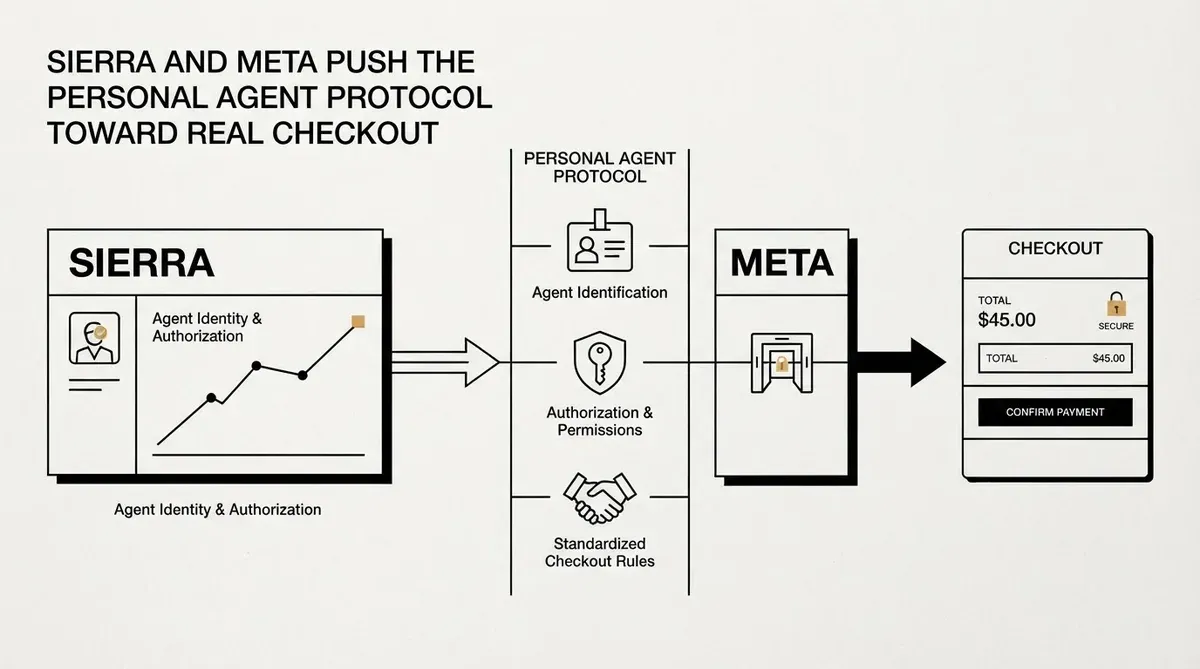
Sierra and Meta are co-developing the Personal Agent Protocol, an open standard that defines how personal AI agents identify themselves to businesses, prove that a customer authorized them, and stay inside granted permissions. The companies introduced the effort at Sierra Summit 2026 in San Francisco on October 6. A v0.1 specification is scheduled for release in late October 2026.
The problem the standard addresses shows up at checkout. Agents that buy on a customer's behalf do it today by reading pages and entering data into forms, the approach web automation has used for two decades. The Personal Agent Protocol would replace that with an authenticated link between the agent and the business.
How the Protocol Works
OAuth handles sessions and authorization. The choice carries weight because OAuth already underwrites delegated access across the consumer internet, so an agent can receive a limited grant in place of a password or a copied session cookie. A customer sets how much read and write access an agent gets, and can reduce it later.
A business receiving a request gets three answers before it acts: the identity of the agent, whether the customer authorized it, and the read and write scope attached to it. Control over that authority sits with the consumer and the business, not with the platform that shipped the agent.
The protocol is designed to work across three surfaces:
- Websites: an agent arriving at an existing storefront or portal
- APIs: MCP and OpenAPI endpoints that businesses already expose
- Conversational agents: chat and voice systems that handle customer contact
The named partners are Genesys, Instinct, Rocket, Shopify, Stripe and Walmart. Stripe and Shopify cover payments and storefronts. Walmart brings retail scale. Genesys sells contact-centre software, where an unverified agent consumes the most staff time.
Consent design will decide whether the OAuth choice holds up. A grant a customer approves once and never revisits is simple to ship and difficult to defend. A grant tied to one merchant, one action and a set window takes more work and is far easier to audit. The read/write split gives implementers a way to describe the second option without requiring it. Revocation matters as much as issuance: an agent holding a stale or expired grant is the failure merchants worry about most.
The Partner List Is the Substance
The roster is the most informative part of the announcement. Publishing a protocol is cheap; implementing one is not. The companies that signed on are the ones whose production systems would have to accept or reject an incoming agent, and they fall into two groups where an unidentified agent creates immediate liability.
The first group is the transaction. Where an agent can reach a Stripe payment flow or a Shopify checkout, the merchant needs certainty about who is spending the customer's money and under what mandate. The second is the contact centre, where an agent that cannot be identified looks the same as abuse and gets queued, throttled or blocked. Genesys joining puts the protocol in the position of a traffic filter, a wider role than shopping convenience.
The engineering consequence is narrower than the framing suggests. Businesses that already publish OpenAPI or MCP endpoints can serve agent traffic without maintaining a second interface. Businesses that depend on consumers clicking through their own pages take on the harder work, because the model shifts toward publishing machine-readable permission boundaries instead of defending a form.
Agent identity and user identity are separate problems, and the difference is easy to lose. A business on the receiving end needs the platform behind the agent, the customer it acts for, and the mandate that links them. Folding all three into one token would rebuild the account-sharing problems that payment and platform companies have spent years dismantling.
Margin is part of the calculation. Agent-mediated checkout removes the merchandising layer: the upsell banner, the loyalty prompt, the recommendation carousel. A merchant that accepts an agent request keeps the sale and gives up the storefront's influence over basket size. That trade is what retail and payments companies want a voice in, rather than leaving the handshake to whichever agent platform gets there first.
The three surfaces differ in effort. Reusing an existing OpenAPI or MCP endpoint is largely a permissions task for an API team. Adapting a consumer website means building an agent-facing path next to the human one. A voice or chat deployment carries the hardest cases, because the agent has to be recognized partway through a session rather than at the start.
Where the Standard Could Stall
The main counter-argument is that v0.1 is a draft, and a draft commits no one. Sierra and Meta list partners without implementation dates, and a voluntary specification arrives with no enforcement. A merchant can back the Personal Agent Protocol in principle and still send agent traffic through manual review for years.
Governance is the second open question. Two agent-platform vendors are writing the standard, and both have commercial interests in how personal agents reach businesses. Merchants that adopt a specification shaped by those vendors are counting on neutral stewardship that the public materials do not yet describe. A standard with a thin institutional base tends to split into vendor-specific versions, the outcome the word open is supposed to rule out.
Merchants can also refuse. Permission bounding works in both directions: the same mechanism that lets a business recognize a legitimate agent lets it restrict that agent to read-only access, or reject the session. In categories with thin margins or regulated disclosure rules, blocking agents may remain the sensible choice. That leaves the protocol as a way to negotiate agent-driven commerce rather than a guarantee of it.
Liability is the gap the public materials leave. Limiting an agent's permissions does not settle who absorbs the loss when an agent exceeds them, or which party must prove what happened afterward. Merchants will want an answer before routing real money through a new handshake. This detail decides whether a specification gets built or merely referenced.
Timing adds pressure. The announcement came on October 6 and the specification follows within weeks, which leaves partners and outside developers little room to argue over token scope, revocation, and what happens when an agent's authority lapses mid-transaction. Specifications written on that schedule tend to reflect the priorities of whoever holds the pen first.
The adoption case rests on one asymmetry. Meta's consumer reach means agent traffic will exist whether or not merchants are ready. Without a defined handshake, the alternative is more scraping, more support tickets and more disputes resolved after the fact. For a payment processor or a contact-centre vendor, joining early buys influence over the rules instead of inheriting them.
Why This Matters
The weight behind the Personal Agent Protocol comes from its partner list. Stripe, Shopify, Walmart, Genesys, Instinct and Rocket run systems that would have to accept or reject agent requests, and their participation is the closest thing to a commitment in an announcement that otherwise offers a draft and a date. For checkout teams, contact-centre operators and consumer platforms, the weeks before the late-October release are when the rules stay open. Agent traffic is coming either way. Whether it arrives through a shared handshake or through form-filling is what remains undecided.
AI-generated image.
Related Articles
- Agentic Commerce Moves to Checkout as Google Arms Merchants for the 2026 Holidays
- BigCommerce and PayPal Launch AI-Powered Shopping Integration for Agentic Commerce
- Synchrony OpenAI agentic commerce push brings store-card checkout to ChatGPT
✔Human Verified
Researched and cross-referenced against primary sources by the Bytevyte editorial team. This article was generated with the assistance of artificial intelligence and reviewed by the Bytevyte editorial team.