
SK Hynix and Intel Weigh US Memory Chip Production in Ohio
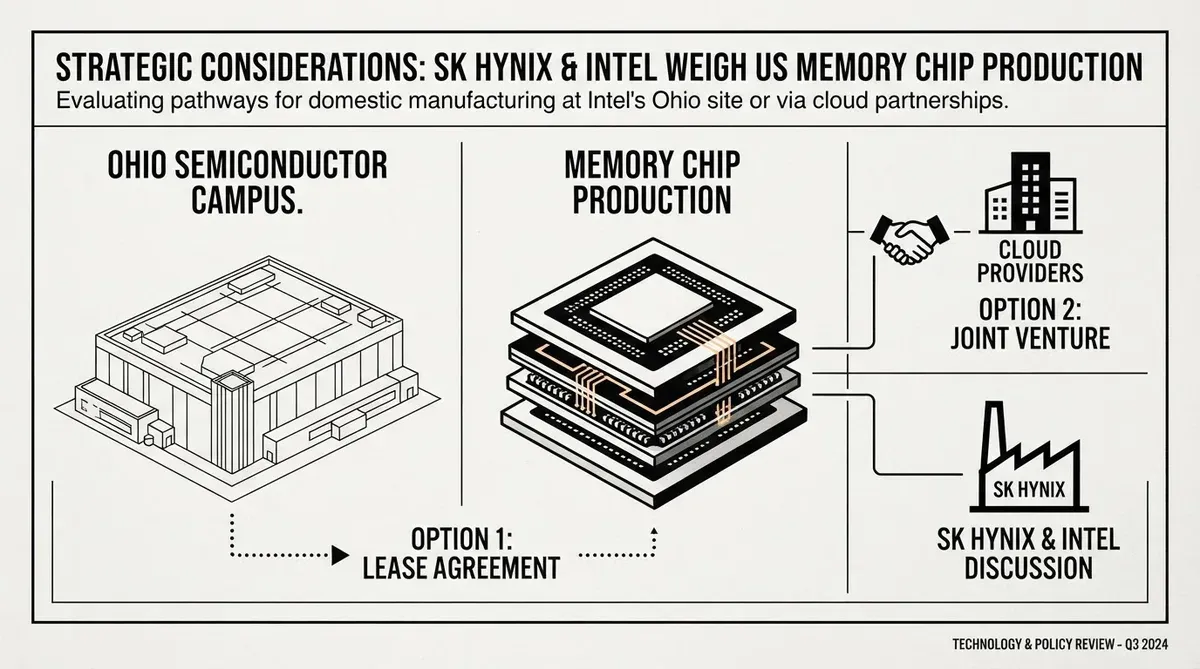
SK Hynix is negotiating with Intel over a plan that would establish US memory chip production for the Korean company for the first time, with Intel's delayed Ohio campus as the most likely site. Both companies describe the talks as exploratory. Two structures are under discussion: leasing space inside Intel's Ohio semiconductor site, or a joint venture that would also bring major cloud service providers in as partners to secure stable memory supply. Nothing has been decided on which chip types would be produced or how the arrangement would be structured.
The gap the plan would close is specific. SK Hynix makes memory wafers in Icheon and Cheongju in South Korea and in Wuxi, Chongqing and Dalian in China. Its American footprint today is one packaging operation.
Indiana Is Not a Wafer Fab
SK Hynix broke ground in late August 2026 on a facility in West Lafayette, Indiana, worth more than $4 billion, dedicated to advanced packaging of high-bandwidth memory for AI accelerators. The site targets mass production in the second quarter of 2029. Chief executive Kwak Noh-Jung has said Indiana will be a key memory production base by 2030.
Packaging is the back end, where HBM stacks are assembled and tested. Wafer fabrication, where DRAM dies are patterned onto silicon, has stayed in Asia. A US packaging line shortens the final assembly step. A US wafer fab would move the most capital-intensive and most politically sensitive stage of memory manufacturing across the Pacific. That is why the Intel talks carry more weight than the Indiana ceremony did.
The Indiana schedule also sets expectations. Groundbreaking in August 2026 with output in the second quarter of 2029 means roughly three years from ceremony to production, and that covers assembly rather than wafer processing. A leased wafer line inside an existing Intel building could move faster because the shell is already funded. Either way, US memory chip production from SK Hynix would not arrive in time to relieve the shortage that AI and data-centre demand has created. The talks are positioning for the next supply cycle, not this one.
Two Paths to US Memory Chip Production
| Structure | What it involves | Main attraction | Main constraint |
|---|---|---|---|
| Lease inside Intel's Ohio campus | SK Hynix takes space and capacity in a site Intel has already funded | Fastest route to US wafer output without greenfield construction | Inherits Intel's construction schedule, which has slipped |
| Joint venture with cloud providers | Intel, SK Hynix and hyperscalers share ownership of the venture | Spreads capital cost and locks in offtake commitments | Slower to negotiate; harder allocation and governance questions |
Leasing is the quicker option. It uses capacity Intel has already paid for and delivers US output without a multi-year build. It also imports Intel's timing risk, and the multibillion-dollar Ohio campus has fallen behind its original schedule.
The joint venture asks more of both sides. It spreads the capital cost and locks in offtake from the cloud providers that buy HBM in volume. It also means sharing ownership of output with the customers who currently compete for allocation. For SK Hynix that trade is real: it would surrender some of the pricing power it holds on its strongest product in exchange for committed demand and a smaller capital bill.
The cloud provider angle explains the timing as much as the structure. Hyperscalers have spent two years competing for HBM allocation rather than negotiating over price, and their leverage depends on who controls wafer starts. Equity in a fab, or a long-term offtake agreement, converts a recurring supply fight into a capital commitment that lands on the balance sheet instead of in spot pricing.
Schedule risk cuts the other way for SK Hynix. If the Ohio site slips further, a lease signed today could commit the company to a building that is not ready when the next shortage peaks. That argues for staged capacity rather than one upfront commitment, and it may be part of why a joint venture is among the structures under discussion.
Intel Needs This More Than SK Hynix Does
For Intel, a tenant or a partner at Ohio puts part of an expensive, underused investment to work and eases the strain on a balance sheet already carrying the campus. Intel's foundry business also needs outside customers to justify the capacity it has committed to build.
A second thread runs alongside the Ohio discussions. SK Hynix is exploring Intel as a foundry for the base dies used in next-generation HBM4E, work that currently runs through TSMC. Base dies are the logic layer beneath the memory stack that manages it. Moving that work to Intel would give SK Hynix a second source at a time when every AI accelerator shipped depends on high-bandwidth memory. For Intel it would be a foothold in the memory supply chain that the company does not have today.
One point is easy to misread. The arrangement under discussion does not put Intel into the memory business. The wafers would be SK Hynix's, made on SK Hynix's process, inside space Intel controls. Intel's gain is occupancy and, if the base-die work follows, a foundry customer for a logic product. A lease generates rental and services income rather than the margins of a memory maker.
SK Hynix's own incentives point the same way from a different starting position. It is a leading supplier of HBM, it is expanding capacity in Korea, and it is weighing a decision in October on a record share buyback. A record buyback and a US manufacturing commitment draw on the same balance sheet, which makes the October decision a signal about which the board treats as the priority. A lease costs far less than a fab, and that gap may explain why the lighter structure is the one under discussion.
Seoul Is a Third Party to a Two-Company Deal
South Korea's trade ministry has said any decision rests with SK Hynix. It has also noted that projects involving nationally important technology can be subject to review under the Industrial Technology Protection Act. Advanced DRAM and HBM process technology sit inside that category, which makes the Korean government a gatekeeper on how much manufacturing know-how crosses the Pacific.
That review is the least predictable element of the plan. The two structures carry different exposure. A lease that places SK Hynix tools and engineers inside an Intel building raises different questions from a joint venture that shares ownership of output and, by extension, of process decisions. Which version Seoul would treat more favourably is not established by anything either company has said.
What the Market Read Into It
Shares in both companies rose on the report. The move reversed part of a bruising stretch for memory stocks, which had led a broad AI-related selloff after Anthropic and OpenAI leaders publicly urged slower development of frontier systems. SK Hynix shares fell sharply during that slide and rebounded once the Intel talks surfaced.
The value of the story is in the direction of travel rather than the output. Nothing has been signed, the memory types are undecided, and the arrangement could still collapse into a lease that never happens. What has shifted is that a leading HBM supplier is now willing to discuss US memory chip production, and Intel is willing to host it. Three markers will show whether that becomes real: whether SK Hynix pairs its October capital-return decision with a US investment commitment, whether Intel restates the Ohio timeline with a partner attached, and whether Seoul's technology-protection review is triggered at all.
Why this matters
For anyone buying AI infrastructure, the talks turn US memory chip production into a question of geography as much as engineering. HBM supply already constrains how many accelerators can ship, and relocating part of the manufacturing base changes who holds leverage over that supply without adding capacity quickly. For Intel, it is a test of whether an unfinished campus can be monetised through a partner rather than through customers of its own process technology. Investors have already priced in the possibility, which shows how little separation now exists between an exploratory conversation and a strategic shift.
AI-generated image.
Related Articles
- The Solidigm IPO calculus: SK Hynix's plan to fund American factories
- SK Hynix Buyback Sets a South Korean Record as Dream Chip Memory Debuts
- Nvidia SB Energy investment talks target $3B stake in Ohio data center [Update]
✔Human Verified
Researched and cross-referenced against primary sources by the Bytevyte editorial team. This article was generated with the assistance of artificial intelligence and reviewed by the Bytevyte editorial team.