
Sony and Universal Are Monetising AI Music Licensing While Suing Suno
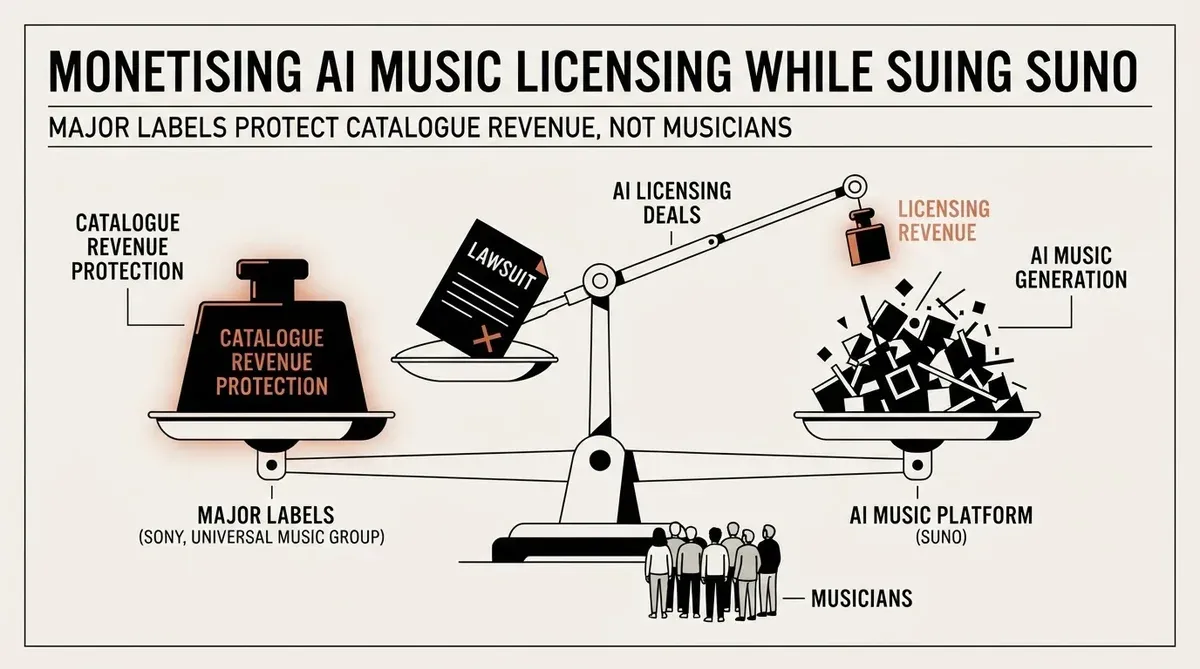
I have spent the past week reading the filings in the AI music licensing fight between the major labels and the generative start-ups, and I am now convinced the majors are running the litigation and the licensing as one commercial strategy while describing it as a fight over principles. Sony Music Entertainment and Universal Music Group filed a new 45-page complaint against Suno in the United States on 18 September 2026, aimed squarely at the start-up's Warner-partnered v6 model. The core argument is that the new model grew from the same disputed training foundation as everything that came before it, so a catalogue deal cannot retroactively legitimise the earlier training runs. That is the legal claim. The commercial claim runs on a parallel track, and the two do not conflict at all.
The timing carries more information than the filing itself. Suno had presented the v6 launch, built on licensed catalogue from Warner Music Group, as evidence that the AI and music industries could move forward together. Roughly a week later, two of the three majors named that same model in a new suit. Whatever the complaint says about training data, the sequence says the licensing track and the litigation track are being run as separate businesses with separate balance sheets.
Sony and Universal have framed the training-data use as a threat to the entire music industry, language broad enough to cover everyone from stadium acts to bedroom producers. The filing is narrower than that framing implies. It is directed at one vendor, over one model, at a moment when that vendor was positioning itself as the industry's partner. The complaint is a negotiating instrument as much as a legal document, and the price of settling it is now a matter of commercial discussion rather than judicial determination.
Two Revenue Streams, One Strategy
Strip the rhetoric and the structure is simple. Labels monetise AI through catalogue licences and, in several cases, equity positions in the vendors they are also suing. Universal and Warner have both signed deals with Udio. Suno's licensed model suite draws on the Warner, BMG and Believe catalogues. Sony and Universal simultaneously argue that the training data behind the same class of platforms amounts to wholesale appropriation of copyrighted recordings.
The payouts under those licences are undisclosed. That is the detail I keep returning to. A rights holder that genuinely believed a platform was built on stolen material would not typically hand it a catalogue and then negotiate the price in private. It would seek an injunction and let a court decide. Instead, the majors have built a posture in which litigation sets the leverage and licensing converts that leverage into recurring revenue.
Equity is the quieter part of the arrangement. Taking a stake in an AI vendor gives a label a claim on the upside of the very technology it is litigating against, which means the majors profit whether or not a court ever rules in their favour. The structure also raises the cost of entry for newcomers: a start-up that wants a cleared catalogue, and the legal cover that comes with it, has to accept terms set by the incumbents.
The strongest defence of this behaviour is that it is the only workable path. Copyright litigation against generative AI moves at the speed of a federal docket, and a ruling either way could take years. Licensing puts money in rights holders' hands now, establishes a precedent for compensation, and gives the labels contractual hooks they would never obtain from a courtroom. If the alternative is a decade of unfunded lawsuits, the two-track approach looks pragmatic.
I do not buy it, for a reason the labels supplied themselves. On 21 September 2026, Universal and the Warner labels asked a court to dismiss the American Federation of Musicians' AI licensing suit, arguing that the union's compensation claims should not proceed. If licensing were genuinely about routing money to the people who made the recordings, a performers' claim would be a feature of the strategy rather than something to be struck out. The majors are pursuing compensation for the masters they control while resisting a parallel claim for the musicians who played on them.
Who Is Actually at the Table
That asymmetry defines the episode. The negotiation has three visible parties: the AI vendors, the major labels, and the courts. Working musicians, session players, and the independent distribution layer that sits between DIY artists and streaming platforms are all absent. Independent distributors such as DistroKid, which place hundreds of thousands of self-released tracks into the same systems that train and generate AI music, hold no seat in the licensing conversation at all.
The consequence is concrete rather than theoretical. Per-stream and per-track compensation frameworks were never designed for AI-generated output, and nothing in the AI music licensing deals signed so far updates them. A catalogue licence paid to a major is a lump sum or a royalty structure negotiated at corporate level; it does not automatically convert into a per-play payment for a session bassist whose performance helped train the model. The AFM's case exists because that conversion has not happened.
| Track | Parties | What is at stake | Latest status |
|---|---|---|---|
| Litigation | Sony and Universal against Suno | Earlier training data; damages and injunctive relief | 45-page complaint filed 18 September 2026 |
| Licensing | Warner, BMG and Believe with Suno; Universal and Warner with Udio | Catalogue access; undisclosed payouts | Deals signed through September 2026 |
| Artist compensation | American Federation of Musicians against Universal and Warner | Per-track and per-stream pay for performers | Dismissal motion filed 21 September 2026 |
What AI Music Licensing Does Not Settle
For the AI music start-ups, the practical lesson is that a licence does not clear the past. Suno's partnership with Warner was, on its face, a compliance move: pay for the catalogue, build on cleared material, present the result as the cooperative model for the sector. The new complaint shows that paying for future access does not settle earlier conduct. Any vendor building on scraped or contested data should assume that a deal signed later does not retire the liability attached to the first training run.
That raises the cost of the sector's entire strategy. If retroactive licensing cannot cure prior training, the only clean path is a model built from the outset on licensed or public-domain material. That route costs more and takes longer to develop. Udio's agreements with Universal and Warner face the same unresolved question: whether they cover only forward-looking generation or reach back into the training history as well.
For the majors, the economics are far more comfortable. They hold the catalogues, they hold the leverage that litigation creates, and they hold the option to take equity in the vendors they are suing. Every outcome pays. A court victory yields damages and tighter control, while a settlement yields recurring revenue and a contractual relationship. Litigation is what sets the price of the licensing business.
The Independent Layer Pays the Bill
Independent artists and the distributors who serve them sit on the other side of that equation. They cannot fund a 45-page complaint, they cannot negotiate a catalogue-wide licence, and they have no equity to trade. What they do have is exposure. If training-data litigation produces broad rules about what generative models may do, independent rights holders will be governed by those rules without having shaped them. If it produces private settlements instead, they will not see the proceeds.
Compensation frameworks on the artist side remain undefined for AI output even as AI music licensing deals multiply. That gap is the story. The industry has moved quickly to answer how labels get paid and has left open the question of how everyone else does.
The Compensation Question Goes to Court
The money from both tracks flows to the companies that already control the catalogues. For anyone building or investing in AI music, the operational takeaway is that a licence does not clear prior training liability, and the rules governing the sector are being set in private negotiations that leave performers and independent rights holders outside the room. The compensation question is now in court, and the outcome will determine whether AI music licensing revenue reaches the people who made the source recordings or only the companies that own them.
AI-generated image.
Related Articles
- UMG and ElevenLabs Build a Licensed AI Music Platform on Opt-In Artist Catalogues
- Stability AI Series B: Music, Gaming Giants Take Stakes
- Anthropic Copyright Lawsuit Over Lyrics Puts a Price on Training Data
✔Human Verified
Researched and cross-referenced against primary sources by the Bytevyte editorial team. This article was generated with the assistance of artificial intelligence and reviewed by the Bytevyte editorial team.