
Stripe Data Reveals Rapid Global Growth Within the AI Economy
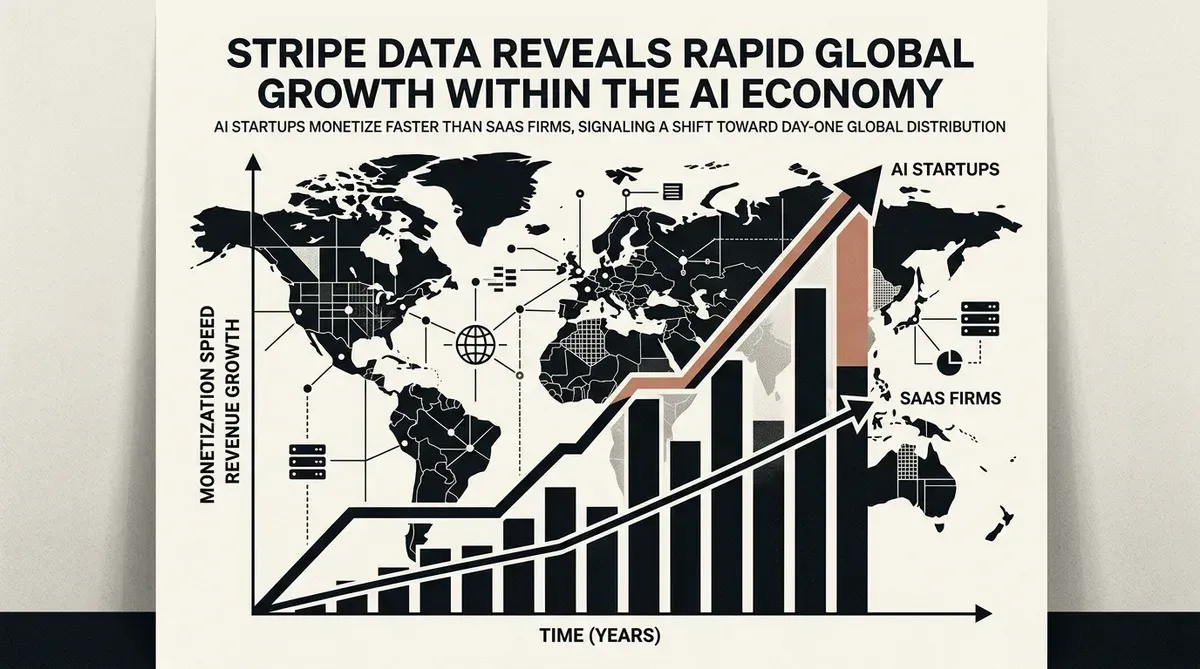
Stripe has revealed that artificial intelligence startups are achieving global monetization milestones at a significantly faster pace than the previous generation of software-as-a-service (SaaS) companies. Data shared by Maia Josebachvili, the head of AI at Stripe, indicates that 86% of the Forbes AI 50 now utilize the platform to manage their international financial operations. This shift suggests that the AI economy is fundamentally different from the regional scaling models that defined the early 2020s.
The current wave of AI-native firms is designed for global distribution from the moment of launch. Unlike traditional SaaS companies that typically expanded through phased regional rollouts, these new entities are bypassing localized growth stages. This rapid international reach is a hallmark of the AI economy, where digital services can be deployed across borders with minimal friction. Stripe is currently adapting its technical infrastructure to accommodate the increasing volume of transactions generated by autonomous agents rather than human users.
Strategic Shifts in the AI Economy
The speed at which these companies are reaching revenue milestones highlights a broader trend in the technology sector. The AI economy rewards firms that can integrate global payment systems early in their lifecycle. By leveraging standardized financial tools, startups are able to focus on model development while the underlying infrastructure handles multi-currency processing and cross-border compliance. This efficiency is a primary driver behind the accelerated monetization observed in 2026.
Infrastructure providers are also seeing a change in how their services are consumed. The rise of autonomous agents means that financial transactions are increasingly programmatic. Stripe has noted that its systems must now support high-frequency, automated payments that differ from traditional consumer-driven commerce. This evolution requires a more resilient and scalable approach to transaction processing to ensure that AI agents can operate without manual intervention.
The data from Stripe confirms that the barrier to entry for global markets has lowered for AI developers. As these firms continue to scale, the focus is shifting from local market fit to global operational readiness. The ability to monetize on day one is no longer an outlier but a standard expectation for top-tier AI startups. This trend is expected to persist as more companies adopt AI-native architectures to compete on a worldwide scale.
While we strive for accuracy, bytevyte can make mistakes. Users are advised to verify all information independently. We accept no liability for errors or omissions.
AI-generated image.
Related Articles
- Databricks and Stripe Launch Payment Infrastructure for Autonomous AI Agents
- Stanford 2026 AI Index: Adoption Surges, Transparency Falls
- OpenAI Launches The Deployment Company with $4 Billion to Scale Enterprise AI
✔Human Verified